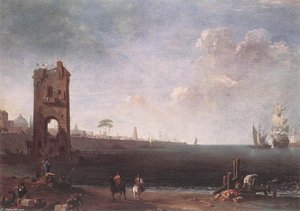
Portræt af Marco Ricci

De 71 mest berømte Marco Ricci-malerier, en galleriselektion

Opdateret november 2026 · rangeret efter vores popularitetsscore (søgninger, besøg og ordrer for hvert værk) · 71 værker af Marco Ricci i vores katalog

Kort sagt

Af alle de originale værker, som Marco Ricci efterlod, er det mest berømte Architectural Capriccio (1702), som er en del af samlingen på Bavarian State Painting Collections i München. Lige efter følger Rehearsal of an opera (1709) og Rehearsal of an opera (1709). Vores katalog indeholder 71 værker af Marco Ricci; galleriet har bevaret de 71 værker, som verden beundrer mest, hver vist med sin dato, sit museum og sin historie.

1676 – 1730, Belluno Baroque Flest værker: Royal Collection

Marco Riccis top 10 malerier: galleriets udvalg

1
Architectural Capriccio (1702) af Marco Ricci

Architectural Capriccio

1702 · Oil On Canvas · Bavarian State Painting Collections, München

In Architectural Capriccio, Marco Ricci presents a fantasy landscape constructed from various architectural elements of antiquity. The work functions as a classical capriccio, assembling disparate ruins into a fictionalized setting. Rather than a topographical record, the scene offers a re-imagined arrangement of stone and structure.

2
Rehearsal of an opera (1709) af Marco Ricci

Rehearsal of an opera

1709 · Oil · Yale Center for British Art, New Haven

The oil painting presents a crowded indoor setting where a group of musicians and singers are gathered for an opera rehearsal. The composition is horizontal, filling the space with figures arranged in the foreground and middle ground. A muted, dark olive-green wall forms the backdrop for the assembly. In the foreground, the curves of a cello and the rectangular frame of a harpsichord are visible among the performers. The color…

3
Rehearsal of an opera (1709) af Marco Ricci

Rehearsal of an opera

1709 · Oil On Canvas · Yale Center for British Art, New Haven

Step into this grand, interior space where the air feels heavy with the anticipation of a performance. We find ourselves in a room of significant scale, perhaps a private salon or a rehearsal hall, where a group of figures has gathered for a musical session. The scene is dense, filled with the quiet energy of artists in motion. A cello rests in the immediate foreground, its dark wood grounding the…

4
Moses and the Miracle of the Rock (1718) af Marco Ricci

Moses and the Miracle of the Rock

1718 · Oil On Canvas · Royal Collection, London

In Moses and the Miracle of the Rock, Marco Ricci presents a scene of intense movement and crowded energy. The composition is structured through a dynamic arrangement of figures that directs the eye from the immediate foreground toward the central action of Moses. This movement is guided by fluid and expressive lines that define the limbs of the multitude and the sudden flow of water. Organic shapes dominate the landscape,…

5
The Outskirts of a Town with Women Washing Linen (1722) af Marco Ricci

The Outskirts of a Town with Women Washing Linen

1722 · Gouache · Royal Collection, London

The scene unfolds in 1722, a moment captured in The Outskirts of a Town with Women Washing Linen. This work emerges from the brush of Marco Ricci, an artist who brings the light of the Italian landscape to life. He was born in Belluno, Italy, in 1676, and his hand moves across the surface to define a world of quiet, daily labor. The air feels heavy with the presence of…

6
Woodland Scene with Bandits (1726) af Marco Ricci

Woodland Scene with Bandits

1726 · Oil · Royal Collection, London

Woodland Scene with Bandits is an oil painting by Marco Ricci. Created about 1726, the work captures a moment of tension within a dense thicket. A group of bandits or travelers occupies the forest, their presence disrupting the quietude of the trees. The scene is framed by the verticality of weathered trunks and the shadows of a deep landscape view.

7
Caprice Landscape with Ruins and a Statue (1729) af Marco Ricci

Caprice Landscape with Ruins and a Statue

1729 · Oil On Canvas · Royal Collection, London

The painting Caprice Landscape with Ruins and a Statue is a work by the Italian artist Marco Ricci. Born in Belluno, Italy, in 1676, Ricci brought a specific Venetian sensibility to this composition. The canvas captures a moment of stillness amidst crumbling stone and weathered marble. It dates to about 1729.

8
Landscape with an Allegorical Monument to Newton (1728) af Marco Ricci

Landscape with an Allegorical Monument to Newton

1728 · Oil On Canvas · Royal Collection, London

We are looking at Landscape with an Allegorical Monument to Newton, a work by the Venetian painter Marco Ricci. Created about 1728, this piece presents an allegorical scene set within a landscape of ancient ruins. The composition focuses on a central structure of classical architectural elements, including a plinth with inscriptions and various sculptural figures, all positioned under a clear blue sky.

10
A Wood with Peasants Alarmed by a Bear (1725) af Marco Ricci

A Wood with Peasants Alarmed by a Bear

1725 · Oil On Canvas · Royal Collection, London

The scene unfolds within the frantic energy of A Wood with Peasants Alarmed by a Bear, a work that captures a sudden moment of chaos amidst the trees. This dramatic encounter is the creation of Marco Ricci, an artist whose life began in Belluno, Italy, in 1676. The painting emerges from a time of great movement in the early eighteenth century, dating to about 1725. Every brushstroke seems to pulse…

Marco Ricci-udvalget fortsætter, fra 11 til 71

11The Courtyard of a Country House (1728) af Marco RicciThe Courtyard of a Country House1728 · Royal Collection 12A Classical Ruin Caprice (1728) af Marco RicciA Classical Ruin Caprice1728 · Royal Collection 13Landscape with a Woman and Child (1727) af Marco RicciLandscape with a Woman and Child1727 · Royal Collection 14Landscape with Women Washing Clothes (1727) af Marco RicciLandscape with Women Washing Clothes1727 · Royal Collection 15Landscape with Peasants and Woodcutters (1725) af Marco RicciLandscape with Peasants and Woodcutters1725 · Royal Collection 16A Ruin Caprice with Roman Motifs (1727) af Marco RicciA Ruin Caprice with Roman Motifs1727 · Royal Collection 17Landscape with Cattle and a Woman Speaking to a Seated Man (1727) af Marco RicciLandscape with Cattle and a Woman Speaking to a Seated Man1727 · Royal Collection 18Villa in a Park Setting (1720) af Marco RicciVilla in a Park Setting1720 · Gallerie dell'Accademia di Venezia 19Landscape with River and Figures (1720) af Marco RicciLandscape with River and Figures1720 · Gallerie dell'Accademia di Venezia 20Landscape with Monks (1705) af Marco RicciLandscape with Monks1705 · Scottish National Gallery 21Ships in a Gale (1707) af Marco RicciShips in a Gale1707 · Indianapolis Kunstmuseum 22Landscape with a road (detail). (1700) af Marco RicciLandscape with a road (detail).1700 · Nationalmuseet i Warszawa 23Christ on the Sea of Galilee (1710) af Marco RicciChrist on the Sea of Galilee1710 · Statens Museum for Kunst 24Landscape (1700) af Marco RicciLandscape1700 25Landscape (1700) af Marco RicciLandscape1700 26Southern Landscape in Evening Light (1712) af Marco RicciSouthern Landscape in Evening Light1712 · Gemäldegalerie 27Venetian Capriccio with a body being exhumed and a Franciscan Monk in Attendance (1714) af Marco RicciVenetian Capriccio with a body being exhumed and a Franciscan Monk in Attendance1714 · Birmingham Museum and Art Gallery 28Capriccio Landscape (1712) af Marco RicciCapriccio Landscape1712 29Capriccio Landscape (1712) af Marco RicciCapriccio Landscape1712 30A Winter Landscape (1720) af Marco RicciA Winter Landscape1720 · Royal Collection 31An Italian Town Caprice (1719) af Marco RicciAn Italian Town Caprice1719 · Royal Collection 32Landscape with a Farm Building at the Centre (1720) af Marco RicciLandscape with a Farm Building at the Centre1720 · Royal Collection 33A Rocky Landscape with a Waterfall (1720) af Marco RicciA Rocky Landscape with a Waterfall1720 · Royal Collection 34A Town and Ruins Beside a River (1719) af Marco RicciA Town and Ruins Beside a River1719 · Royal Collection 35A Wooded Landscape with Huntsmen (1722) af Marco RicciA Wooded Landscape with Huntsmen1722 · Royal Collection 36A Hilly Landscape with two Men on Horseback Galloping (1720) af Marco RicciA Hilly Landscape with two Men on Horseback Galloping1720 · Royal Collection 37Landscape with a Hill Town (1720) af Marco RicciLandscape with a Hill Town1720 · Royal Collection 38View of Belluno (1720) af Marco RicciView of Belluno1720 · Royal Collection 39Landscape with a Sawmill (1720) af Marco RicciLandscape with a Sawmill1720 · Royal Collection 40Landscape with a Foreground River and Buildings Beyond (1720) af Marco RicciLandscape with a Foreground River and Buildings Beyond1720 · Royal Collection 41Ruin Caprice with a Gothic Church (1722) af Marco RicciRuin Caprice with a Gothic Church1722 · Royal Collection 42A Wood with Peasants Alarmed by a Bear (1720) af Marco RicciA Wood with Peasants Alarmed by a Bear1720 · Royal Collection 43A Capriccio of Classical Rome (1720) af Marco RicciA Capriccio of Classical Rome1720 44Coastal View with Tower (1715) af Marco RicciCoastal View with Tower1715 45Landscape with Woodcutters and Two Horsemen (1720) af Marco RicciLandscape with Woodcutters and Two Horsemen1720 · Gallerie dell'Accademia di Venezia 46Landscape with Watering Horses (1720) af Marco RicciLandscape with Watering Horses1720 · Gallerie dell'Accademia di Venezia 47Landscape with River and Figures (detail) (1720) af Marco RicciLandscape with River and Figures (detail)1720 · Gallerie dell'Accademia di Venezia 48A Rocky Landscape with Herds Watering (1727) af Marco RicciA Rocky Landscape with Herds Watering1727 · Royal Collection 49Landscape with a Storm (1729) af Marco RicciLandscape with a Storm1729 · Royal Collection 50A Mountainside with Hermits (1729) af Marco RicciA Mountainside with Hermits1729 · Royal Collection 51Landscape with a Rocky Stream, Peasants and Cattle (1725) af Marco RicciLandscape with a Rocky Stream, Peasants and Cattle1725 · Royal Collection 52Landscape with a Horse being Ferried across a Stream (1723) af Marco RicciLandscape with a Horse being Ferried across a Stream1723 · Royal Collection 53Caprice View with Roman Ruins (1729) af Marco RicciCaprice View with Roman Ruins1729 · Royal Collection 54Mountainous Landscape with a River and a Group of Buildings Beyond (1724) af Marco RicciMountainous Landscape with a River and a Group of Buildings Beyond1724 · Royal Collection 55Architectural Capriccio (1725) af Marco RicciArchitectural Capriccio1725 56Stormy Region (1705) af Marco RicciStormy Region1705 · Szépművészeti Múzeum 57Saint Jérôme dans le désert - Marco Ricci - Musée des Beaux-Arts de Narbonne af Marco RicciSaint Jérôme dans le désert - Marco Ricci - Musée des Beaux-Arts de NarbonneMusée d'art et d'histoire de Narbonne 58Landscape with a Monk in a Storm af Marco RicciLandscape with a Monk in a StormKunsthistorisches Museum 59Landscape (1720) af Marco RicciLandscape1720 · Fondazione Querini Stampalia 60A Courtyard with an Equestrian Statue af Marco RicciA Courtyard with an Equestrian StatueRoyal Collection 61A rocky landscape with figures af Marco RicciA rocky landscape with figuresAuckland Art Gallery Toi o Tāmaki 62Landscape with a bridge and a tower (detail). af Marco RicciLandscape with a bridge and a tower (detail).Nationalmuseet i Warszawa 63A mountainous landscape af Marco RicciA mountainous landscapeFinnish National Gallery 64A Classical Landscape with Ruins af Marco RicciA Classical Landscape with Ruins 65Classical capriccio of Rome af Marco RicciClassical capriccio of Rome 66The waterfall af Marco RicciThe waterfallGallerie dell'Accademia di Venezia 67View with classical Roman ruins af Marco RicciView with classical Roman ruinsCa' Rezzonico – Museum for det 18. århundredes Venedig 68Landscape af Marco RicciLandscapeNationalmuseet i Kraków 69A Courtyard of an Imaginary Palace af Marco RicciA Courtyard of an Imaginary PalaceRoyal Collection 70Figures among Ruins af Marco RicciFigures among Ruins 71Southern Landscape at Twilight af Marco RicciSouthern Landscape at TwilightStaatliche Museen zu Berlin

Marco Riccis berømte malerier, periode for periode

Motiverne, der fangede Marco Riccis blik

De fire motiver, der optræder hyppigst i disse originaler, hver med sit fineste eksempel.

De museer, der udstiller Marco Riccis originalværker

De 8 museer, der rummer flest af malerierne på denne side.

Museum By Værker af Marco Ricci Malerier fra denne liste
Royal Collection, LondonRoyal Collection London 36 Moses and the Miracle of the Rock, The Outskirts of a Town with Women Washing Linen, Woodland Scene with Bandits
Gallerie dell'Accademia di Venezia, VenedigGallerie dell'Accademia di Venezia Venedig 6 Villa in a Park Setting, Landscape with River and Figures, Landscape with Woodcutters and Two Horsemen
Yale Center for British Art, New HavenYale Center for British Art New Haven 2 Rehearsal of an opera, Rehearsal of an opera
Nationalmuseet i Warszawa, WarszawaNationalmuseet i Warszawa Warszawa 2 Landscape with a road (detail)., Landscape with a bridge and a tower (detail).
Bavarian State Painting Collections, MünchenBavarian State Painting Collections München 1 Architectural Capriccio
Scottish National Gallery, EdinburghScottish National Gallery Edinburgh 1 Landscape with Monks
Indianapolis Kunstmuseum, IndianapolisIndianapolis Kunstmuseum Indianapolis 1 Ships in a Gale
Statens Museum for Kunst, KøbenhavnStatens Museum for Kunst København 1 Christ on the Sea of Galilee

Marco Ricci årti for årti: det originale værk, der definerer hvert enkelt

Værker per årti

Vælg et årti for at se det originale værk, der definerer det.

Samleres spørgsmål om Marco Riccis malerier

Hvilket værk er Marco Ricci mest kendt for?Vis svaret

Architectural Capriccio (1702), Bavarian State Painting Collections, München. Derefter følger Rehearsal of an opera (1709) og Rehearsal of an opera (1709).

Hvor gammel var Marco Ricci, da Architectural Capriccio blev skabt?Vis svaret

26 år gammel: Architectural Capriccio er fra 1702, og Marco Ricci blev født i 1676.

Hvad er de ti mest berømte Marco Ricci malerier?Vis svaret

Architectural Capriccio, Rehearsal of an opera, Rehearsal of an opera, Moses and the Miracle of the Rock, The Outskirts of a Town with Women Washing Linen, Woodland Scene with Bandits, Caprice Landscape with Ruins and a Statue, Landscape with an Allegorical Monument to Newton, Landscape with two Praying Monks og A Wood with Peasants Alarmed by a Bear. Ranglisten ovenfor viser det enkelte værks årstal og museum.

Hvor mange malerier efterlod Marco Ricci?Vis svaret

Vores katalog indeholder 71 værker af Marco Ricci, dateret fra 1700 til 1729.

I hvilke museer udstilles Marco Ricci's mesterværker?Vis svaret

Primært i Royal Collection (London), Gallerie dell'Accademia di Venezia (Venedig) og Yale Center for British Art (New Haven). Museumslisten ovenfor viser dem alle.

I hvilke år malede Marco Ricci sine mest berømte værker?Vis svaret

I 1720s: 39 af de 71 værker på denne side blev skabt dengang, herunder The Outskirts of a Town with Women Washing Linen.

Hvad er de første og de sidste berømte originaler af Marco Ricci?Vis svaret

På denne side er det tidligste Landscape with a road (detail). (1700) og det seneste Caprice Landscape with Ruins and a Statue (1729).

Hvilke motiver valgte Marco Ricci oftest?Vis svaret

Trees (13), Landscape (12) og Sky (9), fordelt på de 71 værker på denne side.

Hvilken teknik brugte Marco Ricci mest?Vis svaret

Oil On Canvas, for 13 af de 71 værker på denne side.

Hvilken kunstretning tilhører Marco Ricci?Vis svaret

Baroque, baseret på originalerne på denne side.

Hvilke værker af Marco Ricci udstilles på Royal Collection?Vis svaret

Moses and the Miracle of the Rock, The Outskirts of a Town with Women Washing Linen og Woodland Scene with Bandits: Royal Collection, London har 36 af værkerne på denne side.

Marco Ricci: liv og værk

Den venetianske pioner inden for landskabsmaleriet

Marco Ricci står som en central skikkelse i den storslåede vævning af venetiansk barokmaleri, en mester hvis pensel pustede liv i det 18. århundredes atmosfæriske vidder. Født i Belluno, Italien, i 1676, var Riccis kunstneriske rejse dybt forankret i en slægt af excellence. Hans tidlige uddannelse begyndte under det vågne øje af hans onkel, den berømte Sebastiano Ricci, sandsynligvis i Milans livlige kunstneriske knudepunkter i midten af 1690'erne. Denne formative periode etablerede en dyb forbindelse til den venetianske tradition, da han bevægede sig mod Venedig i 1696 for at forene kræfter med sin onkel. Sammen påbegyndte de en samarbejdsmæssig karriere, der ville redefinere grænserne for landskabsmaleriet ved at blande klassisk storhed med en ny, mere ekspressiv sensibilitet.

Udviklingen af Riccis stil blev formet af en rig sammensmeltning af indflydelser, der brobyggede kløften mellem fortidens strukturerede idealer og rokokoens spirende frihed. Han opsugede det lysende, atmosfæriske perspektiv fra Claude Lorrain og Gaspard Dughet, mestre der havde perfektioneret kunsten at skabe idealiserede naturscener. Alligevel fandtes der en mere rå, emotionel strømning i hans arbejde, hentet fra det ekspressive penselstrøg hos Salvatore Rosa og den løse, energiske påføring, man ser i værker af Alessandro Magnasco. Denne unikke syntese gjorde det muligt for Ricci at bevæge sig ud over blot topografisk registrering og i stedet skabe landskaber, der føltes levende med bevægelse, lys og en følelse af dramatisk narrativ.

En arv af samarbejde og storhed

Et af de mest bemærkelsesværdige aspekter ved Riccis karriere var hans dybe vilje til at indgå i sin tids samarbejdsvillige ånd. Hans arbejde udviskede ofte linjerne mellem individuelt ophav og kollektivt geni, især i storslåede dekorative projekter. Et bemærkelsesværdigt eksempel på denne storhed findes i hans bidrag til dekorationen af Sala d'Ercole i Palazzo Fenzi sammen med Sebastiano Ricci, hvor han demonstrerede en evne til at mestre enorme arkitektoniske rum med vidstrakte udsigter og intrikate detaljer. Dette talent for storskala design strakte sig ind i det teatralske domæne, hvor hans færdigheder inden for operascenedesign gjorde det muligt for ham at manipulere lys og rum for at skabe omsluttende, imaginære verdener.

Riccis indflydelse var ikke begrænset til grænserne for Serenissima-republikken. Drevet af opmuntring fra Charles Montagu, den 4. jarl af Manchester – Venedigs ambassadør i England – begav Ricci sig ud på en transformativ rejse til London i slutningen af 1708. Denne engelske forbindelse udvidede hans horisonter og introducerede hans venetianske sensibilitet for et nyt internationalt publikum, hvilket yderligere cementerede hans ry som en paneuropæisk mester. Hans evne til at tilpasse sin stil til forskellige kulturelle kontekster, mens han bevarede sin kerneidentitet som landskabsinnovatør, står som et vidnesbyrd om hans alsidighed.

Mesterværker af lys og atmosfære

Den vedvarende fascination af Marco Riccis værk ligger i hans evne til at indfange den naturlige verdens flygtige kvaliteter. Hans malerier fungerer ofte som vinduer ind til en idealiseret fortid, hvor klassisk arkitektur og utæmmet natur eksisterer i en delikat, harmonisk balance. Uanset om han skildrer en rolig Villa i en parkomgivelse eller et mere dynamisk Landskab med flod og figurer, brugte Ricci lyset til at guide beskuerens øje gennem komplekse kompositioner, hvilket skabte dybde og en følelse af dyb ro.

Hans tekniske mesterskab er tydeligt i flere nøgleområder af hans arbejde:

  • Atmosfærisk perspektiv: Brugen af bløde, disede toner til at skabe en illusion af enorm afstand og luftighed.
  • Dynamisk penselføring: En livlig påføring af maling, der formidler bevægelsen i vand, vind og løv.
  • Narrativ integration: Den sømløse placering af figurer i landskaberne for at antyde historier fra klassisk mytologi eller det pastorale liv.
  • Arkitektonisk harmoni: Integrationen af ruiner og villaer for at fremkalde en følelse af historie og tidens gang.

I sidste ende var Marco Ricci mere end blot en maler af scenerier; han var en følelsernes arkitekt. Gennem sin innovative tilgang til landskabsgenren banede han vejen for de senere triumfer for Canaletto og Guardi, og sikrede, at den venetianske tradition for landskabsmaleri forblev en hjørnesten i den europæiske kunsthistorie.