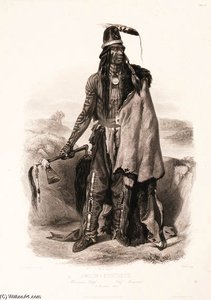
Portræt af Karl Bodmer

De 100 mest berømte Karl Bodmer-malerier, en galleriselektion

Opdateret november 2026 · rangeret efter vores popularitetsscore (søgninger, besøg og ordrer for hvert værk) · 259 værker af Karl Bodmer i vores katalog

Kort sagt

Af alle de originale værker, som Karl Bodmer efterlod, er det mest berømte Kiasax, a Piegen Blackfeet Warrior (1833). Lige efter følger Capture of the Daughters of D. Boone and Callaway by the Indians (1852) og Idols of the Mandan Indians, plate 25 from volume 2 of `Travels in the Interior of North America' (1844). Vores katalog indeholder 259 værker af Karl Bodmer; galleriet har bevaret de 100 værker, som verden beundrer mest, hver vist med sin dato, sit museum og sin historie.

1809 – 1893, Zürich Romanticism Flest værker: Joslyn Art Museum

Karl Bodmers top 10 malerier: galleriets udvalg

1
Kiasax, a Piegen Blackfeet Warrior (1833) af Karl Bodmer

Kiasax, a Piegen Blackfeet Warrior

1833 · Watercolor

Karl Bodmer’s Kiasax, a Piegen Blackfeet Warrior presents a focused study of a Native American man, likely of the Piegan Blackfeet tribe. Created about 1833, the portrait emphasizes the subject's profile and the specific details of his attire. The figure is captured in a contemplative pose, offering a sense of quiet introspection.

3
Idols of the Mandan Indians, plate 25 from volume 2 of `Travels in the Interior of North America' (1844) af Karl Bodmer

Idols of the Mandan Indians, plate 25 from volume 2 of `Travels in the Interior of North America'

1844 · Acrylic On Canvas · Joslyn Art Museum, Omaha

Karl Bodmer’s “Idols of the Mandan Indians,” created in 1844, isn't merely a painting; it’s a meticulously rendered portal to a vanished world. Part of his ambitious ‘Travels in the Interior of North America’ series commissioned by Prince Maximilian zu Wied-Neuwied, this plate from volume two offers an intimate glimpse into the spiritual life and ceremonial practices of the Mandan people – a tribe whose story was tragically cut short…

4
New Harmony On The Wabash River af Karl Bodmer

New Harmony On The Wabash River

Aquatint

The scene known as New Harmony On The Wabash River emerges from the hand of the Swiss artist Karl Bodmer. This work captures a specific moment in time, a window into the landscape of New Harmony, Indiana. It exists as a hand-colored aquatint, a medium that allows the light to settle upon the paper with a particular softness. The image remains a quiet witness to the settlement nestled along the…

5
New-harmony Aus Wabash af Karl Bodmer

New-harmony Aus Wabash

Painting

The scene unfolds in New-harmony Aus Wabash, a work by the Swiss artist Karl Bodmer. This landscape captures the essence of New Harmony, Indiana, as it rests along the banks of the Wabash River. The river flows through the heart of the composition, acting as a central artery for the life of the settlement. Small boats drift upon the water, hinting at the quiet industry of the people living near…

6
Landscape With Herd Of Buffalo On The Upper Missouri af Karl Bodmer

Landscape With Herd Of Buffalo On The Upper Missouri

Watercolor

In this work, titled Landscape With Herd Of Buffalo On The Upper Missouri, the Swiss artist Karl Bodmer captures a quiet moment along the riverbanks. The scene focuses on a herd of buffalo grazing near the water's edge. In the distance, mountains rise to provide a sense of scale and depth to the landscape. It is a study of the natural world as it appeared during the artist's time in…

7
Saukie and Fox Indians, plate 20 from Volume 1 of 'Travels in the Interior of North America' (1833) af Karl Bodmer

Saukie and Fox Indians, plate 20 from Volume 1 of 'Travels in the Interior of North America'

1833 · Watercolor

The scene unfolds in the title Saukie and Fox Indians, plate 20 from Volume 1 of 'Travels in the Interior of North America'. Created about 1833, this work captures a specific moment in the lives of the Sauk—also known as the Sac Sauk and Fox Indians. The artist, Karl Bodmer, brings the figures to life through his meticulous hand, documenting the people of the Missouri River expedition with a precision…

9
Snags on the Missouri River (1833) af Karl Bodmer

Snags on the Missouri River

1833 · Watercolor

In this 1833 work, we find ourselves observing a river scene defined by movement and the quiet industry of early nineteenth-century transit. A steamboat moves steadily down the Missouri River, its presence cutting through the water as it navigates the current. The composition is populated by several vessels, including a boat positioned closer to the left and another situated toward the center, creating a sense of depth and a layered…

Karl Bodmer-udvalget fortsætter, fra 11 til 100

11massika saki indian (1833) af Karl Bodmermassika saki indian1833 12assiniboin indians (1833) af Karl Bodmerassiniboin indians1833 13Mouth of the Wabash (1833) af Karl BodmerMouth of the Wabash1833 14Scalp-Dance of the Minatarres (1832) af Karl BodmerScalp-Dance of the Minatarres1832 15Abdih-Hiddisch, Mandan Chief (1832) af Karl BodmerAbdih-Hiddisch, Mandan Chief1832 16Woman of The Snake-Tribe (1833) af Karl BodmerWoman of The Snake-Tribe1833 17Psihdja-Sahpa Yanktonian Indian (1833) af Karl BodmerPsihdja-Sahpa Yanktonian Indian1833 18Wahk-Ta-Ge-Li Sioux Warrior (1833) af Karl BodmerWahk-Ta-Ge-Li Sioux Warrior1833 19Mato-Tope Mandan Chief (1833) af Karl BodmerMato-Tope Mandan Chief1833 20Bison Dance of the Mandan (1832) af Karl BodmerBison Dance of the Mandan1832 21wakesasse, musquake indian (1833) af Karl Bodmerwakesasse, musquake indian1833 22Pehriska Ruhpa Minatarre or Big Bellied Indian (1833) af Karl BodmerPehriska Ruhpa Minatarre or Big Bellied Indian1833 23rolled scalp (1832) af Karl Bodmerrolled scalp1832 24Woman of The Cree-Tribe (1833) af Karl BodmerWoman of The Cree-Tribe1833 25indians hunting the bison (1833) af Karl Bodmerindians hunting the bison1833 26musquake indian (1833) af Karl Bodmermusquake indian1833 27Pehriska-Ruhpa, in costume of the Dog-Dance (1833) af Karl BodmerPehriska-Ruhpa, in costume of the Dog-Dance1833 28noapeh assiniboin chief (1834) af Karl Bodmernoapeh assiniboin chief1834 29Along the Wabash - (Left ) - (1834) af Karl BodmerAlong the Wabash - (Left ) -1834 30Tombs of Assiniboin Indians in Trees (1833) af Karl BodmerTombs of Assiniboin Indians in Trees1833 31Cutoff River, Branch of the Wabash, plate 8 from Volume 1 of 'Travels in the Interior of North America' (1843) af Karl BodmerCutoff River, Branch of the Wabash, plate 8 from Volume 1 of 'Travels in the Interior of North America'1843 32Mahsette-Kuiuab, Chief of the Cree Indians, plate 22 from volume 1 of `Travels in the Interior of North America' (1843) af Karl BodmerMahsette-Kuiuab, Chief of the Cree Indians, plate 22 from volume 1 of `Travels in the Interior of North America'1843 33Washinga Saba's grave on Blackbirds hill, plate 12 from Volume 2 of 'Travels in the Interior of North America' (1843) af Karl BodmerWashinga Saba's grave on Blackbirds hill, plate 12 from Volume 2 of 'Travels in the Interior of North America'1843 34Pachtuwa-Chta, an Arrikkara Warrior, plate 27 from Volume 1 of 'Travels in the Interior of North America' (1843) af Karl BodmerPachtuwa-Chta, an Arrikkara Warrior, plate 27 from Volume 1 of 'Travels in the Interior of North America'1843 35Sih-Chida and Mahchsi-Karehde, Mandan Indians, plate 20 from Volume 2 of 'Travels in the Interior of North America' (1844) af Karl BodmerSih-Chida and Mahchsi-Karehde, Mandan Indians, plate 20 from Volume 2 of 'Travels in the Interior of North America'1844 36A Mandan village, plate 16 from Volume 1 of 'Travels in the Interior of North America' (1843) af Karl BodmerA Mandan village, plate 16 from Volume 1 of 'Travels in the Interior of North America'1843 37Encampment of the Piekann Indians, plate 43 from Volume 2 of 'Travels in the Interior of North America' (1844) af Karl BodmerEncampment of the Piekann Indians, plate 43 from Volume 2 of 'Travels in the Interior of North America'1844 38Wahk-Ta-Ge-Li, a Sioux Warrior, plate 8 from Volume 2 of 'Travels in the Interior of North America' (1844) af Karl BodmerWahk-Ta-Ge-Li, a Sioux Warrior, plate 8 from Volume 2 of 'Travels in the Interior of North America'1844 39The Interior of a Hut of a Mandan Chief, plate 19 from Volume 2 of 'Travels in the Interior of North America' (1844) af Karl BodmerThe Interior of a Hut of a Mandan Chief, plate 19 from Volume 2 of 'Travels in the Interior of North America'1844 40Mato-Tope, Adorned with the Insignia of his Warlike Deeds, plate 14 from Volume 2 of 'Travels in the Interior of North America' (1843) af Karl BodmerMato-Tope, Adorned with the Insignia of his Warlike Deeds, plate 14 from Volume 2 of 'Travels in the Interior of North America'1843 41Horse Racing of Sioux Indians near Fort Pierre, plate 30 from Volume 1 of 'Travels in the Interior of North America' (1843) af Karl BodmerHorse Racing of Sioux Indians near Fort Pierre, plate 30 from Volume 1 of 'Travels in the Interior of North America'1843 42Ischohä Kakoschochatä Dance of the Mandan Indians, plate 25 from Volume 2 of 'Travels in the Interior of North America' (1843) af Karl BodmerIschohä Kakoschochatä Dance of the Mandan Indians, plate 25 from Volume 2 of 'Travels in the Interior of North America'1843 43Funeral Scaffold of a Sioux Chief near Fort Pierre, plate 11 from Volume 2 of 'Travels in the Interior of North America' (1844) af Karl BodmerFuneral Scaffold of a Sioux Chief near Fort Pierre, plate 11 from Volume 2 of 'Travels in the Interior of North America'1844 44Dacota Woman and Assiniboin Girl (1833) af Karl BodmerDacota Woman and Assiniboin Girl1833 45Oaks and Wild Boars (1865) af Karl BodmerOaks and Wild Boars1865 · Museum of Fine Arts 46New Harmony af Karl BodmerNew Harmony 47Mandan Village af Karl BodmerMandan Village 48Fort Union on the Missouri af Karl BodmerFort Union on the Missouri 49Assiniboin and Cree warriors attack Blackfeet af Karl BodmerAssiniboin and Cree warriors attack Blackfeet 50Young Girls Surprised af Karl BodmerYoung Girls Surprised 51The Steamer Yellow-Stone af Karl BodmerThe Steamer Yellow-Stone 52Massika And Wakusasse af Karl BodmerMassika And Wakusasse 53Junction of the Yellow Stone River af Karl BodmerJunction of the Yellow Stone River 54Punka Indians Encamped on the Banks af Karl BodmerPunka Indians Encamped on the Banks 55A Minatarre Chief af Karl BodmerA Minatarre Chief 56Moennitarri Warrior In The Costume Of The Dog Danse - af Karl BodmerMoennitarri Warrior In The Costume Of The Dog Danse - 57Indians Hunting The Bison af Karl BodmerIndians Hunting The Bison 58Dacota Woman And Assiniboin Girl af Karl BodmerDacota Woman And Assiniboin Girl 59Pehriska-ruhpa af Karl BodmerPehriska-ruhpa 60indians hunting the bison af Karl Bodmerindians hunting the bison 61Mähsette Kuiuab Chief of the Cree indians af Karl BodmerMähsette Kuiuab Chief of the Cree indians 62Medicine Man Of The Mandan Tribe In The Costume af Karl BodmerMedicine Man Of The Mandan Tribe In The Costume 63Washinga Saba's Grave On Blackbirds Hill af Karl BodmerWashinga Saba's Grave On Blackbirds Hill 64Magic Pile Erected By The Assiniboin Indians af Karl BodmerMagic Pile Erected By The Assiniboin Indians 65sharper native americans (24) af Karl Bodmersharper native americans (24) 66Blackfoot Chief And Peikann Chief af Karl BodmerBlackfoot Chief And Peikann Chief 67sharper native americans af Karl Bodmersharper native americans 68sharper native americans (30) af Karl Bodmersharper native americans (30) 69Dacota Woman and Assiniboin Child af Karl BodmerDacota Woman and Assiniboin Child 70Rencontre Des Voyageurs Avec Des Indiens Meunitarri Par Alex Manceau af Karl BodmerRencontre Des Voyageurs Avec Des Indiens Meunitarri Par Alex Manceau 71Sih-Chida and Mahchsi-Karehde, Mandan Indians af Karl BodmerSih-Chida and Mahchsi-Karehde, Mandan Indians 72Bison-Dance, Mandan Indians af Karl BodmerBison-Dance, Mandan Indians 73Sioux Tipis af Karl BodmerSioux Tipis 74Chief Of The Blood Indians War Chief Of The Piekann Indians And Koutani Indian af Karl BodmerChief Of The Blood Indians War Chief Of The Piekann Indians And Koutani Indian 75Missouri Indian Oto Indian And Chief Of The Puncas af Karl BodmerMissouri Indian Oto Indian And Chief Of The Puncas 76Päsesick-Kaskutäu (1833) af Karl BodmerPäsesick-Kaskutäu1833 · Amon Carter Museum of American Art 77Trarbach, Traben Und Die Gräfinburg af Karl BodmerTrarbach, Traben Und Die Gräfinburg 78untitled (3791) af Karl Bodmeruntitled (3791) 79Entry to the Bay of New York af Karl BodmerEntry to the Bay of New York 80Street Scene With A Procession In Progress af Karl BodmerStreet Scene With A Procession In Progress 81New Harmony On The Wabash af Karl BodmerNew Harmony On The Wabash 82Camp of the Gros Ventres af Karl BodmerCamp of the Gros Ventres 83The Mouth Of The Fox River af Karl BodmerThe Mouth Of The Fox River 84Two Etchings af Karl BodmerTwo Etchings 85Saukie and Fox Indians af Karl BodmerSaukie and Fox Indians 86Facsimile of an Indian Painting af Karl BodmerFacsimile of an Indian Painting 87Mato Tope af Karl BodmerMato Tope 88Fort mackenzie af Karl BodmerFort mackenzie 89Indian Utensils And Arms - af Karl BodmerIndian Utensils And Arms - 90View of the Rocky Mountains af Karl BodmerView of the Rocky Mountains 91Fort Clark on the Missouri af Karl BodmerFort Clark on the Missouri 92A Mandan Indian af Karl BodmerA Mandan Indian 93Fort Clack On The Missouri af Karl BodmerFort Clack On The Missouri 94untitled (5404) af Karl Bodmeruntitled (5404) 95Offering Of The Mandan Indians af Karl BodmerOffering Of The Mandan Indians 96Cat Playing With An Adder af Karl BodmerCat Playing With An Adder 97A Mandan Chief af Karl BodmerA Mandan Chief 98Wahk ta Ge Li af Karl BodmerWahk ta Ge Li 99Entry to the Bay of New York taken from Staten af Karl BodmerEntry to the Bay of New York taken from Staten 100Indian Utensils And Arms - af Karl BodmerIndian Utensils And Arms -

Karl Bodmers berømte malerier, periode for periode

Motiverne, der fangede Karl Bodmers blik

De fire motiver, der optræder hyppigst i disse originaler, hver med sit fineste eksempel.

De museer, der udstiller Karl Bodmers originalværker

De 3 museer, der rummer flest af malerierne på denne side.

Museum By Værker af Karl Bodmer Malerier fra denne liste
Joslyn Art Museum, OmahaJoslyn Art Museum Omaha 1 Idols of the Mandan Indians, plate 25 from volume 2 of `Travels in the Interior of North America'
Museum of Fine Arts, BostonMuseum of Fine Arts Boston 1 Oaks and Wild Boars
Amon Carter Museum of American Art, Fort WorthAmon Carter Museum of American Art Fort Worth 1 Päsesick-Kaskutäu

Karl Bodmer årti for årti: det originale værk, der definerer hvert enkelt

Værker per årti

Vælg et årti for at se det originale værk, der definerer det.

Samleres spørgsmål om Karl Bodmers malerier

Hvilket værk er Karl Bodmer mest kendt for?Vis svaret

Kiasax, a Piegen Blackfeet Warrior (1833). Derefter følger Capture of the Daughters of D. Boone and Callaway by the Indians (1852) og Idols of the Mandan Indians, plate 25 from volume 2 of `Travels in the Interior of North America' (1844).

Hvor gammel var Karl Bodmer, da Kiasax, a Piegen Blackfeet Warrior blev skabt?Vis svaret

24 år gammel: Kiasax, a Piegen Blackfeet Warrior er fra 1833, og Karl Bodmer blev født i 1809.

Hvad er de ti mest berømte Karl Bodmer malerier?Vis svaret

Kiasax, a Piegen Blackfeet Warrior, Capture of the Daughters of D. Boone and Callaway by the Indians, Idols of the Mandan Indians, plate 25 from volume 2 of `Travels in the Interior of North America', New Harmony On The Wabash River, New-harmony Aus Wabash, Landscape With Herd Of Buffalo On The Upper Missouri, Saukie and Fox Indians, plate 20 from Volume 1 of 'Travels in the Interior of North America', Mehkskeme-Sukahs, Blackfoot Chief and Tatsicki-Stomick, Piekann Chief, plate 45 from Volume1 of 'Travels in the Interior of North America', Snags on the Missouri River og Indians hunting the bison, plate 31 from Volume 2 of 'Travels in the Interior of North America'. Ranglisten ovenfor viser det enkelte værks årstal og museum.

Hvor mange malerier efterlod Karl Bodmer?Vis svaret

Vores katalog indeholder 259 værker af Karl Bodmer, dateret fra 1832 til 1865.

I hvilke museer udstilles Karl Bodmer's mesterværker?Vis svaret

Primært i Joslyn Art Museum (Omaha), Museum of Fine Arts (Boston) og Amon Carter Museum of American Art (Fort Worth). Museumslisten ovenfor viser dem alle.

I hvilke år malede Karl Bodmer sine mest berømte værker?Vis svaret

I 1830s: 27 af de 100 værker på denne side blev skabt dengang, herunder Kiasax, a Piegen Blackfeet Warrior.

Hvad er de første og de sidste berømte originaler af Karl Bodmer?Vis svaret

På denne side er det tidligste Scalp-Dance of the Minatarres (1832) og det seneste Oaks and Wild Boars (1865).

Hvilke motiver valgte Karl Bodmer oftest?Vis svaret

People (17), Man (14) og Native american culture (13), fordelt på de 100 værker på denne side.

Hvilken teknik brugte Karl Bodmer mest?Vis svaret

Watercolor, for 38 af de 100 værker på denne side.

Hvilken kunstretning tilhører Karl Bodmer?Vis svaret

Romanticism, baseret på originalerne på denne side.

Karl Bodmer: liv og værk

A Swiss Øje på Vesten: Karl Bodmers Liv og Kunst

Johann Carl Bodmer, født i Riesbach nær Zürich i 1809, var en kunstner, der unik kombinerer den romantiske æra med et fascinerende blik på det forsvindende Amerika. Hans tidlige liv er omgivet af mystik, men det er klart, at hans kunstneriske talent blev dyrket fra en ung alder gennem undervisning hos sin onkel, Johann Jakob Meier, en anerkendt graver. Denne grundlæggende træning gav Bodmer en præcis sans for detaljer og en dygtighed i tegneteknik, der ville blive kendetegnende for hans stil. I begyndelsen fik han anerkendelse for maleriske syn af Rhin og Mosel-dalene, som blev trykt og udgivet til den voksende turistmarked, men Bodmers talent fangede snart Prins Maximilian zu Wied-Neuwieds opmærksomhed – en tysk aristokrat med en passion for naturhistorie og etnografi. Denne møde ændrede drastisk Bodmers livsbane og sendte ham ud på et eventyr, der ville gøre ham og de kulturer, han mødte, berømte.

Rejsen til Nordamerika: Dokumentation af en Forandrende Verden

I 1832 sluttede Bodmer sig til Prins Maximilian på en dristig ekspedition op ad Missouri River – et eventyr, der havde det ambitiøse mål at dokumentere de amerikanske stammer og landskaber i Vesten. Dette var ikke blot en kunstnerisk bestilling; det var en videnskabelig indsats, og Bodmers rolle udvidede sig ud over blot at være illustratør. Han blev en visuel skildrer, der blev bedt om at fange essensen af en verden i hurtig forandring under trykket fra vestlig ekspansion. I to år nedlagde Bodmer minutiøst sine observationer i over 400 tegninger og vandfarver, der beskrev alt fra dramatiske landskaber til intime portrætter af individer fra stammer som Mandan, Hidatsa, Sioux og Blackfeet. Hans arbejde skiller sig ud ved sin bemærkelsesværdige nøjagtighed og følsomhed – han portrætterede disse mennesker ikke blot som eksotiske emner, men søgte at forstå og repræsentere deres kulturer med respekt og værdighed. De barske realiteter i frontløberlivet – sygdom, konflikt og kulturel forandring – er subtilt til stede i hans billeder, hvilket giver et rørende lag af betydning til hans kunstneriske dokumentation. *Päsesick-Kaskutäu*, en delikat vandfarve der fanger portrættet af en ung Hidatsa mand, illustrerer Bodmers evne til at formidle både fysisk detalje og psykologisk dybde.

Kunstnerisk Stil og Indflydelser: Romantik møder Etnografi

Bodmers kunstneriske stil er dybt rodfæstet i den romantiske tradition – karakteriseret ved en vægtning af følelse, individualisme og en ærbødighed for naturen. Men hans arbejde transcenderer blot æstetisk skønhed; det er infuseret med en skarp etnografisk sans. Han malede ikke blot landskaber eller portrætter – han skabte visuelle dokumenter af kulturer, der stod over for en forestående transformation. Hans kompositioner fremhæver ofte omhyggelige detaljer i tøj, værktøjer og ceremonielle genstande, hvilket giver værdifulde indsigter i disse stammer's materielle kultur. Indflydelsen fra tidligere landskabsmalerier som Caspar David Friedrich er tydelig i hans dramatiske himmelstræk og evokative brug af lys og skygge, mens hans portrætter afslører en følsomhed over for menneskelig udtryk, der minder om kunstnere som Jean-Auguste-Dominique Ingres. **Kombinationen af romantiske æstetikker med etnografisk præcision gør Bodmers arbejde virkelig unikt.** Han balancerede kunstnerisk frihed med videnskabelig nøjagtighed og skabte billeder, der er både visuelt fængslende og historisk betydningsfulde.

Arv og Opdagelse: En Varig Indvirkning

Trods den enorme indsats, der blev lagt i ekspeditionen og efterfølgende udgivelse af Prins Maximilians *Reise in das Innere Nord-Amerikas*, fik værket ikke umiddelbart en varm modtagelse. Bogen var dyr og opnåede ikke bred popularitet, hvilket førte til økonomiske vanskeligheder for begge mænd. Bodmer slog sig til sidst ned i Barbizon, Frankrig, og blev en del af kunstnerkollektivet Barbizon-skolen, der var kendt for deres plein air maleri og realistiske fremstillinger af det landlige liv. Selvom han fortsatte med at male og udstille sit arbejde, blev hans bidrag til amerikansk historie først anerkendt i det 20. århundrede. I dag er hans malerier og vandfarver fejret som uvurderlige historiske dokumenter og mesterværker af romantisk kunst. Museer rundt om i verden – herunder Joslyn Art Museum i Omaha og samlinger i Schweiz – udstiller stolt hans arbejde, hvilket sikrer, at hans arv fortsætter.
  • Hans billeder giver et vigtigt visuelt billede af de amerikanske stammer før de blev uigenkaldeligt forandret af koloniseringen.
  • Bodmers præcise detaljer og kunstneriske dygtighed inspirerer stadig kunstnere og forskere i dag.
  • Han står som et vidnesbyrd om kunstens kraft til at dokumentere, bevare og belyse den menneskelige erfaring.