


1


Opdateret november 2026 · rangeret efter vores popularitetsscore (søgninger, besøg og ordrer for hvert værk) · 36 værker af Jean Marchand i vores katalog
Kort sagt
Self Portrait (1910) er det maleri af Jean Marchand, der vækker mest opsigt; originalen findes på Rhode Island School of Design Museum of Art, Providence. Derefter falder blikket på Girl in a Basket Chair (1921) og Maternity (La Maternité) (1921). Blandt de 36 værker af Jean Marchand i vores katalog er disse 31 de mest berømte, hver især et unikt originalværk præsenteret med sit årstal, sit museum og årsagen til dets tidløse betydning.
 The Aspidistra1912 · Bristol Museum - Art Gallery
12
 Palm Tree1914 · Courtauld Gallery
13
 Still Life with Fruit and a Flower Pot1912 · Charleston
14
 Vence1920 · Metropolitan Museum of Art
15
 Les Terrasses1918 · The Ashmolean Museum of Art and Archaeology
16
 Saint Paul, Côte d'Azur1921 · Courtauld Gallery
17
 Still Life with Earthenware Jug, Loaf and Strawberries1919 · Courtauld Gallery
18
 Crépuscule1923 · Statens Museum for Kunst
19
 Landscape at Vence1927
20
 Angelina1923
21
 Still Life with Fruit and Candlestick1930 · Courtauld Gallery
22
 GoldfishNational Gallery of Ireland
23
 A Street in DamascusNational Gallery of Ireland
24
 Olive Trees, Vence
25
 Landscape with Olive Trees
26
 The Lady in BrownManchester Art Gallery
27
 French VillageManchester Art Gallery
28
 Paysage Provençal
29
 La Rochelle, FranceMuseum of Gloucester
30
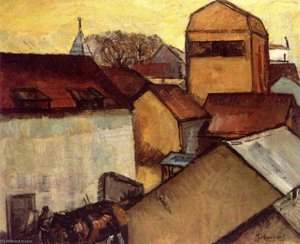 The Farm
31
 Still LifeFitzwilliam-museet
De fire motiver, der optræder hyppigst i disse originaler, hver med sit fineste eksempel.
De 8 museer, der rummer flest af malerierne på denne side.
| Museum | By | Værker af Jean Marchand | Malerier fra denne liste |
|---|---|---|---|
 National Gallery of Ireland |
Dublin | 4 | Girl in a Basket Chair, A Cabaret Scene in Damascus, Goldfish |
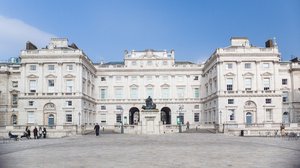 Courtauld Gallery |
London | 4 | Palm Tree, Saint Paul, Côte d'Azur, Still Life with Earthenware Jug, Loaf and Strawberries |
 Metropolitan Museum of Art |
New York | 2 | Reclining Figure, Vence |
 Manchester Art Gallery |
Manchester | 2 | The Lady in Brown, French Village |
 Rhode Island School of Design Museum of Art |
Providence | 1 | Self Portrait |
 Petit Palais |
Paris | 1 | Work: Sketch for the porch of the boys' school on Avenue Simon-Bolivar, 19th arrondissement of Paris |
 Scottish National Gallery of Modern Art |
Edinburgh | 1 | The Lake |
 Bristol Museum - Art Gallery |
Bristol | 1 | The Aspidistra |
Vælg et årti for at se det originale værk, der definerer det.


Self Portrait (1910), Rhode Island School of Design Museum of Art, Providence. Derefter følger Girl in a Basket Chair (1921) og Maternity (La Maternité) (1921).
27 år gammel: Self Portrait er fra 1910, og Jean Marchand blev født i 1883.
Self Portrait, Girl in a Basket Chair, Maternity (La Maternité), Reclining Figure, Work: Sketch for the porch of the boys' school on Avenue Simon-Bolivar, 19th arrondissement of Paris, A Cabaret Scene in Damascus, Woman Reading, Portrait of a Lady, The Lake og View in the Midi (Pays du Midi). Ranglisten ovenfor viser det enkelte værks årstal og museum.
Vores katalog indeholder 36 værker af Jean Marchand, dateret fra 1910 til 1936.
Primært i National Gallery of Ireland (Dublin), Courtauld Gallery (London) og Metropolitan Museum of Art (New York). Museumslisten ovenfor viser dem alle.
I 1910s: 8 af de 31 værker på denne side blev skabt dengang, herunder Self Portrait.
På denne side er det tidligste Self Portrait (1910) og det seneste A Cabaret Scene in Damascus (1936).
Rural france (2) og Rolling hills (2), fordelt på de 31 værker på denne side.
Impressionism, baseret på originalerne på denne side.
Girl in a Basket Chair, A Cabaret Scene in Damascus og Goldfish: National Gallery of Ireland, Dublin har 4 af værkerne på denne side.
Jean Hyppolyte Marchand emerged from the vibrant, shifting currents of the early 20th-century Parisian art scene, a period defined by the tension between classical tradition and radical modernity. Born on November 21, 1883, Marchand’s artistic journey began within the prestigious halls of the École des Beaux-Arts. Under the rigorous guidance of Léon Bonnat, he absorbed the foundational principles of classical technique, yet his spirit was far too restless to remain tethered to the past. His early explorations were deeply rooted in the Impressionist tradition, finding profound beauty in the tranquil landscapes of the Midi region. In these early works, one can observe a meticulous devotion to tonal harmony and light, reminiscent of the masters Cézanne and Sisley, as he sought to capture the quiet, sun-drenched essence of rural France.
Beyond the canvas, Marchand’s formative years were enriched by a diverse engagement with the decorative arts. His experience in jewelry design and textiles provided him with a unique tactile understanding of pattern and form, an expertise that would later inform the structural integrity of his more experimental compositions. This intersection of fine art and decorative elegance allowed him to approach the canvas not just as a window into nature, and but as a space for complex geometric interplay.
One of the most defining chapters in Marchand’s biography was his profound association with the Bloomsbury Group. This legendary circle of intellectuals and artists—including Roger Fry, Clive Bell, Virginia Woolf, and Leonard Woolf—served as a catalyst for his artistic evolution. Through this connection, Marchand was thrust into an environment that championed aesthetic experimentation and challenged the rigid boundaries of Victorian morality and academic art. It was within this influential orbit that his work began to move away from the soft edges of Impressionism toward something far more intellectually rigorous.
The impact of Fry and Bell on Marchand’s trajectory cannot be overstated. Their advocacy for Post-Impressionism provided him with the conceptual framework to embrace the fractured planes and multiple perspectives that were beginning to redefine European art. This period of his life was marked by a daring intellectual fervor, as he grappled with the concepts of simultaneity and spatial ambiguity, seeking to represent the complexity of modern perception through a more structured, analytical lens.
Around 1912, Marchand underwent a transformative stylistic shift, fully embracing the revolutionary language of Cubism. Drawing inspiration from the pioneering techniques of Picasso and Braque, he began to deconstruct his subjects into a series of overlapping planes and geometric facets. His still lifes from this era, such as the celebrated Still Life with Bananas (1910), demonstrate a masterful command of this new vocabulary. These works were not merely exercises in abstraction but were deeply engaged with the physical presence of objects, using light and shadow to navigate the tension between two-dimensional surfaces and three-dimensional depth.
His versatility extended well beyond oil painting into the delicate realms of printmaking and illustration. A notable achievement includes his evocative collaboration with the poet Paul Claudel on Le Chemin de la Croix, where Marchand’s ability to translate spiritual and emotional narratives into visual form was brilliantly displayed. Whether capturing the serene, sun-soaked atmosphere of a Mediterranean village in View in the Midi or exploring the poignant, structured forms of Maternity (La Maternité), Marchand’s oeuvre remains a testament to a life spent at the crossroads of tradition and innovation. His legacy persists as a vital link between the pastoral beauty of the 19th century and the fractured, exhilarating energy of the modern age.


