Portræt af Jan Vonck

Jan Vonck malerier: De 20 mest berømte, set gennem et galleris øjne

Opdateret november 2026 · rangeret efter vores popularitetsscore (søgninger, besøg og ordrer for hvert værk) · 22 værker af Jan Vonck i vores katalog

Kort sagt

I galleriets øjne er Jan Voncks mest berømte maleri Dog attacking a cat (1650), hvis original hænger på Nationalmuseet i Warszawa i Warszawa. Hunting still-life with hanging hare and birds (1657) og Dead Game fuldender trioen, som ethvert øje genkender. Ud af de 22 værker af Jan Vonck i vores katalog præsenterer galleriet herunder de 20 mest berømte, hver som et originalværk med årstal, museum og det, der gør det unikt.

1631 – 1664, Toruń Flest værker: Nationalmuseet i Warszawa

Galleriets top 10 Jan Vonck malerier

1
Dog attacking a cat (1650) af Jan Vonck

Dog attacking a cat

1650 · Oil · Nationalmuseet i Warszawa, Warszawa

In this oil painting, a light-colored dog occupies the lower right foreground, its head turned upward with an alert expression. The animal's fur is rendered with fine brushwork, showing the texture of individual hairs against the darker background. To the left, a collection of animals and game is draped over a mound or basket, including a central dead hare and a bird. A cat is partially visible, peering from the…

2
Hunting still-life with hanging hare and birds (1657) af Jan Vonck

Hunting still-life with hanging hare and birds

1657 · Oil · Musée des Beaux-Arts de Strasbourg, Strasbourg

The air in the room feels heavy, thick with the stillness that follows a sudden, violent movement. A large hare hangs suspended by its hind legs, its weight pulling at a thin, taut chain that cuts through the darkness. The creature's fur, rendered in soft ochre and cream, catches a sliver of light, revealing the tactile reality of its texture against the void. Beside it, a white and grey bird…

3
Dead Game af Jan Vonck

Dead Game

Oil

A dark, shadowed environment provides the stage for this visceral encounter between life and death. In the center of the composition, a bird lies lifeless, its head severed, surrounded by other avian figures and a dead animal. The scene is set in a dim, perhaps subterranean or nocturnal space, where the natural order is stripped to its most primal elements. Small birds are scattered throughout the darkness, adding layers of…

4
Dead Swan (1655) af Jan Vonck

Dead Swan

1655 · Oil On Canvas · Groninger Museum, Groningen

Created in 1655, this work emerges from the tradition of 17th-century Dutch still life. It captures a moment of absolute repose, where the vitality of the natural world has been replaced by a profound quiet. The painting explores the tension between the softness of the feathers and the hard reality of death. It is a meditation on the cycle of existence, rendered with a precision that makes the silence feel…

5
Vanitas Still Life (1654) af Jan Vonck

Vanitas Still Life

1654 · Oil · Groninger Museum, Groningen

Shadows stretch across a dark, stone-like ledge, claiming the space where life once resided. A human skull rests heavily in the center, its weathered surface catching a sharp, directional light that spills from the upper left. Beside it, a small candle sits in its holder, its flame extinguished, leaving only a tiny, ghostly wisp of smoke that curls upward into the darkness. The air feels heavy with the silence of…

6
Still Life with Dead Birds and a Flower Pot (1652) af Jan Vonck

Still Life with Dead Birds and a Flower Pot

1652 · Oil On Canvas · Museum Boijmans Van Beuningen, Rotterdam

This 1652 oil painting presents a somber and dramatic Dutch still life set within a dark, atmospheric environment. The composition is characterized by an asymmetrical arrangement, featuring a cluster of hanging birds on the left side that is balanced by birds resting on a stone ledge in the lower right. The scene is rendered in a chiaroscuro style, utilizing a strong directional light source from the upper left to illuminate…

7
Dead birds on a stone ledge (1660) af Jan Vonck

Dead birds on a stone ledge

1660 · Oil On Panel · Dordrechts Museum, Dordrecht

A collection of dead birds rests upon a thick, grey stone ledge, their forms arranged centrally against a dark, shadowed background. The composition is horizontal, emphasizing the weight of the stone protrusion that extends from the left. Light enters from the upper left, casting a sharp chiaroscuro effect across the scene. This illumination catches the granular texture of the stone and the delicate, downy layers of plumage, while leaving the…

8
Still Life of Dead Birds (1660) af Jan Vonck

Still Life of Dead Birds

1660 · Oil · Minneapolis Institute of Art, Minneapolis

A heavy silence rests upon the stone ledge. Several dead birds lie in a quiet, asymmetrical arrangement, their forms slumped against the hard, cold surface. The composition pulls the eye downward, where the weight of the subjects settles in the lower half of the frame. Deep browns and charcoal grays dominate the shadows, creating a space of profound stillness. Through the gloom, sudden flashes of crimson, orange, and white emerge…

10
Game Birds (1650) af Jan Vonck

Game Birds

1650 · Oil On Canvas · Bergen Kunstmuseum, Bergen

A heavy, silent weight settles over the ledge where a collection of game birds lies in a dense, horizontal cluster. The scene is caught in a moment of profound stillness, a quiet aftermath of the hunt. Deep browns and ochres dominate the palette, grounding the composition in earthy tones that feel as though they have risen from the forest floor itself. Amidst the muted greens and creams, a sudden flash…

Jan Voncks malerier, rangeret fra 11 til 20

Motiverne, der fangede Jan Voncks blik

De fire motiver, der optræder hyppigst i disse originaler, hver med sit fineste eksempel.

De museer, der udstiller Jan Voncks originalværker

De 8 museer, der rummer flest af malerierne på denne side.

Museum By Værker af Jan Vonck Malerier fra denne liste
Nationalmuseet i Warszawa, WarszawaNationalmuseet i Warszawa Warszawa 2 Dog attacking a cat, Dog attacking a cat
Groninger Museum, GroningenGroninger Museum Groningen 2 Dead Swan, Vanitas Still Life
Museum Boijmans Van Beuningen, RotterdamMuseum Boijmans Van Beuningen Rotterdam 2 Still Life with Dead Birds and a Flower Pot, Dead Birds
Dordrechts Museum, DordrechtDordrechts Museum Dordrecht 2 Dead birds on a stone ledge, Trompe-l'œil Still Life with Dead Birds
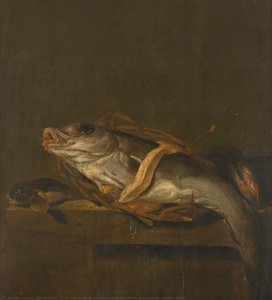
Rijksmuseum, AmsterdamRijksmuseum Amsterdam 2 Still Life with a Haddock and Gurnard, Jan Vonck, 1640 - 1662, Dead Birds, Jan Vonck, 1640 - 1662
The Ashmolean Museum of Art and Archaeology, OxfordThe Ashmolean Museum of Art and Archaeology Oxford 2 Still Life of dead Birds, Still Life of Game on a stone Sill
Musée des Beaux-Arts de Strasbourg, StrasbourgMusée des Beaux-Arts de Strasbourg Strasbourg 1 Hunting still-life with hanging hare and birds
Minneapolis Institute of Art, MinneapolisMinneapolis Institute of Art Minneapolis 1 Still Life of Dead Birds

Jan Vonck, årets signaturmalerier

Jan Voncks karriere på denne side strækker sig over 14 år, fra 1650 til 1663: hvert år vises her med de mest berømte originalværker.

Værker per år

Vælg et årstal for at se de originale værker.

Jan Vonck's malerier: galleriets svar

Hvilket maleri af Jan Vonck er det mest berømte af alle?Vis svaret

Dog attacking a cat (1650), Nationalmuseet i Warszawa, Warszawa. Derefter følger Hunting still-life with hanging hare and birds (1657) og Dead Game.

Hvor gammel var Jan Vonck, da Dog attacking a cat blev færdiggjort?Vis svaret

19 år gammel: Dog attacking a cat er fra 1650, og Jan Vonck blev født i 1631.

Hvilke er Jan Voncks top 10 malerier?Vis svaret

Dog attacking a cat, Hunting still-life with hanging hare and birds, Dead Game, Dead Swan, Vanitas Still Life, Still Life with Dead Birds and a Flower Pot, Dead birds on a stone ledge, Still Life of Dead Birds, Dead Birds og Game Birds. Ranglisten ovenfor viser det enkelte værks årstal og museum.

Hvor mange værker skabte Jan Vonck?Vis svaret

Vores katalog indeholder 22 værker af Jan Vonck, dateret fra 1650 til 1663.

Hvor hænger Jan Voncks mest berømte originaler?Vis svaret

Primært i Nationalmuseet i Warszawa (Warszawa), Groninger Museum (Groningen) og Museum Boijmans Van Beuningen (Rotterdam). Museumslisten ovenfor viser dem alle.

Hvornår skabte Jan Vonck sine mest berømte malerier?Vis svaret

I 1660: 3 af de 20 værker på denne side blev skabt dengang, herunder Dead birds on a stone ledge.

Hvilke er Jan Voncks tidligste og seneste berømte værker?Vis svaret

På denne side er det tidligste Dog attacking a cat (1650) og det seneste Trompe-l'œil Still Life with Dead Birds (1663).

Hvilke motiver vendte Jan Vonck oftest tilbage til?Vis svaret

Feathers (10), Dead birds (8) og Stone ledge (5), fordelt på de 20 værker på denne side.

Hvilket medie arbejdede Jan Vonck mest med?Vis svaret

Oil, for 6 af de 20 værker på denne side.

Hvilke originalværker af Jan Vonck findes i Nationalmuseet i Warszawa?Vis svaret

Dog attacking a cat og Dog attacking a cat: Nationalmuseet i Warszawa, Warszawa har 2 af værkerne på denne side.

Jan Vonck: kunstneren

Jan Vonck: A Dutch Master of Living Birds

Born in Torun, Poland, in 1631, Jan Vonck’s artistic journey began amidst the turmoil of a shifting political landscape. His early life was shaped by his father, Elias Vonck – also a painter – who instilled in him a deep appreciation for depicting the natural world, particularly its feathered inhabitants. This familial legacy proved pivotal, establishing a foundation rooted in meticulous observation and a commitment to capturing the vitality of birds within their environments. Vonck’s career unfolded primarily in Amsterdam, a vibrant hub of artistic activity during the Dutch Golden Age, where he honed his skills and established himself as a respected artist specializing in a remarkably specific yet captivating genre: the still life of living birds.

Vonck's artistic development was profoundly influenced by the masters who preceded him. He clearly drew inspiration from the techniques of Joannes Fijt, Jan Baptist Weenix, Alexander Adriaenssen, and Melchior Hondecoeter – all renowned for their masterful depictions of animals in natural settings. These artists established a precedent for portraying birds with an astonishing level of realism, capturing not just their physical appearance but also their inherent movement and alertness. Vonck’s work can be seen as a continuation of this tradition, building upon the foundations laid by his predecessors while imbuing it with his own unique style.

The Art of the Living Still Life

Vonck's fame rests almost entirely on his series of still life paintings featuring birds. These weren’t simply depictions of animals; they were carefully constructed narratives, often set within richly detailed landscapes. He frequently portrayed hunting scenes – a common motif during that era – showcasing dead poultry alongside the living birds, creating a poignant commentary on the cycle of life and death. The inclusion of elements like flower pots, fruits, and other domestic objects added layers of meaning to these compositions, suggesting themes of abundance, mortality, and the relationship between humanity and nature.

What distinguishes Vonck’s work is his extraordinary ability to convey a sense of immediacy and dynamism. He meticulously rendered each feather, capturing its texture and sheen with remarkable precision. His birds weren't static subjects; they appeared poised for flight, alert to their surroundings, or engaged in various behaviors – preening, foraging, or observing the viewer. This attention to detail, combined with his skillful use of light and shadow, created a powerful illusion of life within the painted surface.

Notable Works and Influences

Among Vonck’s most celebrated works is “Stilleven met dode vogels en een bloempot” (Still Life with Dead Birds and a Flower Pot), currently housed at the Rijksmuseum in Amsterdam. This painting exemplifies his signature style, seamlessly blending elements of realism, symbolism, and narrative. Another significant piece is "Dode Vogels" (Dead Birds), also held by the Rijksmuseum, which further demonstrates his ability to evoke emotion through the juxtaposition of life and death.

Interestingly, Vonck’s work has been linked to the landscapes of Jacob van Ruysdael. There are documented instances where he painted birds within Ruysdael's compositions, suggesting a collaborative relationship or an exchange of ideas between these two masters. This association highlights the broader artistic context in which Vonck operated and underscores his position as a key figure in the Dutch Golden Age.

Legacy and Historical Significance

Jan Vonck’s career was tragically cut short at the relatively young age of 32, dying in Amsterdam in 1664. Despite his brief life, he left behind a significant body of work that continues to captivate art lovers today. His meticulous depictions of birds have earned him a place among the most accomplished artists of the Dutch Golden Age, and his influence can be seen in the works of subsequent generations of painters.

Vonck’s legacy extends beyond his technical skill; he represents a pivotal moment in the history of still life painting. By elevating the depiction of animals to an art form, he demonstrated that nature itself could serve as a source of profound beauty and intellectual inquiry. His work remains a testament to the power of observation, the artistry of representation, and the enduring fascination with the natural world.