Portræt af James Hawkins

De 11 mest berømte James Hawkins-malerier, en galleriselektion

Opdateret november 2026 · rangeret efter vores popularitetsscore (søgninger, besøg og ordrer for hvert værk) · 11 værker af James Hawkins i vores katalog

Kort sagt

Af alle de originale værker, som James Hawkins efterlod, er det mest berømte The Great Glen through Four Seasons (panel 4 of 4) (2004), som er en del af samlingen på Inverness Airport i Inverness. Lige efter følger The Great Glen through Four Seasons (panel 3 of 4) (2004) og The Black Rock Falls (1992). Vores katalog indeholder 11 værker af James Hawkins; galleriet har bevaret de 11 værker, som verden beundrer mest, hver vist med sin dato, sit museum og sin historie.

født 1954, Bath Contemporary realism Flest værker: Inverness Airport

James Hawkinss top 10 malerier: galleriets udvalg

1
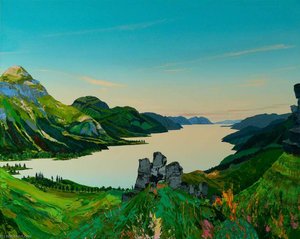
The Great Glen through Four Seasons (panel 4 of 4) (2004) af James Hawkins

The Great Glen through Four Seasons (panel 4 of 4)

2004 · Oil On Panel · Inverness Airport, Inverness

In this breathtaking fourth panel of his seasonal series, James Hawkins invites the viewer into a profound communion with the Scottish Highlands. The Great Glen through Four Seasons is more than a mere landscape; it is a meditative exploration of time and the enduring spirit of the earth. The composition centers on a vast, tranquil body of water that acts as a mirror to the towering mountains in the distance,…

2
The Great Glen through Four Seasons (panel 3 of 4) (2004) af James Hawkins

The Great Glen through Four Seasons (panel 3 of 4)

2004 · Oil On Panel · Inverness Airport, Inverness

In the breathtaking landscape of The Great Glen through Four Seasons (panel 3 of 4), artist James Hawkins invites the viewer into a profound meditation on the cyclical nature of existence. This particular panel serves as a mesmerizing window into a world where time is not a linear progression, but a rhythmic dance of light and life. The composition is anchored by the majestic presence of snow-capped peaks that pierce…

7
The Great Glen through Four Seasons (panel 1 of 4) (2004) af James Hawkins

The Great Glen through Four Seasons (panel 1 of 4)

2004 · Inverness Airport, Inverness

In this breathtaking landscape, the first movement of a larger seasonal quartet, James Hawkins invites the viewer into a profound dialogue with the Scottish Highlands. The painting captures the majestic expanse of the Great Glen, where towering mountains stand as silent sentinels over a tranquil, mirror-like lake. There is an immediate sense of atmospheric depth achieved through the masterful layering of light and shadow; the distant peaks emerge from a…

8
Pools beside the Rhue Burn (1993) af James Hawkins

Pools beside the Rhue Burn

1993 · Acrylic On Canvas · Scottish National Gallery of Modern Art, Edinburgh

James Hawkins’s “Pools beside the Rhue Burn,” painted in 1993, offers a captivating glimpse into the heart of British landscape painting, echoing the sensibilities of masters like Henri Matisse while forging its own quiet beauty. This evocative work depicts a tranquil river scene nestled within a rugged, mountainous terrain – a quintessential representation of the Scottish Highlands that speaks to a deep appreciation for nature’s power and serenity. The artist's…

James Hawkins-udvalget fortsætter, fra 11 til 11

Motiverne, der fangede James Hawkinss blik

De fire motiver, der optræder hyppigst i disse originaler, hver med sit fineste eksempel.

De museer, der udstiller James Hawkinss originalværker

De 3 museer, der rummer flest af malerierne på denne side.

Museum By Værker af James Hawkins Malerier fra denne liste
Inverness Airport, InvernessInverness Airport Inverness 4 The Great Glen through Four Seasons (panel 4 of 4), The Great Glen through Four Seasons (panel 3 of 4), The Great Glen through Four Seasons (panel 2 of 4)
Scottish National Gallery of Modern Art, EdinburghScottish National Gallery of Modern Art Edinburgh 1 Pools beside the Rhue Burn
High Life Highland Exhibitions Unit, InvernessHigh Life Highland Exhibitions Unit Inverness 1 Untitled

James Hawkins år for år: de originale værker, der definerer hvert år

Udvælgelsen strækker sig over 13 år med James Hawkins, fra 1992 til 2004, og indeholder de fineste originalværker fra hvert år.

Værker per år

Vælg et årstal for at se de originale værker.

Samleres spørgsmål om James Hawkinss malerier

Hvilket værk er James Hawkins mest kendt for?Vis svaret

The Great Glen through Four Seasons (panel 4 of 4) (2004), Inverness Airport, Inverness. Derefter følger The Great Glen through Four Seasons (panel 3 of 4) (2004) og The Black Rock Falls (1992).

Hvor gammel var James Hawkins, da The Great Glen through Four Seasons (panel 4 of 4) blev skabt?Vis svaret

50 år gammel: The Great Glen through Four Seasons (panel 4 of 4) er fra 2004, og James Hawkins blev født i 1954.

Hvad er de ti mest berømte James Hawkins malerier?Vis svaret

The Great Glen through Four Seasons (panel 4 of 4), The Great Glen through Four Seasons (panel 3 of 4), The Black Rock Falls, Changing Horizons on the Beach, Harris, Galleon Rock, The Great Glen through Four Seasons (panel 2 of 4), The Great Glen through Four Seasons (panel 1 of 4), Pools beside the Rhue Burn, The Shore of the Loch og Untitled. Ranglisten ovenfor viser det enkelte værks årstal og museum.

Hvor mange malerier efterlod James Hawkins?Vis svaret

Vores katalog indeholder 11 værker af James Hawkins, dateret fra 1992 til 2004.

I hvilke museer udstilles James Hawkins's mesterværker?Vis svaret

Primært i Inverness Airport (Inverness), Scottish National Gallery of Modern Art (Edinburgh) og High Life Highland Exhibitions Unit (Inverness). Museumslisten ovenfor viser dem alle.

I hvilke år malede James Hawkins sine mest berømte værker?Vis svaret

I 2004: 4 af de 11 værker på denne side blev skabt dengang, herunder The Great Glen through Four Seasons (panel 4 of 4).

Hvad er de første og de sidste berømte originaler af James Hawkins?Vis svaret

På denne side er det tidligste The Black Rock Falls (1992) og det seneste The Great Glen through Four Seasons (panel 4 of 4) (2004).

Hvilke motiver valgte James Hawkins oftest?Vis svaret

Landscape (4), Mountains (4) og Trees (4), fordelt på de 11 værker på denne side.

Hvilken teknik brugte James Hawkins mest?Vis svaret

Oil On Panel, for 2 af de 11 værker på denne side.

Hvilken kunstretning tilhører James Hawkins?Vis svaret

Contemporary realism, baseret på originalerne på denne side.

Hvilke værker af James Hawkins udstilles på Inverness Airport?Vis svaret

The Great Glen through Four Seasons (panel 4 of 4), The Great Glen through Four Seasons (panel 3 of 4) og The Great Glen through Four Seasons (panel 2 of 4): Inverness Airport, Inverness har 4 af værkerne på denne side.

James Hawkins: liv og værk

Henri Matisse: A Life Painted in Color

Born Henri Émile Benoît Matisse on December 31, 1869, in Cateau-Cambrésis, Northern France, Matisse’s journey to becoming one of the most influential artists of the 20th century was marked by a relentless pursuit of color and form. His life spanned nearly nine decades, witnessing and profoundly shaping the evolution of modern art, from the vibrant energy of Fauvism to the refined elegance of his later years. He died on November 3, 1954, leaving behind an astonishing body of work that continues to captivate audiences worldwide.

Matisse’s early artistic development was shaped by a formal education in law and literature – pursuits he largely abandoned for the burgeoning world of art. He initially studied at the École des Beaux-Arts in Paris, but found the rigid academic style stifling. It was during this period that he encountered the Impressionists and Post-Impressionists, artists who prioritized subjective perception over strict representation. These encounters proved pivotal, igniting a passion for capturing light and emotion through color and brushstroke. His early works reflected a more traditional approach, but it wasn’t long before he began to experiment with bolder techniques and palettes.

The Fauvist Revolution

Matisse's artistic breakthrough arrived in the early 1900s with his embrace of Fauvism – a movement characterized by its unrestrained use of color, often applied in arbitrary and non-naturalistic ways. This radical departure from established conventions shocked the art world, earning him the moniker “wild beast.” Works like *Woman with a Hat* (1905) and *The Joy of Life* (1906) exemplify this period, showcasing vibrant reds, blues, yellows, and greens applied with thick, expressive brushstrokes. These paintings weren’t intended to depict reality faithfully; instead, they aimed to evoke mood and emotion through the sheer intensity of color.

Influenced by Paul Gauguin's use of color in Tahiti and Vincent van Gogh’s emotionally charged brushwork, Matisse sought to create a visual language that transcended mere representation. He believed that color itself could communicate feelings and ideas, independent of subject matter. This philosophy drove him to explore the expressive potential of his palette with an almost obsessive dedication.

Mature Style & Beyond

Following the initial shock of Fauvism, Matisse gradually refined his style, moving towards a more controlled and decorative approach. He developed a distinctive technique characterized by flattened forms, simplified shapes, and rhythmic patterns. This period saw him create iconic works such as *The Red Studio* (1911), a bold exploration of color and composition, and *Dance* (1910), which captured the dynamism of movement through vibrant hues and angular lines. He also experimented with printmaking, creating striking lithographs and woodcuts that showcased his mastery of line and color.

Despite facing health challenges in his later years, Matisse continued to paint prolifically, focusing on paper cutouts – intricate compositions created by arranging brightly colored pieces of paper. These works, produced between 1947 and 1954, represent a remarkable testament to his artistic vitality and ingenuity. They demonstrate a shift towards abstraction while retaining the fundamental principles of color and composition that defined his entire career.

Legacy & Historical Significance

Henri Matisse’s impact on the art world is undeniable. He was instrumental in breaking away from academic traditions and paving the way for future generations of artists to explore new possibilities in color, form, and expression. His influence can be seen in the works of numerous artists who followed, including Joan Miró, Paul Klee, and Wassily Kandinsky. Matisse’s emphasis on intuition, emotion, and the transformative power of color continues to resonate with audiences today, solidifying his place as one of the most important figures in modern art.

His work is held in major museums worldwide, including the MoMA in New York, the Tate Modern in London, and the Centre Pompidou in Paris. Matisse’s legacy extends beyond the canvas; he was also a celebrated designer, creating textiles, wallpaper, and furniture that further demonstrated his innovative approach to visual communication.