Portræt af Girolamo Da Santacroce

Girolamo Da Santacroce malerier: De 28 mest berømte, set gennem et galleris øjne

Opdateret november 2026 · rangeret efter vores popularitetsscore (søgninger, besøg og ordrer for hvert værk) · 31 værker af Girolamo Da Santacroce i vores katalog

Kort sagt

I galleriets øjne er Girolamo Da Santacroces mest berømte maleri Young Mercury Stealing Cattle from Apollo's Herd (1540), hvis original hænger på Rijksmuseum i Amsterdam. St John the Baptist (1500) og The Virgin and Child with Saint Stephen and Saint Lawrence (1502) fuldender trioen, som ethvert øje genkender. Ud af de 31 værker af Girolamo Da Santacroce i vores katalog præsenterer galleriet herunder de 28 mest berømte, hver som et originalværk med årstal, museum og det, der gør det unikt.

1480 – 1556, San Pellegrino Terme Renaissance Flest værker: Gemäldegalerie

Galleriets top 10 Girolamo Da Santacroce malerier

1
Young Mercury Stealing Cattle from Apollo's Herd (1540) af Girolamo Da Santacroce

Young Mercury Stealing Cattle from Apollo's Herd

1540 · Oil · Rijksmuseum, Amsterdam

The sun hangs heavy over a rolling, hilly landscape, casting a soft, diffused glow across the pastoral scene. In the foreground, a young figure moves with quiet intent. This is Mercury, the small thief, his feet marked by delicate wings. He moves through the grass, a shadow of mischief against the earthy greens and ochres of the Italian countryside. Nearby, a lyra hangs from a tree trunk, its strings silent,…

2
St John the Baptist (1500) af Girolamo Da Santacroce

St John the Baptist

1500 · Oil On Panel · Szépművészeti Múzeum, Budapest

The work carries the unmistakable influence of the Venetian school, characterized by an atmospheric depth and a sophisticated use of color. The palette remains restrained, favoring the earthy tones of the natural world over bright, jarring hues. This restraint allows the viewer to focus on the interplay of light and shadow, a technique that lends a three-dimensional quality to the figure. The painting captures a specific tension between the physical…

3
The Virgin and Child with Saint Stephen and Saint Lawrence (1502) af Girolamo Da Santacroce

The Virgin and Child with Saint Stephen and Saint Lawrence

1502 · Oil On Panel · Northants, Northampton

The Virgin Mary sits at the center of this 1502 composition, her presence anchored by a mantle of deep ultramarine blue. She holds the Christ Child, whose small form is framed by the soft, pale light of an outdoor setting. To her sides, Saint Stephen and Saint Lawrence flank the central figures, their liturgical garments heavy with gold embroidery. The scene is set against a receding landscape where hills and…

4
Saint Lawrence (1525) af Girolamo Da Santacroce

Saint Lawrence

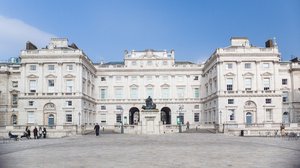
1525 · Oil On Panel · Courtauld Gallery, London

The figure of Saint Lawrence rises from a landscape of soft blues and distant, hazy mountains. He stands with a quiet, vertical strength, draped in the heavy folds of a white alb and an ornate dalmatic. Gold and ochre tones cling to his liturgical vestments, catching a light that feels diffused and steady. He does not look away from the viewer but remains anchored in a moment of sacred stillness.…

5
Interior with a company at the table and music-making satyrs (1545) af Girolamo Da Santacroce

Interior with a company at the table and music-making satyrs

1545 · Oil On Panel · Bonnefanten Museum, Maastricht

A round table sits at the center of a crowded room, draped in a white cloth that catches the light. Around it, human figures dine, their movements caught in a moment of festive excess. The air feels heavy with the scent of wine and the sound of unseen instruments. In the foreground, satyrs with muscular, organic forms provide a rhythmic counterpoint to the diners, their bodies twisting in a dance…

6
The Annunciation to Mary (1545) af Girolamo Da Santacroce

The Annunciation to Mary

1545 · Oil On Panel · Gemäldegalerie, Berlin

In this oil on panel composition, we find ourselves within a quiet, structured interior where the terrestrial and the celestial meet. The scene captures the precise instant of the Annunciation, a moment of profound stillness and movement. On the left, the Archangel Gabriel enters with a sense of dynamic purpose, wings spread as he approaches the Virgin Mary. She is depicted in a posture of prayerful acceptance, her arms crossed…

7
The Coronation of virgin Mary (1545) af Girolamo Da Santacroce

The Coronation of virgin Mary

1545 · Oil On Panel · Gemäldegalerie, Berlin

In this Renaissance-style religious painting, the celestial realm unfolds before us. The Coronation of virgin Mary by Girolamo Da Santacroce captures a divine moment of transition and grace. Around about 1545, the artist Girolamo Da Santacroce rendered this sacred event, placing the viewer directly into a scene of heavenly adoration. The Virgin Mary sits on the left, her hands crossed over her chest in a quiet gesture of humility. To…

8
Virgin and Child Enthroned (1516) af Girolamo Da Santacroce

Virgin and Child Enthroned

1516 · Tempera On Panel · Art Institute of Chicago, Chicago

In this 1516 composition, the Virgin Mary is seated upon a structured architectural throne, cradling the Christ Child. The arrangement follows a formal, symmetrical pattern, focusing the viewer's attention on the intimate connection between mother and child. Deep crimson and navy blue tones dominate the drapery, which falls in heavy, sculptural folds to suggest physical weight and volume. Behind the figures, a soft blue sky and white clouds provide a…

9
The Adoration of the Three Kings af Girolamo Da Santacroce

The Adoration of the Three Kings

Oil · Walters Art Museum, Baltimore

The scene unfolds in an outdoor setting where a group of fourteen figures gathers around a central infant. This assembly, composed of adults and children, is caught in a moment of profound reverence. Some figures kneel in devotion while others stand, their attention fixed upon the child. A horse rests to the left, grounding the spiritual event in a tangible, earthly reality. The composition is punctuated by small natural details,…

10
The Martyrdom of Saint Lawrence (1555) af Girolamo Da Santacroce

The Martyrdom of Saint Lawrence

1555 · Oil · Nelson-Atkins Museum of Art, Kansas City

The scene unfolds through a painting titled The Martyrdom of Saint Lawrence. Girolamo Da Santacroce captures this intense moment of faith and suffering, rendering the heavy textures of the oil to bring the narrative to life. The work dates to about 1555, a period when the artist was deeply immersed in the visual language of the Venetian tradition. Every brushstroke works to ground this sacred event in a tangible, earthly…

Girolamo Da Santacroces malerier, rangeret fra 11 til 28

Motiverne, der fangede Girolamo Da Santacroces blik

De fire motiver, der optræder hyppigst i disse originaler, hver med sit fineste eksempel.

De museer, der udstiller Girolamo Da Santacroces originalværker

De 8 museer, der rummer flest af malerierne på denne side.

Museum By Værker af Girolamo Da Santacroce Malerier fra denne liste
Gemäldegalerie, BerlinGemäldegalerie Berlin 4 The Annunciation to Mary, The Coronation of virgin Mary, The Crucifixion of Christ
Bonnefanten Museum, MaastrichtBonnefanten Museum Maastricht 2 Interior with a company at the table and music-making satyrs, Saint John the Baptist
The Phillips Collection, Washington, D.C.The Phillips Collection Washington, D.C. 2 Landscape with Rider, Landscape with Rider
National Gallery, LondonNational Gallery London 2 A youthful saint reading, A Saint with a Fortress and a Banner
Rijksmuseum, AmsterdamRijksmuseum Amsterdam 1 Young Mercury Stealing Cattle from Apollo's Herd
Szépművészeti Múzeum, BudapestSzépművészeti Múzeum Budapest 1 St John the Baptist
Northants, NorthamptonNorthants Northampton 1 The Virgin and Child with Saint Stephen and Saint Lawrence
Courtauld Gallery, LondonCourtauld Gallery London 1 Saint Lawrence

Girolamo Da Santacroce, ét signaturmaleri per årti

Værker per årti

Vælg et årti for at se det originale værk, der definerer det.

Girolamo Da Santacroce's malerier: galleriets svar

Hvilket maleri af Girolamo Da Santacroce er det mest berømte af alle?Vis svaret

Young Mercury Stealing Cattle from Apollo's Herd (1540), Rijksmuseum, Amsterdam. Derefter følger St John the Baptist (1500) og The Virgin and Child with Saint Stephen and Saint Lawrence (1502).

Hvor gammel var Girolamo Da Santacroce, da Young Mercury Stealing Cattle from Apollo's Herd blev færdiggjort?Vis svaret

60 år gammel: Young Mercury Stealing Cattle from Apollo's Herd er fra 1540, og Girolamo Da Santacroce blev født i 1480.

Hvilke er Girolamo Da Santacroces top 10 malerier?Vis svaret

Young Mercury Stealing Cattle from Apollo's Herd, St John the Baptist, The Virgin and Child with Saint Stephen and Saint Lawrence, Saint Lawrence, Interior with a company at the table and music-making satyrs, The Annunciation to Mary, The Coronation of virgin Mary, Virgin and Child Enthroned, The Adoration of the Three Kings og The Martyrdom of Saint Lawrence. Ranglisten ovenfor viser det enkelte værks årstal og museum.

Hvor mange værker skabte Girolamo Da Santacroce?Vis svaret

Vores katalog indeholder 31 værker af Girolamo Da Santacroce, dateret fra 1500 til 1555.

Hvor hænger Girolamo Da Santacroces mest berømte originaler?Vis svaret

Primært i Gemäldegalerie (Berlin), Bonnefanten Museum (Maastricht) og The Phillips Collection (Washington, D.C.). Museumslisten ovenfor viser dem alle.

Hvornår skabte Girolamo Da Santacroce sine mest berømte malerier?Vis svaret

I 1540s: 4 af de 28 værker på denne side blev skabt dengang, herunder Young Mercury Stealing Cattle from Apollo's Herd.

Hvilke er Girolamo Da Santacroces tidligste og seneste berømte værker?Vis svaret

På denne side er det tidligste St John the Baptist (1500) og det seneste The Martyrdom of Saint Lawrence (1555).

Hvilke motiver vendte Girolamo Da Santacroce oftest tilbage til?Vis svaret

Landscape (7), Clouds (4) og Blue sky (4), fordelt på de 28 værker på denne side.

Hvilket medie arbejdede Girolamo Da Santacroce mest med?Vis svaret

Oil On Panel, for 6 af de 28 værker på denne side.

Hvilken stilart er Girolamo Da Santacroce associeret med?Vis svaret

Renaissance, baseret på originalerne på denne side.

Hvilke originalværker af Girolamo Da Santacroce findes i Gemäldegalerie?Vis svaret

The Annunciation to Mary, The Coronation of virgin Mary og The Crucifixion of Christ: Gemäldegalerie, Berlin har 4 af værkerne på denne side.

Girolamo Da Santacroce: kunstneren

The Venetian Legacy of Girolamo da Santacroce

In the luminous heart of the Venetian Renaissance, where the light of the lagoons dances upon canvas, the name Girolamo da Santacroce resonates as a testament to the profound power of artistic lineage and devotion. Born in Bergamo around 1480, Santacroce’s journey was one intimately entwined with the very fabric of the Venetian school. His early years were shaped by an extraordinary apprenticeship under the venerable Gentile Bellini, a connection so significant that it transcended mere instruction; upon Bellini's passing in 1507, Santacroce was bequeathed half of the master's precious Oriental drawings. This inheritance provided him with a unique window into diverse aesthetic worlds, fueling a lifelong fascination with intricate detail and cross-cultural visual narratives.

As he navigated the bustling workshops of Venice, Santaciente did not merely observe from the periphery but immersed himself in the creative currents alongside giants such as Giovanni Bellini and Cima da Conegliano. This period of formative apprenticeship allowed him to absorb the subtle nuances of Venetian color and the atmospheric depth that would become hallmarks of his era. His work, while often characterized by its role in reproducing the masterpieces of his contemporaries, reveals a profound understanding of the High Renaissance spirit—a period where the boundaries between imitation and innovation were beautifully blurred.

A Master of Mimicry and Emotional Depth

To speak of Santacroce is to speak of a master of the reproduction, yet to dismiss him as a mere copyist would be to overlook the technical brilliance required to breathe life into the works of others. He was a prolific chronicler of the Venetian style, producing numerous canvases after the legendary Titian and Palma Vecchio. Through these works, he captured the dramatic lighting and muscular vitality of Titian, alongside the elegant, lyrical figures characteristic of Palma Vecchio. His ability to translate the heavy textures of oil and the subtle gradations of skin tones allowed him to participate in a vital artistic discourse, ensuring that the stylistic triumphs of the great masters were documented and disseminated throughout the mainland.

Beyond the technicality of his copies, Santacroce’s original contributions and his interpretations possess a distinct warmth. His canvases often pulsate with a certain sensuality and emotional resonance, particularly in his religious compositions. Whether depicting the serene beauty of a Madonna or the harrowing intensity of a martyrdom, he utilized a rich color palette and a masterful command of light to evoke deep spiritual contemplation. In works such as The Adoration of the Three Kings, one can observe a meticulous attention to the natural world—the delicate rendering of birds on a branch or the rugged texture of stone—which grounds his sacred narratives in a tangible, earthly reality.

Historical Significance and Enduring Presence

The historical importance of Girolamo da Santacroce lies in his role as a vital link in the chain of Venetian art history. He was an active participant in the evolution of the Renaissance, acting as both a student of the old guard and a bridge to the burgeoning styles of the mid-16th century. His dedication to the faithful recreation of masterpieces served a dual purpose: it functioned as a rigorous training ground for the workshop system and acted as a preservation of the Venetian aesthetic during a period of rapid stylistic change.

Though some scholarly debates persist regarding the exact attribution of certain works—particularly when distinguishing his hand from other artists of similar names in Naples—his footprint in the Venetian mainland remains indelible. His legacy is found in the museums that house his treasures, such as the Museo Civico di Vicenza and The Walters Art Museum, where his paintings continue to offer modern viewers a window into the soul of the Renaissance. Through his brush, the grandeur of the Venetian masters was not only preserved but reimagined, ensuring that the brilliance of the 16th century continues to illuminate the halls of art history.