


1


Opdateret november 2026 · rangeret efter vores popularitetsscore (søgninger, besøg og ordrer for hvert værk) · 30 værker af George Henry Hall i vores katalog
Kort sagt
I galleriets øjne er George Henry Halls mest berømte maleri Victorian Arrangement (1864). Still LIfe with Flowers: Red Roses (1861) og Miranda (from "The Tempest") (1856) fuldender trioen, som ethvert øje genkender. Ud af de 30 værker af George Henry Hall i vores katalog præsenterer galleriet herunder de 29 mest berømte, hver som et originalværk med årstal, museum og det, der gør det unikt.


A single female figure occupies the center of this oil on canvas, positioned against a turbulent landscape of churning sea and dark mountains. The woman, identified as Miranda, is depicted from the knees up, her body angled toward the left while her gaze is directed downward. Her expression is one of melancholy. She wears a garment of dark tones, contrasted by a yellow-gold veil that billows in the wind, sweeping…


is a vibrant and dramatic still life painting featuring a bouquet of flowers arranged in a tall, slender metallic vase against a dark, moody background. The composition is centered and vertically oriented, utilizing a high-contrast color palette of deep blue, bright white, and vivid red to evoke a sense of patriotism. The use of light is focused on the central floral cluster, creating a strong chiaroscuro effect that pulls the…

There is a profound stillness in this 1866 oil on canvas. A solitary peach rests upon a dark, reflective surface, its presence commanding the space through a soft, focused light. The composition is intimate, pulling the viewer into a private moment of observation. The peach itself is rendered with a luminous quality, its skin transitioning through shades of cream, pale pink, and warm yellow. This light does not merely hit…

 Young Girl with Fruit and Flowers1854
12
 Hanging Grapes1863
13
 Peaches, Grapes and Cherries1865 · Brooklyn Museum
14
 A Peach, Seville1866
15
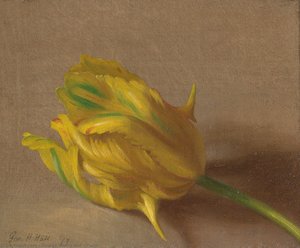 Tulip1869 · National Gallery of Art
16
 Still Life with Flowers and Strawberries1868
17
 Rug Bazaar, Cairo1877
18
 Lemons1884 · National Gallery of Art
19
 A Pomegranate, Siena1885 · National Gallery of Art
20
 The Turners Shop, Palensville, Catskill Mountains1879
21
 The Twins, Chianti Grapes1885
22
 Grapes on a Tabletop1888
23
 Peaches and Grapes1890
24
 Peaches and Grapes on a Tabletop1888
25
 La Feria de Jueves (The Thursday Fair of Seville)Rhode Island School of Design Museum of Art
26
 Bouquet of Raspberries
27
 Grapes and Peach
28
 The Pomegranate
29
 Still Life: Pink Rose in a Green Vase
De fire motiver, der optræder hyppigst i disse originaler, hver med sit fineste eksempel.
De 8 museer, der rummer flest af malerierne på denne side.
| Museum | By | Værker af George Henry Hall | Malerier fra denne liste |
|---|---|---|---|
 National Gallery of Art |
Washington | 4 | A Peach, Seville, Tulip, Lemons |
 Smithsonian American Art Museum |
Washington, D.C. | 1 | Miranda (from "The Tempest") |
 Georgia Museum of Art |
Athen | 1 | Boys Pilferings Molasses |
 Museum of Fine Arts |
Boston | 1 | Roman Wine Cart |
 National Academy of Design |
New York City | 1 | A Dead Rabbit |
 Detroit Institute of Arts |
Detroit | 1 | Patriotic Bouquet |
 Harvard Art Museums |
Cambridge | 1 | Grapes, Rome |
 Brooklyn Museum |
Brooklyn | 1 | Peaches, Grapes and Cherries |
Vælg et årti for at se det originale værk, der definerer det.
A single female figure occupies the center of this oil on canvas, positioned against a turbulent landscape of churning sea and dark mountains. The woman, identified as Miranda, is depicted from the knees up, her body angled toward the left while her gaze is directed downward. Her expression is one of melancholy. She wears a garment of dark tones, contrasted by a yellow-gold veil that billows in the wind, sweeping…


Victorian Arrangement (1864). Derefter følger Still LIfe with Flowers: Red Roses (1861) og Miranda (from "The Tempest") (1856).
39 år gammel: Victorian Arrangement er fra 1864, og George Henry Hall blev født i 1825.
Victorian Arrangement, Still LIfe with Flowers: Red Roses, Miranda (from "The Tempest"), Boys Pilferings Molasses, Roman Wine Cart, A Dead Rabbit, In a Rug Bazaar, Cairo, Patriotic Bouquet, A Peach, Seville og Grapes, Rome. Ranglisten ovenfor viser det enkelte værks årstal og museum.
Vores katalog indeholder 30 værker af George Henry Hall, dateret fra 1851 til 1890.
Primært i National Gallery of Art (Washington), Smithsonian American Art Museum (Washington, D.C.) og Georgia Museum of Art (Athen). Museumslisten ovenfor viser dem alle.
I 1860s: 9 af de 29 værker på denne side blev skabt dengang, herunder Victorian Arrangement.
På denne side er det tidligste Roman Wine Cart (1851) og det seneste Peaches and Grapes (1890).
Flowers (5), Life (3) og Vase (2), fordelt på de 29 værker på denne side.
Oil On Canvas, for 2 af de 29 værker på denne side.
Realism, baseret på originalerne på denne side.
A Peach, Seville, Tulip og Lemons: National Gallery of Art, Washington har 4 af værkerne på denne side.
To step into the world of George Henry Hall is to enter a realm where time slows, and the ephemeral beauty of the natural world is captured with breathtaking permanence. Born in 1825, Hall was an artist whose life spanned the transformative decades of the nineteenth century, bridging the gap between American roots and European refinement. While his origins are often traced to Manchester, New Hampshire, and his early years were shaped by the cultural landscape of Boston, his artistic soul was forged in the great academies of Europe. His journey took him through the prestigious studios of Düsseldorf and Paris, allowing him to absorb the rigorous technical discipline of German realism and the atmospheric elegance of French painting. This international odyssey endowed his work with a unique versatility, making him one of the most respected still-life painters of his era, capable of rendering the simplest piece of fruit with the dignity of a classical masterpiece.
The essence of Hall’s artistry lies in his profound ability to marry scientific observation with Romantic sentiment. Influenced heavily by the writings of John Ruskin, Hall embraced a philosophy that sought truth in nature through meticulous detail and moral beauty. This influence is palpable in his approach to composition; he did not merely paint objects, but rather staged them within environments that felt alive and breathing. Whether he was depicting the rugged charm of a blacksmith's workshop in the Catskills or the delicate arrangement of Mediterranean flora, there is always an underlying sense of verisimilitude—a commitment to representing the world as it truly appears under the shifting play of light. His technique involved sophisticated glazing methods that allowed light to penetrate layers of oil paint, creating a luminous, inner glow that makes his peaches appear succulent and his grapes appear heavy with juice.
Hall’s oeuvre is a testament to the Victorian fascination with the tactile and the transient. He possessed an uncanny knack for capturing textures that invite the viewer to reach out and touch the canvas. In his celebrated still lifes, one can almost feel the velvet skin of a ripening peach or the cool, waxy surface of a leaf. This mastery extended beyond mere imitation; it was an exploration of symbolism and vitality. His paintings often served as celebrations of abundance and the fleeting perfection of the harvest. By placing his subjects in outdoor, natural settings rather than sterile studio interiors, he infused his still lifes with a sense of atmosphere, suggesting that these beautiful objects were part of a larger, interconnected ecosystem of light, air, and earth.
Throughout his prolific career, Hall achieved significant milestones that cemented his place in the annals of art history:
Ultimately, the historical significance of George Henry Hall resides in his ability to capture the spirit of an age. He lived through a period where the world was expanding through scientific discovery and industrial progress, yet he chose to focus his lens on the enduring, quiet wonders of the natural world. His paintings remain much more than mere records of botanical specimens; they are emotional evocations of peace, prosperity, and the sublime beauty found in the smallest details of life. Today, his works continue to enchant collectors and historians alike, serving as luminous windows into the heart of the nineteenth century.

