Early Life, Family and Training
Paris, 1861. George Desvallières enters a world shaped by academic tradition. He carries the lineage of the artist Gabriel-Marie Legouvé, a man who achieved the status of academician. This connection to established art circles is woven into his very beginning. His upbringing is defined by religious instruction, a foundation that settles deep within his early years.
The path toward formal mastery begins in the studios of Paris. Desvallières enters the Académie Julian, placing himself under the guidance of Tony Robert-Fleury. The training is rigorous. He moves from these lessons to the École des Beaux-Arts, where the instruction shifts to the hand of Jules Valadon. These years of study form the technical bedrock of his career, grounding his developing vision in the disciplined methods of the French tradition.
Artistic Style and Religious Interests
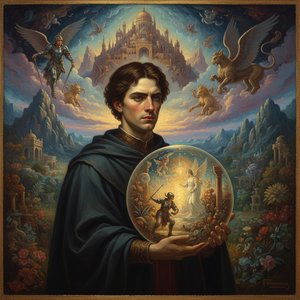
A shift occurs through a relationship with Gustave Moreau. This connection pulls Desvallières away from his early portraiture and toward the realms of mythology and religion. The focus narrows onto the spiritual and the symbolic. He begins to construct a visual language defined by dark subjects and violent color. This approach creates a dramatic conception of religion, moving far from traditional academic restraint.
The Symbolist movement finds its footing in his compositions. He populates his canvases with various symbolist characters, seeking to capture the essence of myth through heavy, emotive strokes. His work avoids the purely decorative, opting instead for a tension between light and shadow that mirrors the intensity of his chosen themes.
In 1919, the focus turns toward institutional renewal. Desvallières joins Maurice Denis to found the Ateliers d'Art Sacré. This initiative seeks to revitalize interest in religious art, functioning much like the medieval artist studios of the Middle Ages. The atelier becomes a center for a renewed spiritual aesthetic, emphasizing the sacred through a modern, expressive lens.
War Years and Public Commissions
The Great War shifts the trajectory of Desvallières' life through personal tragedy. In 1915, his son is killed during the conflict, a loss that anchors his focus firmly toward religious art. He does not remain a mere observer of the violence; he commands a battalion in the Vosges. The war becomes a central theme in his output, manifesting in both public and private decorative programs that grapple with the scale of the devastation.
His work moves from the canvas to the architecture of memory. He tackles large-scale commissions, including stained glass windows for the Douaumont ossuary. His reach extends beyond French borders to a church in Pawtucket, Rhode Island. These works translate the heavy atmosphere of the era into glass and light. Until 1950, he continues to receive State commissions, maintaining a presence in the official artistic landscape of France.