The Scholar-Official’s Brush
Zhuang Jiongsheng stands as a luminous figure from the Qing Dynasty, an era where the boundaries between administrative duty and artistic expression were often beautifully blurred. Born in 1626 into a family deeply rooted in Confucian tradition, his life was shaped by the rigorous intellectual demands of the Imperial Examination system. This scholarly ascent was not merely a pursuit of status but a foundation for a profound aesthetic vision. As he navigated the intricate corridors of power within the imperial court, notably serving during the reign of Emperor ShIzu, Zhuang’s identity as a high-ranking official became inextricably linked to his mastery of the brush.His life reflected the dual ambitions of his age: a dedication to the stability of governance and an unyielding devotion to the spiritual truths found in nature. Through his administrative prowess, he contributed to the fabric of the Qing state, yet it was through his ink and paper that he achieved a form of immortality, leaving behind a legacy of breathtaking landscapes that continue to captivate the modern imagination.
Landscapes of the Soul
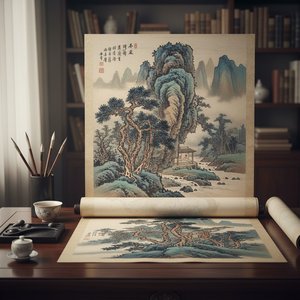
The artistry of Zhuang Jiongsheng is characterized by an exceptional sensitivity to the natural world, where every stroke serves as a bridge between the physical landscape and the metaphysical realm. Drawing deep inspiration from the venerable techniques of the Yuan Dynasty, he mastered the art of layering and tonal gradation to breathe life into his compositions. His works, such as the exquisite River Landscape preserved in the Metropolitan Museum of Art, reveal a profound understanding of atmosphere. Through meticulous observation, he captured serene mountain vistas bathed in soft, ethereal light, creating a sense of contemplative harmony that invites the viewer into a state of quietude.Within these landscapes, specific motifs emerge to tell a story of enduring virtue and cosmic order:
- Pine Trees: These resilient sentinels serve as symbols of longevity and steadfastness, embodying the Confucian ideal of strength through adversity.
- Mountain Vistas: The grandeur of the peaks reflects a Daoist appreciation for the sublime and the eternal rhythms of the universe.
- Water and Mist: The delicate use of ink to depict flowing rivers and drifting clouds creates a sense of depth, mirroring the fluid nature of existence itself.
A Legacy of Harmony
Beyond the technical brilliance of his brushwork, Zhuang Jiongsheng’s significance lies in his ability to synthesize the political and the poetic. His paintings are more than mere depictions of scenery; they are historical documents that capture the spirit of the mid-17th century through a lens of philosophical depth. By blending the meticulous detail required of an official with the spiritual fluidity of a Daoist sage, he created a body of work that transcends his era.His ability to employ layering and tonal gradation to create atmosphere allowed him to mirror the grandeur of the natural world, ensuring that his art remained a living, breathing entity. Today, his legacy continues to resonate, offering a window into a time when art was the ultimate expression of a life lived in pursuit of both earthly duty and heavenly harmony.
Spørgsmål & svar
Hvor kan man finde Full Name In English Not Provideds værker grupperet efter kunstretning?
De kunstretninger, som Full Name In English Not Provided arbejdede inden for, kan ses på kunstnerens Alle ismer-side, som grupperer værkerne efter kunstretning.
Kan jeg gennemse Full Name In English Not Provideds værker efter stemning?
Stemningsrum for Full Name In English Not Provided er en side, der arrangerer kunstnerens værker efter stemning.
Kan jeg gennemse Full Name In English Not Provideds værker efter medie?
Siden Alle medier grupperer Full Name In English Not Provideds værker efter teknik.