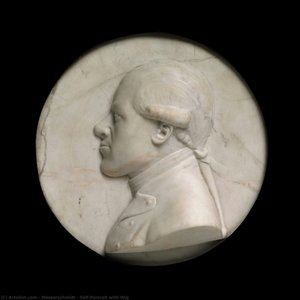
Portræt af Franz Xaver Messerschmidt

Franz Xaver Messerschmidt malerier: De 19 mest berømte, set gennem et galleris øjne

Opdateret november 2026 · rangeret efter vores popularitetsscore (søgninger, besøg og ordrer for hvert værk) · 24 værker af Franz Xaver Messerschmidt i vores katalog

Kort sagt

I galleriets øjne er Franz Xaver Messerschmidts mest berømte maleri Self-Portrait with Wig (1780), hvis original hænger på Szépművészeti Múzeum i Budapest. Self-Portrait: Laughing (1780) og The Yawner (1775) fuldender trioen, som ethvert øje genkender. Ud af de 24 værker af Franz Xaver Messerschmidt i vores katalog præsenterer galleriet herunder de 19 mest berømte, hver som et originalværk med årstal, museum og det, der gør det unikt.

1736 – 1783, Wiesensteig Neoclassicism Flest værker: Szépművészeti Múzeum

Galleriets top 10 Franz Xaver Messerschmidt malerier

1
Self-Portrait with Wig (1780) af Franz Xaver Messerschmidt

Self-Portrait with Wig

1780 · Marble · Szépművészeti Múzeum, Budapest

Franz Xaver Messerschmidt, a name often whispered in circles devoted to early Expressionism, remains an artist profoundly intriguing for his singular vision. Born into a lineage steeped in sculpting tradition – his family were renowned carvers in Bavaria – Messerschmidt didn’t simply inherit a craft; he seemed to wrestle with the very essence of human emotion, translating it into powerfully unsettling and intensely personal busts. His “Self-Portrait with Wig,” created…

2
Self-Portrait: Laughing (1780) af Franz Xaver Messerschmidt

Self-Portrait: Laughing

1780 · Sculpture · Szépművészeti Múzeum, Budapest

Franz Xaver Messerschmidt's "Self-Portrait: Laughing," created around 1780, is not merely a depiction of an artist; it’s a profound exploration of the human psyche rendered in the cool, enduring medium of marble. Born into a family steeped in sculpting tradition – his uncle, Johann Baptist Straub, instilled in him the fundamentals of carving – Messerschmidt quickly transcended mere technical skill to become a figure both celebrated and increasingly shadowed by…

3
The Yawner (1775) af Franz Xaver Messerschmidt

The Yawner

1775 · Marble · Kunstpalast, Düsseldorf

The Yawner is a work by Franz Xaver Messerschmidt, dated 1775. It belongs to the series of character heads that define the artist's most striking output. These studies focus on the expressive power of the human face through extreme physiognomic contortions.

4
Character Head: Childish Weeping (1783) af Franz Xaver Messerschmidt

Character Head: Childish Weeping

1783 · Bronze · Szépművészeti Múzeum, Budapest

In the quiet, somber depths of Franz Xaver Messerschmidt’s “Character Head: Childish Weeping,” one encounters more than a mere sculpture; one meets a profound psychological confrontation. Created in 1783, this bronze bust serves as a haunting window into the human soul, capturing a moment of raw, unadulterated sorrow that transcends the boundaries of its era. While many sculptors of the late eighteenth century sought to immortalize the idealized grace of…

5
Character Head: Quiet, Peaceful Sleep (1783) af Franz Xaver Messerschmidt

Character Head: Quiet, Peaceful Sleep

1783 · Bronze · Szépművészeti Múzeum, Budapest

The bronze bust titled Character Head: Quiet, Peaceful Sleep emerges from the shadows of history, a singular creation by the artist Franz Xaver Messerschmidt. This sculpture, dating to 1783, captures a man's head and upper shoulders in a moment of profound stillness. The metal holds the form of a face surrendered to rest, frozen in a state of deep relaxation. It is a quiet departure from the more turbulent expressions…

6
Portrait of a Woman af Franz Xaver Messerschmidt

Portrait of a Woman

Sculpture · Bratislava City Gallery, Bratislava

In this portrait, we find ourselves observing a sculpted bust of a woman, captured within the soft, circular confines of a frame. The work presents a study in monochromatic restraint, relying on a palette of grays, whites, and blacks to define the contours of the human form. There is a certain stillness here, a composure that suggests a moment of dignified reflection. The lighting is diffused, washing over the surface…

7
Character Head: The Yawner (1783) af Franz Xaver Messerschmidt

Character Head: The Yawner

1783 · Bronze · Szépművészeti Múzeum, Budapest

Franz Xaver Messerschmidt's "Character Head: The Yawner," created in 1783, isn’t merely a sculpture; it’s an excavation of the human psyche. Born in Bavaria during a period of shifting artistic sensibilities—bridging the Baroque’s grandeur with the nascent Neoclassicism—Messerschmidt carved out a singular path, driven by a profound fascination with capturing raw emotion through his art. This particular piece, rendered in bronze, stands as one of his most arresting “Character Heads,”…

9
Character Head: The Hanged (1770) af Franz Xaver Messerschmidt

Character Head: The Hanged

1770 · Sculpture · Østrigske Galerie Belvedere, Wien

Franz Xaver Messerschmidt's "Character Head: The Hanged," crafted in 1770-83 from alabaster, stands as a profoundly unsettling and remarkably prescient work of art. More than simply a sculpture, it’s a psychological portrait rendered in stone—a glimpse into the turbulent inner world of an artist grappling with his own anxieties and perhaps, foreshadowing the rise of Expressionism nearly a century before its formal emergence. The piece isn't merely aesthetically pleasing; it…

10
Character Head: The Beaked (1770) af Franz Xaver Messerschmidt

Character Head: The Beaked

1770 · Sculpture · Österreichische Galerie Belvedere, Wien

Franz Xaver Messerschmidt's "Character Head: The Beaked," sculpted in alabaster around 1770, isn’t merely a portrait; it’s an arresting distillation of human emotion rendered with unsettling precision. This small, yet profoundly impactful sculpture offers a rare glimpse into the mind of a man grappling with psychological turmoil and a unique artistic vision—a vision that anticipated elements of Expressionism by nearly a century. The piece immediately commands attention, not through grand…

Franz Xaver Messerschmidts malerier, rangeret fra 11 til 19

Franz Xaver Messerschmidts berømte malerier, periode for periode

Motiverne, der fangede Franz Xaver Messerschmidts blik

De fire motiver, der optræder hyppigst i disse originaler, hver med sit fineste eksempel.

De museer, der udstiller Franz Xaver Messerschmidts originalværker

De 6 museer, der rummer flest af malerierne på denne side.

Museum By Værker af Franz Xaver Messerschmidt Malerier fra denne liste
Szépművészeti Múzeum, BudapestSzépművészeti Múzeum Budapest 5 Self-Portrait with Wig, Self-Portrait: Laughing, Character Head: Childish Weeping
Bratislava City Gallery, BratislavaBratislava City Gallery Bratislava 3 Portrait of a Woman, Portrait of a Man, The Capuchin
Østrigske Galerie Belvedere, WienØstrigske Galerie Belvedere Wien 2 Character Head: The Lecher, Character Head: The Hanged
Liechtenstein Museum, WienLiechtenstein Museum Wien 2 Elijah Increases the Oil of the Widow, Elijah Increases the Oil of the Widow (detail)
Kunstpalast, DüsseldorfKunstpalast Düsseldorf 1 The Yawner
Österreichische Galerie Belvedere, WienÖsterreichische Galerie Belvedere Wien 1 Character Head: The Beaked

Franz Xaver Messerschmidt, årets signaturmalerier

Franz Xaver Messerschmidts karriere på denne side strækker sig over 14 år, fra 1770 til 1783: hvert år vises her med de mest berømte originalværker.

Værker per år

Vælg et årstal for at se de originale værker.

Franz Xaver Messerschmidt's malerier: galleriets svar

Hvilket maleri af Franz Xaver Messerschmidt er det mest berømte af alle?Vis svaret

Self-Portrait with Wig (1780), Szépművészeti Múzeum, Budapest. Derefter følger Self-Portrait: Laughing (1780) og The Yawner (1775).

Hvor gammel var Franz Xaver Messerschmidt, da Self-Portrait with Wig blev færdiggjort?Vis svaret

44 år gammel: Self-Portrait with Wig er fra 1780, og Franz Xaver Messerschmidt blev født i 1736.

Hvilke er Franz Xaver Messerschmidts top 10 malerier?Vis svaret

Self-Portrait with Wig, Self-Portrait: Laughing, The Yawner, Character Head: Childish Weeping, Character Head: Quiet, Peaceful Sleep, Portrait of a Woman, Character Head: The Yawner, Character Head: The Lecher, Character Head: The Hanged og Character Head: The Beaked. Ranglisten ovenfor viser det enkelte værks årstal og museum.

Hvor mange værker skabte Franz Xaver Messerschmidt?Vis svaret

Vores katalog indeholder 24 værker af Franz Xaver Messerschmidt, dateret fra 1770 til 1783.

Hvor hænger Franz Xaver Messerschmidts mest berømte originaler?Vis svaret

Primært i Szépművészeti Múzeum (Budapest), Bratislava City Gallery (Bratislava) og Østrigske Galerie Belvedere (Wien). Museumslisten ovenfor viser dem alle.

Hvornår skabte Franz Xaver Messerschmidt sine mest berømte malerier?Vis svaret

I 1770: 3 af de 19 værker på denne side blev skabt dengang, herunder Character Head: The Lecher.

Hvilke er Franz Xaver Messerschmidts tidligste og seneste berømte værker?Vis svaret

På denne side er det tidligste Character Head: The Lecher (1770) og det seneste Character Head: Childish Weeping (1783).

Hvilke motiver vendte Franz Xaver Messerschmidt oftest tilbage til?Vis svaret

Sculpture (7), Baroque (3) og Human emotion (3), fordelt på de 19 værker på denne side.

Hvilket medie arbejdede Franz Xaver Messerschmidt mest med?Vis svaret

Marble, for 4 af de 19 værker på denne side.

Hvilken stilart er Franz Xaver Messerschmidt associeret med?Vis svaret

Neoclassicism, baseret på originalerne på denne side.

Hvilke originalværker af Franz Xaver Messerschmidt findes i Szépművészeti Múzeum?Vis svaret

Self-Portrait with Wig, Self-Portrait: Laughing og Character Head: Childish Weeping: Szépművészeti Múzeum, Budapest har 5 af værkerne på denne side.

Franz Xaver Messerschmidt: kunstneren

Franz Xaver Messerschmidt – Master sculptor of haunting 'Character Heads' – intensely expressive busts exploring human emotion & psychology. A unique precursor to Expressionism.

Franz Xaver Messerschmidt, born in the Bavarian village of Wiesensteig in 1736, occupies a singular and often unsettling position in the history of sculpture. He wasn’t merely a product of his time—a bridge between the opulent late Baroque and the emerging Neoclassical styles—but an artist who seemed to anticipate the emotional intensity of Expressionism nearly a century before its formal emergence. His life, marked by both artistic promise and increasing psychological turmoil, is inextricably linked to his most enduring legacy: the “Character Heads,” busts that capture human emotion in states of raw, almost unbearable intensity. Messerschmidt’s early training was steeped in family tradition; he first learned the craft under the tutelage of his uncle, Johann Baptist Straub, a sculptor working in Munich. This foundational period instilled in him a mastery of traditional techniques, which he further honed through apprenticeships with another uncle, Philipp Jakob Straub, in Graz, and later at the Academy of Fine Arts Vienna, where Jacob Schletterer guided his development. These early works demonstrate a clear proficiency in the prevailing Baroque style, particularly evident in commissions for Empress Maria Theresa—bronze busts and reliefs that adhered to the conventions of courtly representation favored by artists like Balthasar Ferdinand Moll. He was, initially, a sculptor very much *of* his time, skilled at portraying power and status with appropriate grandeur.

Early Years & Artistic Foundations

Born February 6, 1736, in the southwestern town of thence Bavarian Wiesensteig, located in the region of (now) Baden-Württemberg in Germany. Messerschmidt grew up in the Munich home of his uncle, Johann Baptist Straub, who became his first master. He spent two years in Graz, in the workshop of his other maternal uncle, Philipp Jakob Straub, and later at the Academy of Fine Arts Vienna, where Jacob Schletterer mentored him. These formative experiences instilled within him a profound understanding of Baroque sculptural conventions—the dramatic chiaroscuro, the idealized human form, and the meticulous attention to detail—influencing his subsequent artistic endeavors. His early commissions for Maria Theresa showcased this skill, producing impressive bronze busts and reliefs that upheld the standards of Habsburg courtly art. These works established Messerschmidt as a respected craftsman within the established artistic landscape of his era.

The Genesis of Disquiet: The Character Heads

Around 1769-1770, however, a dramatic shift began to occur in Messerschmidt’s artistic vision. While continuing to accept traditional portrait commissions—a testament to his adaptability and commercial acumen—he embarked on the creation of what would become his defining work—the “Character Heads.” These were not portraits in the conventional sense; they weren't intended to flatter or commemorate. Instead, they depicted faces contorted in extreme emotional expressions: laughter bordering on hysteria, grief etched into every line, grimaces of anguish and despair. The origins of this unsettling departure are complex, interwoven with both artistic experimentation and a deepening personal struggle. Accounts from the time, particularly those provided by Friedrich Nicolai following a visit to Messerschmidt in 1781, reveal an artist obsessed with capturing the full spectrum of human emotion—a preoccupation that would ultimately shape his entire oeuvre. Nicolai’s observations documented Messerschmidt's peculiar method: he would reportedly pinch his own lower ribs, observing the resulting facial contortions in a mirror and then attempting to replicate them in marble or bronze. This self-experimentation suggests a deliberate effort to access and portray authentic emotional states—a radical departure from the idealized representations favored by many of his contemporaries. Furthermore, Messerschmidt believed he was striving to represent all 64 “canonical grimaces” of the human face—a monumental undertaking that demanded an unprecedented level of anatomical precision and psychological insight. This ambition speaks to a deeper philosophical underpinning—a desire to understand and codify the fundamental expressions of humanity—reflecting influences from Hermetic teachings and a fascination with universal balance.

A Revolutionary Approach: Exploring Emotion Through Sculpture

The Character Heads represent a pivotal moment in Messerschmidt’s artistic trajectory, marking a decisive break from Baroque formalism and foreshadowing the expressive fervor of Expressionism. Unlike earlier sculptures designed to convey noble virtues or commemorate historical figures, these busts confronted viewers with visceral depictions of human suffering—a daring challenge to aesthetic conventions that demanded an uncompromising commitment to emotional truthfulness. The resulting sculptures are characterized by their unsettling realism—faces frozen in moments of intense emotion—and their masterful manipulation of sculptural form to communicate psychological states. Messerschmidt’s meticulous anatomical studies informed his work, ensuring accuracy while simultaneously serving as a vehicle for conveying profound feelings. He achieved this remarkable feat through subtle shifts in facial musculature and posture, creating images that resonate with an unsettling immediacy.

Later Years & Legacy

Following his expulsion from the Academy of Fine Arts in 1774—a consequence of his increasingly erratic behavior and unorthodox artistic methods—Messerschmidt retreated to Wiesensteig, where he continued to sculpt until his death in 1783. Despite facing financial hardship and social isolation, Messerschmidt remained steadfast in his pursuit of artistic excellence, producing a final series of Character Heads that embody the culmination of his lifelong fascination with human emotion. These sculptures—particularly those created during his later years—are considered among his most poignant and psychologically complex works. Ernst Kris’s groundbreaking analysis suggested that Messerschmidt's obsessive preoccupation with capturing emotional expression stemmed from paranoid delusions—a controversial interpretation that nevertheless underscores the profound influence of psychological turmoil on his artistic output. Nevertheless, Franz Xaver Messerschmidt’s legacy endures as a testament to the transformative potential of art—specifically its capacity to confront uncomfortable truths and explore the depths of human experience. His pioneering approach to sculptural expression continues to inspire artists today, cementing his place as a singular visionary whose work transcends stylistic boundaries and speaks directly to the enduring power of emotion. His contribution extends beyond individual artworks; he fundamentally altered the possibilities of sculptural representation—a legacy that secures his position as one of the most important sculptors of his time.