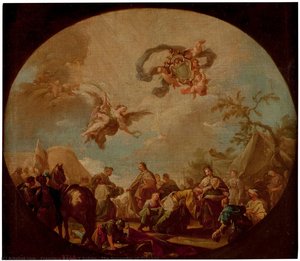
The Painter of Kings: The Life and Legacy of Francisco Bayeu y Subías
In the grand, sun-drenched corridors of 18th-century Spain, few names resonate with as much institutional prestige and technical mastery as Francisco Bayeu y Subías. Born in the historic city of Zaragoza in 1734, Bayeu emerged not merely as a painter, but as a central architect of the Spanish Neoclassical aesthetic. His journey from the provincial landscapes of Aragon to the opulent heart of the Royal Court in Madrid is a narrative of disciplined intellect and profound artistic evolution. Early training under José Luzán provided him with a foundation steeped in the dramatic, emotive traditions of the Italian Baroque, yet it was his encounter with the burgeoning Enlightenment ideals that would truly define his brushwork. Through his studies at the Academia Real de Bellas Artes de San Fernando, Bayeu began to shed the heavy shadows of the past in favor of a more luminous, structured clarity.
The trajectory of Bayeu’s career was irrevocily altered by the gravitational pull of Madrid’s artistic elite. Influenced heavily by the monumental presence of Anton Raphael Mengs and the airy, theatrical brilliance of Giovanni Battista Tiepolo, Bayeu learned to balance the weight of historical gravity with a delicate, idealized grace. This period of his life was marked by a transition toward Neoclassicism—a movement that demanded restraint, anatomical precision, and a return to the noble simplicity of antiquity. His talent was so undeniable that he was summoned to decorate the Royal Palace, a commission that placed him at the very epicenter of European power and culture. It was during this era of high courtly splendor that his life became inextricably linked with another titan of Spanish art; through his marriage to Josefa Bayeu, he formed a familial and professional bond with Francisco Goya, creating a creative nexus that would influence the direction of Spanish painting for decades.
A Mastery of Scale: From Royal Frescoes to Tapestry Design
Bayeu’s versatility was perhaps his greatest strength, allowing him to navigate between the intimate scale of portraiture and the overwhelming grandeur of architectural decoration. As the appointed Court Painter to King Charles III from 1767, he became a master of the multi-sensory environment. His work was not confined to canvas alone; he breathed life into the very walls of Spain’s most significant structures. His achievements include:
- Monumental Frescoes: Creating expansive ceiling decorations that transformed palace interiors into celestial realms, utilizing light and perspective to dissolve architectural boundaries.
- Tapestry Cartoons: Designing intricate, highly detailed preparatory paintings for the Royal Tapestry Factory, which translated fine art into woven narratives for the Spanish nobility.
- Religious Iconography: Executing profound altarpieces that maintained a sense of Neoclassical decorum while honoring the deep spiritual traditions of the Spanish Church.
- Historical Narratives: Crafting large-scale compositions that celebrated the triumphs and virtues of the Bourbon monarchy through idealized historical scenes.
The technical execution of his work often reflected a sophisticated "Flemish echo," blending the meticulous detail found in Northern traditions with the structural elegance of the Mediterranean. His ability to manage complex compositions involving numerous figures, while maintaining a sense of unified light and atmosphere, remains a testament to his rigorous academic training. Even as the art world began to shift toward the more turbulent and emotive styles of the late 18th century, Bayeu remained a steadfast guardian of order and clarity.
Historical Significance and the Twilight of an Era
The historical importance of Francisco Bayeu y Subías lies in his role as a bridge between eras. He stood at the crossroads where the lingering echoes of the Baroque met the disciplined dawn of Neoclassicism. While history often focuses on the revolutionary shadows of Goya, it was Bayeu who provided the structural and institutional framework within which much of this Spanish Golden Age flourished. His work in the Royal Palace served as a visual manifesto for the Enlightenment, projecting an image of a stable, enlightened, and culturally sophisticated monarchy.
As he navigated the complexities of court life until his death in 1795, Bayeu left behind a legacy of architectural integration and decorative excellence. He did not merely paint pictures; he designed environments. His influence can be felt in the way subsequent generations approached the concept of total art—where painting, architecture, and textile design converge to create a singular, immersive experience. Today, his oeuvre stands as a vital record of 18th-century Spanish identity, capturing a moment of profound transition, elegance, and intellectual rebirth.