Portræt af Ferran Cabrera i Cantó

Ferran Cabrera i Cantó malerier: De 16 mest berømte, set gennem et galleris øjne

Opdateret november 2026 · rangeret efter vores popularitetsscore (søgninger, besøg og ordrer for hvert værk) · 16 værker af Ferran Cabrera i Cantó i vores katalog

Kort sagt

I galleriets øjne er Ferran Cabrera i Cantós mest berømte maleri El Abismo. Escena en la Iglesia og Mujer del pintor fuldender trioen, som ethvert øje genkender. Ud af de 16 værker af Ferran Cabrera i Cantó i vores katalog præsenterer galleriet herunder de 16 mest berømte, hver som et originalværk med årstal, museum og det, der gør det unikt.

1866 – 1937, Alcoy

Galleriets top 10 Ferran Cabrera i Cantó malerier

1
El Abismo af Ferran Cabrera i Cantó

El Abismo

The composition is defined by a stark, monochromatic tension, utilizing a palette of deep blacks and jarring yellows to render a scene of profound human distress. Set against a coastal backdrop where the ocean meets the shore, the work captures a moment of acute instability. Figures are scattered across the terrain; some remain upright in states of agitation, while others lie prone, surrendered to the earth. Two boats, positioned at…

2
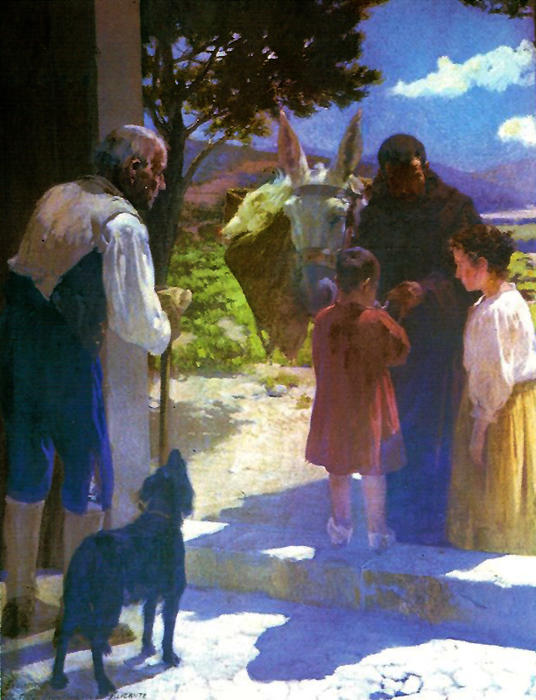
Escena en la Iglesia af Ferran Cabrera i Cantó

Escena en la Iglesia

The afternoon sun casts a gentle light over a peaceful scene unfolding before the stone facade of a church. A man moves through the space, leaning slightly on a cane, his blue trousers catching the light as he walks alongside his faithful dog. There is a sense of unhurried movement here, a moment caught in the middle of a communal pause. Nearby, an ox stands still, its heavy presence grounding…

3
Mujer del pintor af Ferran Cabrera i Cantó

Mujer del pintor

Oil On Canvas

The portrait depicts a seated woman, positioned centrally within the frame. Her upper body and face occupy the primary focus, while the background recedes into a soft, blurred expanse of foliage and atmospheric haze. The lighting is diffused, casting a gentle glow across the contours of her face and the folds of her clothing. Warm tones of yellow and ochre dominate the palette, creating a sense of luminosity that permeates…

4
Mujer Rezando af Ferran Cabrera i Cantó

Mujer Rezando

Oil On Canvas

A single light source descends from above, carving the subject out of a heavy, dark void. The woman sits at a table, her hands clasped in a silent plea. Shadows pool in the folds of her clothing and the hollows of her face, creating a sharp contrast that pulls the viewer into her private sanctuary. Beside her, a vase holds pink flowers, their soft petals offering the only hint of…

Ferran Cabrera i Cantós malerier, rangeret fra 11 til 16

Motiverne, der fangede Ferran Cabrera i Cantós blik

De fire motiver, der optræder hyppigst i disse originaler, hver med sit fineste eksempel.

Ferran Cabrera i Cantó's malerier: galleriets svar

Hvilket maleri af Ferran Cabrera i Cantó er det mest berømte af alle?Vis svaret

El Abismo. Derefter følger Escena en la Iglesia og Mujer del pintor.

Hvilke er Ferran Cabrera i Cantós top 10 malerier?Vis svaret

El Abismo, Escena en la Iglesia, Mujer del pintor, Mujer Rezando, Retrato de mujer, Paisaje con arbol, Paisaje Verde, Mujer Joven, Escena en el Jardin og Paisaje. Ranglisten ovenfor viser det enkelte værks årstal og museum.

Hvor mange værker skabte Ferran Cabrera i Cantó?Vis svaret

Vores katalog indeholder 16 værker af Ferran Cabrera i Cantó.

Hvilke motiver vendte Ferran Cabrera i Cantó oftest tilbage til?Vis svaret

People (2), Portrait (2) og Reflection (2), fordelt på de 16 værker på denne side.

Hvilket medie arbejdede Ferran Cabrera i Cantó mest med?Vis svaret

Oil On Canvas, for 2 af de 16 værker på denne side.

Ferran Cabrera i Cantó: kunstneren

The Genesis of a Spanish Master

Born amidst the cultural richness of Valencia in 1866, Fernando Cabrera Cantó embarked on an artistic journey that would eventually bridge the gap between the grounded reality of the late 19th century and the ethereal whispers of Symbolism. His early training at the Real Academia de Bellas Artes de San Carlos under Lorenzo Casanova provided a sturdy foundation, but it was his travels through Madrid and Italy—supported by the generosity of the Diputación provincial de Alicante—that truly expanded his visual vocabulary. This period of wandering and study allowed him to absorb the technical precision of Spanish realism while preparing his soul for the more decorative, flowing aesthetics of the burgeoning Art Nouveau movement.

A Tapestry of Light and Shadow

The brilliance of Cabrera Cantó lies in his remarkable ability to traverse the vast emotional landscape of the human condition. His oeuvre is a study in contrasts, where one might encounter the cheerful, sun-drenched satire of a genre scene only to be confronted by the darkly morbid or the profoundly contemplative. In works such as Mujer Rezando, he utilizes a delicate rendering and subtle light to capture moments of serene devotion, echoing the influence of masters like Fortuny and Pinazo. Conversely, his more somber compositions, such as Sermón soporífero, demonstrate a mastery of atmosphere, using heavy, contemplative tones to evoke a sense of solemnity that lingers in the viewer's mind long after the gaze has departed. Whether through the organic lines of Art Nouveau or the psychological depth of his portraits, his brushwork remains an intimate dialogue between the artist and the subject.

Legacy Beyond the Canvas

Beyond his individual canvases, Cabrera Cantó’s influence permeated the very architecture and education of his era. His collaboration with the architect Vicente Pascual Pastor in decorating the iconic Casa del Pavo stands as a testament to his ability to integrate fine art into the living fabric of the Art Nouveau landscape in Alcoy. Furthermore, his tenure as a teacher at the School of Arts and Crafts ensured that his technical prowess and philosophical approach to painting were passed down to a new generation of Spanish talent. His life’s work remains a vital link in the evolution of Spanish art, reminding us of a time when the boundaries between realism, decoration, and emotion were beautifully, inextricably blurred.