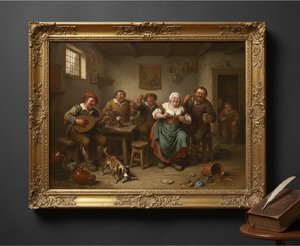
Egbert Lievensz van der Poel: Life & Legacy
Early Life and Family
- Born in Delft, Netherlands in 1621, Egbert van der Poel came from a family of artisans. His father was a goldsmith in Delft.
- He may have been related to the painter Adriaen Lievensz van der Poel, potentially as a brother.
- Early influences likely stemmed from his upbringing within a creative household and the artistic environment of Delft.
Artistic Training & Influences
- Van der Poel’s formal training remains somewhat unclear, but it is believed he studied under Esaias van de Velde and Aert van der Neer.
- Some sources suggest a period of study with Cornelis Saftleven in Rotterdam.
- These influences are visible in his landscapes, which demonstrate an attention to atmospheric effects and detailed rendering of natural elements.
Career & Guild Membership
- He registered with the Guild of St. Luke in Delft on October 17, 1650, identifying himself as a landscape painter.
- In 1651, he married Aeltgen Willems van Linschooten in Maassluis, near Rotterdam.
- He and his wife had one son and three daughters.
Major Works & Artistic Style
- The Delft Gunpowder Explosion of 1654 is undoubtedly Van der Poel’s most famous subject. He created several paintings depicting the event and its aftermath, offering a valuable historical record.
- His style blends genre scenes with landscape painting, often featuring dramatic lighting and detailed depictions of everyday life.
- Characteristic features include his use of impasto (thickly applied paint) to create texture and depth, particularly in fire scenes.
- He also painted night scenes, village fires, and interiors with still lifes.
Historical Significance & Legacy
- Van der Poel’s paintings provide a unique visual documentation of 17th-century Dutch life and the devastating impact of the Delft explosion.
- His work offers insights into the social, economic, and physical landscape of the Netherlands during the Golden Age.
- Although not as widely celebrated as some of his contemporaries, Van der Poel’s paintings are valued for their historical importance and artistic merit.
- He died in Rotterdam in 1664.
Spørgsmål & svar
Kan jeg studere Egbert Lievensz van der Poels farvebrug på tværs af alle værker?
Farvepalettens genom for Egbert Lievensz van der Poel er en side, der præsenterer farveprofilen i kunstnerens samlede værk.
Hvor kan man finde Egbert Lievensz van der Poels værker grupperet efter kunstretning?
De kunstretninger, som Egbert Lievensz van der Poel arbejdede inden for, kan ses på kunstnerens Alle ismer-side, som grupperer værkerne efter kunstretning.
I hvilken historisk periode arbejdede Egbert Lievensz van der Poel?
Egbert Lievensz van der Poel arbejdede i Early Modern-perioden. Perioden placerer kunstnerens virke i historien.