Portræt af Edward Lamson Henry

De 100 mest berømte Edward Lamson Henry-malerier, en galleriselektion

Opdateret november 2026 · rangeret efter vores popularitetsscore (søgninger, besøg og ordrer for hvert værk) · 106 værker af Edward Lamson Henry i vores katalog

Kort sagt

Af alle de originale værker, som Edward Lamson Henry efterlod, er det mest berømte Sir William Johnson Presenting Medals to the Indian Chiefs of the Six Nations at Johnstown, N.Y. (1903). Lige efter følger The Camden and Amboy Railroad with the Engine Planet'' in 1834'' (1904) og Saint George's Church, New York (1875). Vores katalog indeholder 106 værker af Edward Lamson Henry; galleriet har bevaret de 100 værker, som verden beundrer mest, hver vist med sin dato, sit museum og sin historie.

1841 – 1919, Charleston Realism Flest værker: Metropolitan Museum of Art

Edward Lamson Henrys top 10 malerier: galleriets udvalg

1
Sir William Johnson Presenting Medals to the Indian Chiefs of the Six Nations at Johnstown, N.Y. (1903) af Edward Lamson Henry

Sir William Johnson Presenting Medals to the Indian Chiefs of the Six Nations at Johnstown, N.Y.

1903 · Oil On Canvas

In this 1903 oil on canvas, Edward Lamson Henry captures a specific intersection of colonial diplomacy and indigenous leadership. The work, titled Sir William Johnson Presenting Medals to the Indian Chiefs of the Six Nations at Johnstown, N.Y., reconstructs a gathering from 1772. The scene focuses on a conference held at Johnson Hall, where Sir William Johnson meets with the Iroquois. It is a moment of formal recognition, frozen in…

2
The Camden and Amboy Railroad with the Engine Planet'' in 1834'' (1904) af Edward Lamson Henry

The Camden and Amboy Railroad with the Engine Planet'' in 1834''

1904 · Oil On Canvas

The steam and iron of a transformative era emerge through the brush of Edward Lamson Henry in his work, The Camden and Amboy Railroad with the Engine Planet'' in 1834''. Created in 1904, this piece looks back across the decades to capture a specific, bustling moment in American transit. The scene centers on the Camden and Amboy Railroad, frozen in the year 1834, as the engine known as the "Planet"…

3
Saint George's Church, New York (1875) af Edward Lamson Henry

Saint George's Church, New York

1875 · Lithograph · Metropolitan Museum of Art, New York

To stand before this evocative print is to step directly into the vibrant, yet sepia-toned, heart of New York City circa 1875. Edward Lamson Henry, through his masterful rendering, has gifted us more than just a depiction of architecture; he has captured the very breath of a bygone era. The composition centers unwaveringly on Saint George's Church, its spire piercing the hazy expanse as a beacon against the dense tapestry…

4
Westover, Virginia (1865) af Edward Lamson Henry

Westover, Virginia

1865 · Oil

The composition centers on a large red brick mansion characterized by white trim and a prominent steeple, which lends the structure the appearance of a church. A layer of white snow covers the ground, establishing a cold, wintry atmosphere across the landscape. In the foreground and middle ground, several horses are positioned near the house; some stand in close proximity to one another, while others are scattered across the snowy…

5
A Summer Day (1890) af Edward Lamson Henry

A Summer Day

1890 · Oil

In this 1890 composition, we find ourselves transported to a tranquil rural landscape, where the pace of life is dictated by the steady rhythm of hoofbeats on a dirt path. The scene captures a group of riders on horseback, moving leisurely through a sun-drenched country setting. There is a certain stillness here, despite the movement of the animals. A wagon rests in the distance, and a solitary chair sits near…

6
The Departure (1901) af Edward Lamson Henry

The Departure

1901 · Oil

The painting depicts a small town street populated by several figures on horseback. In the foreground, horses and riders move through the thoroughfare, some positioned closer to the viewer while others recede into the background. To the right, a carriage is parked or moving along the edge of the scene. A wooden bench sits in the middle of the composition, offering a stationary point amidst the movement. The architecture and…

7
Waiting for the Ferry (1906) af Edward Lamson Henry

Waiting for the Ferry

1906 · Watercolor

Waiting for the Ferry is a work by Edward Lamson Henry. Created about 1906, the piece reflects the artist's established interest in capturing specific moments of American life. Henry was born in 1841 and lived until May 9, 1919.

8
St. Mark's in the Bowery in the Early Forties (1917) af Edward Lamson Henry

St. Mark's in the Bowery in the Early Forties

1917

The scene captures a moment of urban movement near St. Mark's in the Bowery in New York City. Pedestrians navigate the grounds of the church, their figures scattered across the foreground and middle distance. The composition is anchored by the church's architecture, specifically a prominent clock tower that rises above the street-level activity. Horses and carriages, typical of the era, populate the thoroughfare, suggesting the rhythmic, animal-powered pulse of a…

9
A Philadelphia Doorway (1882) af Edward Lamson Henry

A Philadelphia Doorway

1882 · Olie på lærred · Yale University Art Gallery, Hartford

Edward Lamson Henry og "A Philadelphia Doorway": Nostalgiens Kunstner Edward Lamson Henry (1841–1919) var en amerikansk genremaler, født i Charleston, South Carolina. Selvom hans forældre døde tidligt, fandt han hjem i New York City sammen med familiemedlemmer og udviklede en unik stil præget af detaljeret observation og sentimentalitet – egenskaber der gjorde ham til en af sin tids mest populære kunstnere. Henry studerede ved Pennsylvania Academy of Fine Arts og…

10
Interior (1870) af Edward Lamson Henry

Interior

1870 · Oil · Smithsonian American Art Museum, Washington, D.C.

In Interior, Edward Lamson Henry invites us into a quiet, historical setting that feels deeply lived-in. The scene captures a subtle moment of interaction between two figures within an ornate room. To the left, a woman sits at a table near a large leaded-glass window, her form catching the bright, directional light that pours into the space. Opposite her, a man stands before a fireplace, his presence grounding the domestic…

Edward Lamson Henry-udvalget fortsætter, fra 11 til 100

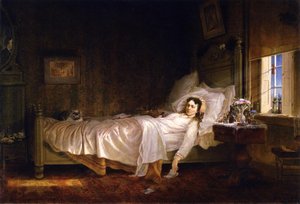
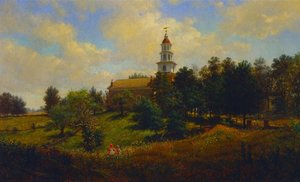
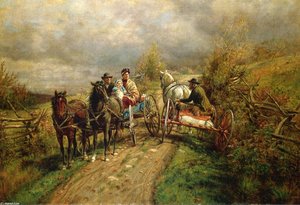
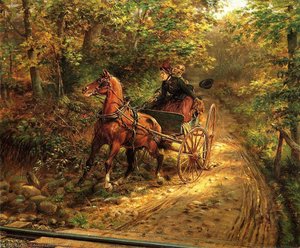
11A Carriage Ride (1885) af Edward Lamson HenryA Carriage Ride1885 · Metropolitan Museum of Art 12Country Breakfast (1884) af Edward Lamson HenryCountry Breakfast1884 · New Britain Museum of American Art 13Capital and Labor (1881) af Edward Lamson HenryCapital and Labor1881 · New York Historical Society 14Forty Winks (1880) af Edward Lamson HenryForty Winks1880 15East Hampton Beach (1880) af Edward Lamson HenryEast Hampton Beach1880 16Teatime (1890) af Edward Lamson HenryTeatime1890 · New Britain Museum of American Art 17Carriage Ride (1886) af Edward Lamson HenryCarriage Ride1886 18Stopping for a Chat (1889) af Edward Lamson HenryStopping for a Chat1889 19In The Shenandoah Valley (Off the Main Road) (1897) af Edward Lamson HenryIn The Shenandoah Valley (Off the Main Road)1897 · New Britain Museum of American Art 20The Ferry Crossing at Von Steuben Tavern (1909) af Edward Lamson HenryThe Ferry Crossing at Von Steuben Tavern1909 21Changing Horses (1880) af Edward Lamson HenryChanging Horses1880 22The North Dutch Church, Fulton and William Streets, New York (1869) af Edward Lamson HenryThe North Dutch Church, Fulton and William Streets, New York1869 · Metropolitan Museum of Art 23Village Squire Entertaining the New Minister af Edward Lamson HenryVillage Squire Entertaining the New Minister 24In the Roaring Forties (1884) af Edward Lamson HenryIn the Roaring Forties1884 25Parlor on Brooklyn Heights of Mr. and Mrs. John Ballard (1872) af Edward Lamson HenryParlor on Brooklyn Heights of Mr. and Mrs. John Ballard1872 26Moonlight Landscape with House (1860) af Edward Lamson HenryMoonlight Landscape with House1860 27A Chat after Meeting (1871) af Edward Lamson HenryA Chat after Meeting1871 28Descending the Stairs (1870) af Edward Lamson HenryDescending the Stairs1870 29On the James River, Virginia (1864) af Edward Lamson HenryOn the James River, Virginia1864 30The John Hancock House (1865) af Edward Lamson HenryThe John Hancock House1865 · Yale University Art Gallery 31The Invalid (1868) af Edward Lamson HenryThe Invalid1868 · Fogg Art Museum 32The Old Westover House (1869) af Edward Lamson HenryThe Old Westover House1869 · National Gallery of Art 33Drafting the Letter (1871) af Edward Lamson HenryDrafting the Letter1871 34Station on the Morris and Essex Railroad (1864) af Edward Lamson HenryStation on the Morris and Essex Railroad1864 35The Old Clock on the Stairs (1868) af Edward Lamson HenryThe Old Clock on the Stairs1868 36The Attack on Chew's House during the Battle of Germantown, 1777 (1878) af Edward Lamson HenryThe Attack on Chew's House during the Battle of Germantown, 17771878 · Art Institute of Chicago 37The Widower (1873) af Edward Lamson HenryThe Widower1873 · Smithsonian American Art Museum 38Can They Go Too. (1877) af Edward Lamson HenryCan They Go Too.1877 39Totally Absorbed (1874) af Edward Lamson HenryTotally Absorbed1874 40The Lafayette Reception (1874) af Edward Lamson HenryThe Lafayette Reception1874 41Examining Illustrations by the Fire (1872) af Edward Lamson HenryExamining Illustrations by the Fire1872 42City Point, Virginia, Headquarters of General Grant (1873) af Edward Lamson HenryCity Point, Virginia, Headquarters of General Grant1873 · Addison Gallery of American Art 43Le Paresseuse (also known as The Idle One) (1876) af Edward Lamson HenryLe Paresseuse (also known as The Idle One)1876 44The Old Dutch Church, Bruynswick (1878) af Edward Lamson HenryThe Old Dutch Church, Bruynswick1878 45The Meeting of General Washington and Rochambeau (1873) af Edward Lamson HenryThe Meeting of General Washington and Rochambeau1873 · Virginia Museum of Fine Arts 46Miss X and Sister (1884) af Edward Lamson HenryMiss X and Sister1884 47Still LIfe of Rhododendrons (1885) af Edward Lamson HenryStill LIfe of Rhododendrons1885 48The Little Flower Girl (1880) af Edward Lamson HenryThe Little Flower Girl1880 49Old Enemies (1885) af Edward Lamson HenryOld Enemies1885 50The Conversation (1882) af Edward Lamson HenryThe Conversation1882 51The Latest Village Scandal (1885) af Edward Lamson HenryThe Latest Village Scandal1885 52The King of the Montauks (1880) af Edward Lamson HenryThe King of the Montauks1880 · Detroit Institute of Arts 53Stagecoach (1881) af Edward Lamson HenryStagecoach1881 54The Sunny Hours of Childhood (1879) af Edward Lamson HenryThe Sunny Hours of Childhood1879 55On the Way to Market (1888) af Edward Lamson HenryOn the Way to Market1888 56The New Woman (1892) af Edward Lamson HenryThe New Woman1892 57Interior at Petworth (1886) af Edward Lamson HenryInterior at Petworth1886 58Horse and Buggy on Main Street (1889) af Edward Lamson HenryHorse and Buggy on Main Street1889 59A Country School (1890) af Edward Lamson HenryA Country School1890 · Yale University Art Gallery 60A Lover of Old China (1889) af Edward Lamson HenryA Lover of Old China1889 61A Virginia Wedding (1890) af Edward Lamson HenryA Virginia Wedding1890 62A Moment of Peril (1890) af Edward Lamson HenryA Moment of Peril1890 63Mrs. Lydig and Her Daughter Greeting Their Guest (1891) af Edward Lamson HenryMrs. Lydig and Her Daughter Greeting Their Guest1891 64Visit to the Plantation (1898) af Edward Lamson HenryVisit to the Plantation1898 65Return to the Farm (1895) af Edward Lamson HenryReturn to the Farm1895 66An Informal Call (1895) af Edward Lamson HenryAn Informal Call1895 67A Country Lawyer (1895) af Edward Lamson HenryA Country Lawyer1895 68Waiting for the Ferry, Shelter Island, New York (1895) af Edward Lamson HenryWaiting for the Ferry, Shelter Island, New York1895 69The Pillory and Whipping Post, New Castle, Delaware (1896) af Edward Lamson HenryThe Pillory and Whipping Post, New Castle, Delaware1896 70The Message (1893) af Edward Lamson HenryThe Message1893 · Fogg Art Museum 71Vespers (1898) af Edward Lamson HenryVespers1898 72A Stormy Morning (also known as Leaving in the Early Morn in a Nor’easter) (1899) af Edward Lamson HenryA Stormy Morning (also known as Leaving in the Early Morn in a Nor’easter)1899 73What's That You Say (1905) af Edward Lamson HenryWhat's That You Say1905 74One Sunday Afternoon (1902) af Edward Lamson HenryOne Sunday Afternoon1902 75An October Day (also known as Cragsmoor Post Office) (1903) af Edward Lamson HenryAn October Day (also known as Cragsmoor Post Office)1903 76Waiting for the Stagecoach (1905) af Edward Lamson HenryWaiting for the Stagecoach1905 77Passing the Outposts on the Old Kingsbridge Road (1903) af Edward Lamson HenryPassing the Outposts on the Old Kingsbridge Road1903 78The Homecoming (1899) af Edward Lamson HenryThe Homecoming1899 79Stopping to Water His Horse (1904) af Edward Lamson HenryStopping to Water His Horse1904 80Young Girl with a Parrot af Edward Lamson HenryYoung Girl with a Parrot 81Horse and Buggy af Edward Lamson HenryHorse and Buggy 82Scene along Delaware and Hudson Canal (1907) af Edward Lamson HenryScene along Delaware and Hudson Canal1907 83In East Tennessee (1906) af Edward Lamson HenryIn East Tennessee1906 84What Luck (1910) af Edward Lamson HenryWhat Luck1910 85What's the News. (also known as Stopping for a Chat) (1909) af Edward Lamson HenryWhat's the News. (also known as Stopping for a Chat)1909 86Unexpected Visitors (1909) af Edward Lamson HenryUnexpected Visitors1909 87Colonial Wedding (1911) af Edward Lamson HenryColonial Wedding1911 88St. John's Church, Varick Street, New York (1914) af Edward Lamson HenrySt. John's Church, Varick Street, New York1914 · New York Historical Society 89News of the War of 1812 (1913) af Edward Lamson HenryNews of the War of 18121913 90Gathering Flowers (1913) af Edward Lamson HenryGathering Flowers1913 91The Sitting Room (1883) af Edward Lamson HenryThe Sitting Room1883 92Memories (1873) af Edward Lamson HenryMemories1873 · Yale University Art Gallery 93Later Afternoon on the Old Delaware and Hudson Canal, at Port Ben, Ulster County, New York (1894) af Edward Lamson HenryLater Afternoon on the Old Delaware and Hudson Canal, at Port Ben, Ulster County, New York1894 94Going to Town af Edward Lamson HenryGoing to TownThe Phillips Collection 95Country Landscape af Edward Lamson HenryCountry Landscape 96Leaving Home af Edward Lamson HenryLeaving Home 97Nearing the Bend af Edward Lamson HenryNearing the Bend 98Coming Home af Edward Lamson HenryComing Home 99Early Days of Rapid Transit af Edward Lamson HenryEarly Days of Rapid Transit 100The Village Street af Edward Lamson HenryThe Village Street

Edward Lamson Henrys berømte malerier, periode for periode

Motiverne, der fangede Edward Lamson Henrys blik

De fire motiver, der optræder hyppigst i disse originaler, hver med sit fineste eksempel.

De museer, der udstiller Edward Lamson Henrys originalværker

De 8 museer, der rummer flest af malerierne på denne side.

Museum By Værker af Edward Lamson Henry Malerier fra denne liste
Metropolitan Museum of Art, New YorkMetropolitan Museum of Art New York 4 Saint George's Church, New York, A Carriage Ride, The North Dutch Church, Fulton and William Streets, New York
New Britain Museum of American Art, New BritainNew Britain Museum of American Art New Britain 3 Country Breakfast, Teatime, In The Shenandoah Valley (Off the Main Road)
Smithsonian American Art Museum, Washington, D.C.Smithsonian American Art Museum Washington, D.C. 4 Interior, The Widower
Yale University Art Gallery, HartfordYale University Art Gallery Hartford 2 A Philadelphia Doorway, Memories
New York Historical Society, New York CityNew York Historical Society New York City 2 Capital and Labor, St. John's Church, Varick Street, New York
Yale University Art Gallery, New HavenYale University Art Gallery New Haven 2 The John Hancock House, A Country School
Fogg Art Museum, CambridgeFogg Art Museum Cambridge 2 The Invalid, The Message
National Gallery of Art, WashingtonNational Gallery of Art Washington 1 The Old Westover House

Edward Lamson Henry årti for årti: det originale værk, der definerer hvert enkelt

Værker per årti

Vælg et årti for at se det originale værk, der definerer det.

Samleres spørgsmål om Edward Lamson Henrys malerier

Hvilket værk er Edward Lamson Henry mest kendt for?Vis svaret

Sir William Johnson Presenting Medals to the Indian Chiefs of the Six Nations at Johnstown, N.Y. (1903). Derefter følger The Camden and Amboy Railroad with the Engine Planet'' in 1834'' (1904) og Saint George's Church, New York (1875).

Hvor gammel var Edward Lamson Henry, da Sir William Johnson Presenting Medals to the Indian Chiefs of the Six Nations at Johnstown, N.Y. blev skabt?Vis svaret

62 år gammel: Sir William Johnson Presenting Medals to the Indian Chiefs of the Six Nations at Johnstown, N.Y. er fra 1903, og Edward Lamson Henry blev født i 1841.

Hvad er de ti mest berømte Edward Lamson Henry malerier?Vis svaret

Sir William Johnson Presenting Medals to the Indian Chiefs of the Six Nations at Johnstown, N.Y., The Camden and Amboy Railroad with the Engine Planet'' in 1834'', Saint George's Church, New York, Westover, Virginia, A Summer Day, The Departure, Waiting for the Ferry, St. Mark's in the Bowery in the Early Forties, A Philadelphia Doorway og Interior. Ranglisten ovenfor viser det enkelte værks årstal og museum.

Hvor mange malerier efterlod Edward Lamson Henry?Vis svaret

Vores katalog indeholder 106 værker af Edward Lamson Henry, dateret fra 1860 til 1917.

I hvilke museer udstilles Edward Lamson Henry's mesterværker?Vis svaret

Primært i Metropolitan Museum of Art (New York), New Britain Museum of American Art (New Britain) og Smithsonian American Art Museum (Washington, D.C.). Museumslisten ovenfor viser dem alle.

I hvilke år malede Edward Lamson Henry sine mest berømte værker?Vis svaret

I 1880s: 23 af de 100 værker på denne side blev skabt dengang, herunder A Philadelphia Doorway.

Hvad er de første og de sidste berømte originaler af Edward Lamson Henry?Vis svaret

På denne side er det tidligste Moonlight Landscape with House (1860) og det seneste St. Mark's in the Bowery in the Early Forties (1917).

Hvilke motiver valgte Edward Lamson Henry oftest?Vis svaret

People (13), Horse (11) og Woman (9), fordelt på de 100 værker på denne side.

Hvilken teknik brugte Edward Lamson Henry mest?Vis svaret

Oil On Canvas, for 18 af de 100 værker på denne side.

Hvilken kunstretning tilhører Edward Lamson Henry?Vis svaret

Realism, baseret på originalerne på denne side.

Hvilke værker af Edward Lamson Henry udstilles på Metropolitan Museum of Art?Vis svaret

Saint George's Church, New York, A Carriage Ride og The North Dutch Church, Fulton and William Streets, New York: Metropolitan Museum of Art, New York har 3 af værkerne på denne side.

Edward Lamson Henry: liv og værk

En nostalgisk vision af Amerika: Livet og kunsten hos Edward Lamson Henry

Edward Lamson Henry, født i Charleston, South Carolina, i 1841, var ikke blot en maler af scener; han var en krønikeskriver af en forsvindende amerikansk identitet. Hans lærreder fremkalder en dyb følelse af nostalgi ved omhyggeligt at rekonstruere øjeblikke fra nationens fortid – fra den pulserende energi i de tidlige jernbanerejser til det stille nærvær i dagliglivet og de dvælende skygger fra borgerkrigen. Selvom hans tidlige liv var præget af tragedie – han blev forældreløs i en alder af syv år – har dette måske indgydt ham et ønske om at bevare minder, om at indfange en verden, der glider væk med hvert svundne år. Han flyttede til New York City for at bo hos sine fætre og begyndte sin kunstneriske rejse midt i metropolens spirende kulturelle landskab, før han senere formaliserede sin uddannelse ved Pennsylvania Academy of Fine Arts i Philadelphia.

Parisisk indflydelse og realismens frø

Det afgørende øjeblik i Henrys udvikling indtraf i 1860 med hans flytning til Paris. Dette var en periode med enorm kunstnerisk ferment, og Henry fandt sig selv opslugt af en cirkel af banebrydende malere, herunder Claude Monet, Pierre-Auguste Renoir, Frédéric Bazille og Alfred Sisley – kunstnere, der snart skulle redefinere kunstens grænser. Han studerede under Charles Gleyre og absorberede klassiske teknikker, men det var Gustave Courbets urokkelige realisme, der for alvor resonerede i ham. Courbets dedikation til at skildre hverdagslivet uden idealisering påvirkede dybt Henrys egen kunstneriske retning. Selvom han ikke fuldt ud ville omfavne impressionismen ligesom sine samtidige, indprentede den parisiske oplevelse ham en hengivenhed for at indfange autentiske øjeblikke og en skarp observation af lys og atmosfære. Denne periode var formativ og lagde grundstenen til hans særprægede stil – en blanding af minutiøse detaljer og evokativ historiefortælling.

Tjeneste i borgerkrigen og genremaleriets fremkomst

Udbruddet af den amerikanske borgerkrig afbrød Henrys kunstneriske bestræbelser. Han vendte tilbage til USA og tjente som skriver på et unions-transportskib, en oplevelse, der skulle få dyb indvirkning på hans senere arbejde. Krigens efterspil nærede en række malerier inspireret af hans observationer – scener, der ikke handlede om store slag, men om det hverdagsliv, som konflikten havde berørt. Han bosatte sig i New York City og blev en del af det levende kunstneriske samfund omkring Tenth Street Studio Building, hvor han delte atelier med skikkelser som Winslow Homer. Det var i denne tid, at Henry for alvor omfavnede genremaleriet – skildringen af almindelige mennesker og deres daglige liv. Han opnåede hurtigt anerkendelse for sin evne til at genskabe historiske øjeblikke med bemærkelsesværdig nøjagtighed og et strejf af charmerende humor. I 1869 cementerede hans valg til National Academy of Design hans position i den amerikanske kunstverden.

En mester af detaljen: Historisk fiktion på lærred

Henrys malerier er kendetegnet ved en ekstraordinær opmærksomhed på detaljen – en omhyggelig rekonstruktion af periodens dragter, arkitektur og hverdagsobjekter. Han malede ikke blot scener; han byggede verdener. Hans motiver kredsede ofte om kolonitidens og det tidlige Amerikas temaer, jernbanerejser, køreture med postvogne og livet på kanalbåde. Han blev berømt for at gengive disse scener i et minutiøst format, der inviterede beskueren til at fordybe sig i fortidens kompleksitet. Det er dog vigtigt at bemærke, at Henrys arbejde ikke var rent dokumentarisk. Han indrømmede frit at benytte sig af kunstnerisk frihed, hvor han prioriterede atmosfære og narrativ over streng historisk korrekthed – hvilket skabte det, hans samtidige kaldte "historiske fiktioner". Denne vilje til at udsmykke for at opnå en følelsesmæssig effekt er et nøgleelement i hans appel; han var ikke interesseret i blot at registrere historien, men i at fremkalde en bestemt stemning og en følelse af nostalgi. Hans kone, Frances Livingston Wells, spillede en afgørende rolle i denne proces ved at sikre detaljernes autenticitet gennem omfattende research med brug af antikviteter, gamle fotografier og diverse Americana.

Eftermæle og historisk betydning

Edward Lamson Henrys værk tilbyder et unikt vindue til det 19. århundredes amerikanske kultur – en romantiseret vision af en simplere fortid. Hans malerier resonerede med et publikum, der var ivrige efter at omfavne en følelse af national identitet og nostalgi for en svunden æra. Han var medlem af New-York Historical Society, hvilket yderligere cementerede hans rolle som visuel historiker. Hans dedikation til detaljen førte til, at hans samtidige betragtede hans arbejde som autentiske rekonstruktioner, selvom han ofte prioriterede den kunstneriske effekt over streng nøjagtighed. Senere i livet var Henry med til at grundlægge en kunstnerkoloni i Cragsmoor, New York, hvor han fremmede et fællesskab dedikeret til at bevare og fejre den amerikanske arv. Selvom han måske ikke er lige så bredt anerkendt i dag som nogle af sine impressionistiske samtidige, forbliver Edward Lamson Henry en betydningsfuld skikkelse i amerikansk kunsthistorie – en mester i genremaleri, hvis stemningsfulde lærreder fortsat fanger beskueren med deres charme, detaljerigdom og vedvarende følelse af nostalgi.