Portræt af Edward Bird

De 54 mest berømte Edward Bird-malerier, en galleriselektion

Opdateret november 2026 · rangeret efter vores popularitetsscore (søgninger, besøg og ordrer for hvert værk) · 54 værker af Edward Bird i vores katalog

Kort sagt

Af alle de originale værker, som Edward Bird efterlod, er det mest berømte The Scavengers (1800), som er en del af samlingen på Musée Cognacq-Jay i Paris. Lige efter følger Village Choristers Rehearsing an Anthem for Sunday (1810) og Mr Ricketts' Return From Shooting. Vores katalog indeholder 54 værker af Edward Bird; galleriet har bevaret de 54 værker, som verden beundrer mest, hver vist med sin dato, sit museum og sin historie.

1772 – 1819, Wolverhampton Flest værker: Sunnycroft

Edward Birds top 10 malerier: galleriets udvalg

1
The Scavengers (1800) af Edward Bird

The Scavengers

1800 · Oil On Canvas · Musée Cognacq-Jay, Paris

Two small figures occupy the center of a shadowed world. They are children, caught in a quiet act of discovery amidst the heavy, dark foliage of a large tree. A strong light descends from the upper left, carving their pale faces out of the gloom and catching the light-colored fabric of a girl's apron. The scene is a study in contrast, where the soft skin of youth meets the rough,…

2
Village Choristers Rehearsing an Anthem for Sunday (1810) af Edward Bird

Village Choristers Rehearsing an Anthem for Sunday

1810 · Oil On Canvas · Royal Collection, London

The scene unfolds within a crowded, dimly lit room where a group of villagers has assembled for a musical rehearsal. The composition is dense, with figures arranged in a semi-circle around a central wooden table. To the left, seated musicians anchor the group, while standing figures occupy the right side of the frame. Light enters from a window on the far left, casting directional beams that illuminate faces and hands…

3
Mr Ricketts' Return From Shooting af Edward Bird

Mr Ricketts' Return From Shooting

Oil

The room is heavy with the scent of roasted meat and the warmth of a low fire. At the head of the table, a man sits in a green coat, his yellow waistcoat catching the light as he turns his gaze toward the viewer. He has returned from the field, his presence anchoring the domestic scene. Beside him, a woman in a blue dress looks upward, her posture a silent…

4
The Reading Of The Will Concluded af Edward Bird

The Reading Of The Will Concluded

Oil On Panel

The air in the room feels heavy, thick with the unspoken expectations of those gathered. A man stands at the center of the composition, his posture firm as he holds a document that holds the power to shift fortunes. He reads aloud, his voice cutting through the stillness of the drawing room. Around him, the figures are frozen in a state of intense observation. Some sit in chairs, their bodies…

5
Proclaiming Joash King af Edward Bird

Proclaiming Joash King

Oil

Proclaiming Joash King is an oil painting by the English artist Edward Bird. Created about 1815, the work depicts a specific narrative from the Old Testament of the Bible. The scene focuses on the anointing of the young Joash as the king of Judah. This historical and religious subject matter reflects the artist's transition toward large-scale historical and religious themes during this period of his career.

6
Princess Caraboo of Javasu , (1817) af Edward Bird

Princess Caraboo of Javasu ,

1817 · Oil

Edward Bird painted Princess Caraboo of Javasu , in 1817. The portrait presents Mary Baker in exotic attire, presenting her as the fictional Princess Caraboo of Javasu. This identity was a fabrication used by Baker, an English impostor, to claim royal lineage from a non-existent island in the Indian Ocean.

Edward Bird-udvalget fortsætter, fra 11 til 54

Edward Birds berømte malerier, periode for periode

Motiverne, der fangede Edward Birds blik

De fire motiver, der optræder hyppigst i disse originaler, hver med sit fineste eksempel.

De museer, der udstiller Edward Birds originalværker

De 4 museer, der rummer flest af malerierne på denne side.

Museum By Værker af Edward Bird Malerier fra denne liste
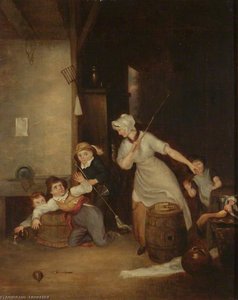
Sunnycroft, WellingtonSunnycroft Wellington 2 A Dame Scolding Naughty Children, The Toy Prisoner Being Shot In The School Room
Musée Cognacq-Jay, ParisMusée Cognacq-Jay Paris 1 The Scavengers
Royal Collection, LondonRoyal Collection London 1 Village Choristers Rehearsing an Anthem for Sunday
Anglesey AbbeyAnglesey Abbey 1 The Life Guards In A Guardroom

Edward Bird år for år: de originale værker, der definerer hvert år

Fra 1800 til 1817 arbejdede Edward Bird i 18 år: udvalget følger denne lange karriere år for år, gennem de fineste originalværker.

Værker per år

Vælg et årstal for at se de originale værker.

Samleres spørgsmål om Edward Birds malerier

Hvilket værk er Edward Bird mest kendt for?Vis svaret

The Scavengers (1800), Musée Cognacq-Jay, Paris. Derefter følger Village Choristers Rehearsing an Anthem for Sunday (1810) og Mr Ricketts' Return From Shooting.

Hvor gammel var Edward Bird, da The Scavengers blev skabt?Vis svaret

28 år gammel: The Scavengers er fra 1800, og Edward Bird blev født i 1772.

Hvad er de ti mest berømte Edward Bird malerier?Vis svaret

The Scavengers, Village Choristers Rehearsing an Anthem for Sunday, Mr Ricketts' Return From Shooting, The Reading Of The Will Concluded, Proclaiming Joash King, Princess Caraboo of Javasu ,, The Arrival of Louis XVIII at Calais, The Birth, The Duet og The Life Guards In A Guardroom. Ranglisten ovenfor viser det enkelte værks årstal og museum.

Hvor mange malerier efterlod Edward Bird?Vis svaret

Vores katalog indeholder 54 værker af Edward Bird, dateret fra 1800 til 1817.

I hvilke museer udstilles Edward Bird's mesterværker?Vis svaret

Primært i Sunnycroft (Wellington), Musée Cognacq-Jay (Paris) og Royal Collection (London). Museumslisten ovenfor viser dem alle.

Hvad er de første og de sidste berømte originaler af Edward Bird?Vis svaret

På denne side er det tidligste The Scavengers (1800) og det seneste Princess Caraboo of Javasu , (1817).

Hvilke motiver valgte Edward Bird oftest?Vis svaret

Children (5), Man (3) og Royalty (3), fordelt på de 54 værker på denne side.

Hvilken teknik brugte Edward Bird mest?Vis svaret

Oil, for 3 af de 54 værker på denne side.

Hvilke værker af Edward Bird udstilles på Sunnycroft?Vis svaret

A Dame Scolding Naughty Children og The Toy Prisoner Being Shot In The School Room: Sunnycroft, Wellington har 2 af værkerne på denne side.

Edward Bird: liv og værk

Edward Bird (1772–1819): A Pioneer of Naturalism in Bristol School Painting

  • Early Life and Training:
  • Born in Wolverhampton, Edward Bird’s artistic journey began within the confines of his father's carpentry workshop. Despite lacking formal training, he honed his skills through apprenticeship as a japanning artist—a meticulous process focused on applying decorative designs to tea trays—demonstrating an early aptitude for precision and detail.
  • Bristol School Formation:
  • Bird’s relocation to Bristol in 1794 marked the genesis of what would become known as the Bristol School. This informal collective fostered a dynamic environment where artists exchanged ideas freely, pushing artistic boundaries. Key influences included George Cumberland, whose expansive library provided access to influential artworks and encouraged experimentation.
  • Stylistic Evolution:
  • Initially drawn to Wilkie’s genre painting style, Bird challenged his dominance, establishing a distinctive aesthetic characterized by naturalism—a commitment to portraying subjects with accuracy and capturing the essence of everyday life—and vibrant color palettes. His paintings reflected a profound understanding of observation and artistic technique.
  • Royal Recognition and Historical Themes:
  • Bird’s success culminated in election as an Associate of the Royal Academy in 1812, followed by full membership in 1815—a testament to his growing reputation. He transitioned towards history painting, specializing in dramatic battle scenes, achieving considerable acclaim for works like ‘The Field of Chevy Chase’ and ‘The Day After the Battle,’ showcasing both technical mastery and emotional resonance.
  • Legacy and Influence:
  • Edward Bird's enduring legacy resides not only in the beauty of his paintings but also in his pivotal role as a catalyst for artistic innovation within the Bristol School—inspiring subsequent generations to embrace naturalism and explore the expressive potential of genre and history painting. His meticulous attention to detail and masterful use of color cemented his place as one of Britain’s foremost artists of the early 19th century.

Influences and Artistic Style

  • Early Influences:
  • The precision and decorative skills honed through japanning techniques served as a foundational element in Bird’s artistic development.
  • George Cumberland’s Collection:
  • Exposure to Cumberland's extensive library broadened Bird’s aesthetic horizons, introducing him to the works of Old Masters and fostering an appreciation for diverse artistic traditions.
  • Sir David Wilkie:
  • Bird initially sought to emulate Wilkie’s genre painting style, engaging in a spirited rivalry that ultimately spurred his own creative exploration.

Notable Works

  • Good News (1809):
  • This monumental canvas secured Bird’s royal recognition and established him as a leading figure in the Bristol School, demonstrating his ability to convey narrative complexity with remarkable skill.
  • The Field of Chevy Chase (1814):
  • A masterpiece of genre painting, ‘The Field of Chevy Chase’ exemplifies Bird's commitment to naturalistic representation and captures the dynamism of historical events with vivid detail.
  • The Day After the Battle (1815):
  • Recognized as Bird’s greatest achievement, this dramatic depiction of a battlefield underscored his technical prowess and emotional depth—a testament to his artistic vision.

Recognition and Honours

  • Election as Associate of the Royal Academy (1812):
  • This prestigious accolade validated Bird’s artistic reputation and signaled his acceptance into the elite circle of British painters.
  • Appointment as Historical Painter to Princess Charlotte (1813):
  • Bird's patronage by Princess Charlotte further solidified his position within the artistic landscape, reflecting the esteem accorded to his talent and contribution.
  • Full Membership of the Royal Academy (1815):
  • This final honour cemented Bird’s legacy as a cornerstone of British art history—a symbol of enduring artistic excellence.

Concluding Remarks

Edward Bird's influence extended beyond his immediate contemporaries, inspiring subsequent generations to embrace naturalism and explore the expressive potential of genre and history painting. His meticulous attention to detail and masterful use of color ensured that he would remain remembered as one of Britain’s most accomplished artists—a true pioneer of the Bristol School aesthetic.