Portræt af Eduard von Steinle

De 21 mest berømte Eduard von Steinle-malerier, en galleriselektion

Opdateret november 2026 · rangeret efter vores popularitetsscore (søgninger, besøg og ordrer for hvert værk) · 21 værker af Eduard von Steinle i vores katalog

Kort sagt

Af alle de originale værker, som Eduard von Steinle efterlod, er det mest berømte Violinist in the Belfry Window (1858), som er en del af samlingen på Städel Museum i Frankfurt. Lige efter følger Madonna del Campidoglio (1841) og Saint Luke painting the Madonna (1842). Vores katalog indeholder 21 værker af Eduard von Steinle; galleriet har bevaret de 21 værker, som verden beundrer mest, hver vist med sin dato, sit museum og sin historie.

1810 – 1886, Vienna Flest værker: Bavarian State Painting Collections

Eduard von Steinles top 10 malerier: galleriets udvalg

1
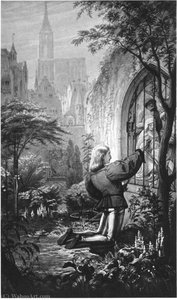
Violinist in the Belfry Window (1858) af Eduard von Steinle

Violinist in the Belfry Window

1858 · Oil · Städel Museum, Frankfurt

There is a profound sense of isolation in this 1858 oil painting, a quietude that seems to emanate from the very stone of the belfry. We find ourselves looking upward, toward an elevated window where a young man sits, lost in the act of playing his violin. The composition is defined by a strong verticality, drawing the eye from the heavy, weathered masonry of the tower up to the slender,…

2
Madonna del Campidoglio (1841) af Eduard von Steinle

Madonna del Campidoglio

1841 · Oil On Canvas · Bavarian State Painting Collections, München

The Madonna del Campidoglio is a work of profound stillness by the German painter Eduard Jakob von Steinle. Created in 1841, the painting emerges from the Nazareno movement, a style defined by its pursuit of spiritual purity and sincere devotion. Steinle brings a quiet, disciplined hand to this composition, focusing on the sacred presence of the Virgin and Child within a landscape of ancient stone.

3
Saint Luke painting the Madonna (1842) af Eduard von Steinle

Saint Luke painting the Madonna

1842 · Oil On Canvas · Staatliche Kunsthalle Karlsruhe, Karlsruhe

A bearded man sits in profile, his gaze fixed upon a drawing board. This is Saint Luke, caught in the act of translating a divine presence into pigment. To his right, the Virgin Mary watches the Christ Child with a tender, steady gaze. The scene is a study in stillness. The light enters from the upper left, casting soft shadows that give the figures a heavy, three-dimensional weight. Deep reds…

4
Holy Family with Christ Child John (1855) af Eduard von Steinle

Holy Family with Christ Child John

1855 · Oil On Canvas

In this 1855 oil on canvas, we find ourselves drawn into a serene, natural landscape that feels both intimate and expansive. The composition centers on the Virgin Mary, whose deep blue mantle and red inner garment provide a grounding weight to the scene. She holds the Christ Child with a gentle grace, while Saint Joseph remains a steady presence to her left. To the right, a young Saint John the…

5
Saint Luke painting the Virgin (1851) af Eduard von Steinle

Saint Luke painting the Virgin

1851 · Oil · Royal Collection, London

The air in the studio feels heavy with a quiet, divine purpose. On the left, Saint Luke leans forward, his profile etched with intense concentration as his brush meets the canvas. He is not merely painting; he is attempting to capture the essence of the divine. Across the composition, the Virgin Mary holds the Christ Child, her presence a calm anchor amidst the creative fervor. A heavy brown curtain frames…

6
The Loreley (Draft) (1863) af Eduard von Steinle

The Loreley (Draft)

1863 · Watercolor · Bavarian State Painting Collections, München

The Loreley (Draft) by Eduard von Steinle, created about 1863, features a vertically oriented composition centered on a solitary female figure. This figure is perched upon a jagged, rocky cliffside that rises above a misty body of water. The woman holds a lute in her hands while looking out over the expanse. In the lower right corner, a small, distant figure in a boat provides a sense of scale against…

7
Adam and Eve (1867) af Eduard von Steinle

Adam and Eve

1867 · Lithograph · Bavarian State Painting Collections, München

A sepia-toned stillness settles over the Garden. In this lithograph, the air feels heavy with the scent of damp earth and crushed leaves. Adam stands on the right, a muscular figure defined by the sharp precision of Academic Realism. He holds a branch, his gaze fixed upon the viewer with a somber, heavy expression. To his left, Eve turns her body away, her arms crossed over her chest in a…

8
Self-Portrait (1883) af Eduard von Steinle

Self-Portrait

1883 · Oil

This oil self-portrait presents a bust-length view of an older man, positioned slightly off-center. He is turned toward the viewer's right, yet his gaze is directed straight forward. The subject wears a heavy, dark navy or black coat paired with a crisp white high collar. A desaturated green background provides a muted backdrop for the figure. Light enters from the upper left, casting soft shadows across the right side of…

Eduard von Steinle-udvalget fortsætter, fra 11 til 21

Motiverne, der fangede Eduard von Steinles blik

De fire motiver, der optræder hyppigst i disse originaler, hver med sit fineste eksempel.

De museer, der udstiller Eduard von Steinles originalværker

De 5 museer, der rummer flest af malerierne på denne side.

Museum By Værker af Eduard von Steinle Malerier fra denne liste
Bavarian State Painting Collections, MünchenBavarian State Painting Collections München 5 Madonna del Campidoglio, The Loreley (Draft), Adam and Eve
Sammlung Schack, MünchenSammlung Schack München 3 The Tower Watchman, The Lorelei (detail), The Lorelei
Städel Museum, FrankfurtStädel Museum Frankfurt 2 Violinist in the Belfry Window, Portrait of Agnes von Steinle the Artist’s Daughter
Staatliche Kunsthalle Karlsruhe, KarlsruheStaatliche Kunsthalle Karlsruhe Karlsruhe 1 Saint Luke painting the Madonna
Royal Collection, LondonRoyal Collection London 1 Saint Luke painting the Virgin

Eduard von Steinle årti for årti: det originale værk, der definerer hvert enkelt

Værker per årti

Vælg et årti for at se det originale værk, der definerer det.

Samleres spørgsmål om Eduard von Steinles malerier

Hvilket værk er Eduard von Steinle mest kendt for?Vis svaret

Violinist in the Belfry Window (1858), Städel Museum, Frankfurt. Derefter følger Madonna del Campidoglio (1841) og Saint Luke painting the Madonna (1842).

Hvor gammel var Eduard von Steinle, da Violinist in the Belfry Window blev skabt?Vis svaret

48 år gammel: Violinist in the Belfry Window er fra 1858, og Eduard von Steinle blev født i 1810.

Hvad er de ti mest berømte Eduard von Steinle malerier?Vis svaret

Violinist in the Belfry Window, Madonna del Campidoglio, Saint Luke painting the Madonna, Holy Family with Christ Child John, Saint Luke painting the Virgin, The Loreley (Draft), Adam and Eve, Self-Portrait, The Tower Watchman og The Lorelei (detail). Ranglisten ovenfor viser det enkelte værks årstal og museum.

Hvor mange malerier efterlod Eduard von Steinle?Vis svaret

Vores katalog indeholder 21 værker af Eduard von Steinle, dateret fra 1841 til 1883.

I hvilke museer udstilles Eduard von Steinle's mesterværker?Vis svaret

Primært i Bavarian State Painting Collections (München), Sammlung Schack (München) og Städel Museum (Frankfurt). Museumslisten ovenfor viser dem alle.

I hvilke år malede Eduard von Steinle sine mest berømte værker?Vis svaret

I 1850s: 4 af de 21 værker på denne side blev skabt dengang, herunder Violinist in the Belfry Window.

Hvad er de første og de sidste berømte originaler af Eduard von Steinle?Vis svaret

På denne side er det tidligste Madonna del Campidoglio (1841) og det seneste Self-Portrait (1883).

Hvilke motiver valgte Eduard von Steinle oftest?Vis svaret

Man (6), Woman (6) og Child (4), fordelt på de 21 værker på denne side.

Hvilken teknik brugte Eduard von Steinle mest?Vis svaret

Oil, for 3 af de 21 værker på denne side.

Hvilke værker af Eduard von Steinle udstilles på Bavarian State Painting Collections?Vis svaret

Madonna del Campidoglio, The Loreley (Draft) og Adam and Eve: Bavarian State Painting Collections, München har 5 af værkerne på denne side.

Eduard von Steinle: liv og værk

A Visionary of the Nazarene Spirit

Born in Vienna, Austria, Edward Jakob von Steinle emerged as a profound voice within the nineteenth-century art world, weaving together the spiritual depth of the Nazarene movement with a masterful command of both painting and printmaking. His artistic journey was deeply shaped by his formative years spent in Rome between 1828 and 1833, where he immersed himself among the leading figures of the Nazarene school. This period of intense study allowed him to absorb a philosophy that sought to revive sincerity and spiritual purity in Christian art, an influence that would remain the heartbeat of his creative output for decades to come.

As his career progressed, Steinle’s presence expanded far beyond the borders of his birthplace. While his roots remained firmly planted in the traditions of Vienna, he eventually settled in Frankfurt, Germany, where he became a central pillar of the German Romantic and Nazarene traditions. His ability to translate complex theological and literary themes into visual narratives made him a sought-after master for monumental commissions. From the delicate precision of his drawings to the grand scale of his frescoes, Steinle’s work often bridged the gap between the earthly and the divine.

Mastery of Sacred and Secular Narratives

The breadth of Steinle's talent is perhaps most evident in his ability to navigate both the sacred and the secular with equal grace. He was a master of monumental fresco and religious panel painting, leaving an indelible mark on the architectural landscape of Europe. His hands touched some of the most significant religious sites of his era, including:

  • The Cologne Cathedral, where his contributions helped sustain the grandeur of Gothic tradition.
  • The Strasbourg Minster, serving as a testament to his skill in large-scale ecclesiastical art.
  • The chapel of Castle Rheineck, where his frescoes brought biblical stories to life through light and color.
  • The Hall of the Emperors (Kaisersaal) in Frankfurt, showcasing his prowess in historical painting.

Beyond these grand religious cycles, Steinle also excelled in creating works that drew from the rich tapestry of literature and folklore. His depictions, such as those found in his interpretations of The Lorelei, demonstrate a captivating ability to capture the ethereal and the mysterious. Whether working with graphite, brush, and gray wash or executing intricate stained glass cartoons, his technique always served a higher purpose: to evoke emotion and invite contemplation.

Legacy and Artistic Significance

Steinle’s historical significance lies in his role as a bridge between eras. By championing the Nazarene ideals of spiritual revival, he helped maintain a sense of moral and aesthetic integrity during a period of rapid industrial and social change. His influence even extended to the next generation of great painters; notably, the renowned Frederic Leighton studied under him, carrying forward the lessons of classical form and expressive depth that Steinle had perfected.

Though his life concluded in Frankfurt, his artistic legacy remains etched in the very fabric of European cathedrals and museum collections. Through his dedication to the beauty of the sacred and the nuance of the human experience, Edward Jakob von Steinle ensured that the spirit of the Nazarene movement would endure as a vital chapter in the history of Western art.