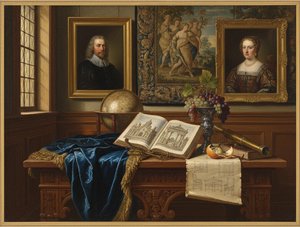
The Enigmatic Portraits of Cornelis van Cuylenburgh II
Cornelis van Cuylenburgh II remains a somewhat elusive figure in the pantheon of 17th-century Dutch portraiture, yet his work possesses a distinctive quality that sets him apart. Born into a prominent Haarlem family – a lineage steeped in civic duty and artistic patronage – he navigated a world undergoing rapid social and economic transformation. While biographical details are sparse, piecing together fragments from archival records and stylistic analysis reveals an artist deeply attuned to the sensibilities of his time, a master of capturing not just likeness but also the inner lives of his sitters. His father, Cornelis van Cuylenburgh I, was a cloth merchant and art collector, providing young Cornelis with early exposure to artistic circles and likely fostering his initial interest in painting. However, unlike many artists who pursued formal apprenticeships, Van Cuylenburgh II appears to have been largely self-taught, developing his unique style through observation and experimentation.
A Haarlem Gentleman Painter
Van Cuylenburgh’s artistic career flourished primarily within the confines of Haarlem during the mid-17th century – a period often referred to as the Dutch Golden Age. He wasn't a prolific painter, which contributes to the relative scarcity of his known works today; however, those that survive demonstrate an exceptional talent for portraiture, particularly in depicting members of the upper echelons of Haarlem society. His paintings are characterized by their refined elegance, meticulous attention to detail, and subtle psychological insight. He eschewed the grand theatricality favored by some of his contemporaries, opting instead for a more intimate and restrained approach.
His sitters aren’t presented as symbols of wealth or power, but rather as individuals with complex personalities. This is achieved through nuanced facial expressions, carefully rendered hands, and the use of soft, diffused lighting that creates an atmosphere of quiet contemplation. He frequently depicted his subjects against dark, neutral backgrounds, further emphasizing their individuality and drawing attention to their inner character.
Influences and Artistic Development
Identifying Van Cuylenburgh’s direct influences is a challenging task given the limited documentation surrounding his training. However, scholars have noted stylistic affinities with painters such as Frans Hals and Pieter Claesz. The influence of Hals is particularly evident in Van Cuylenburgh's loose brushwork and ability to capture fleeting expressions; however, he lacked Hals’s dynamic energy and spontaneity.
He seems to have absorbed elements from various sources, synthesizing them into a style that was uniquely his own. The works of Pieter Claesz, renowned for his still life paintings, may have influenced Van Cuylenburgh's meticulous attention to detail and mastery of texture. Beyond specific painters, the broader artistic climate of Haarlem – characterized by its emphasis on realism and naturalism – undoubtedly played a significant role in shaping his aesthetic sensibilities. He also appears to have been familiar with the work of Anthony van Dyck, whose elegant portraiture was widely admired throughout Europe during this period.
Themes and Techniques
The vast majority of Van Cuylenburgh’s oeuvre consists of portraits – primarily individual or double portraits of Haarlem citizens. He rarely ventured into other genres, suggesting a deliberate focus on capturing the likenesses and personalities of his contemporaries. His technique is marked by a remarkable level of precision and control.
He employed a subtle glazing technique to create luminous skin tones and delicate gradations of light and shadow. His brushwork is generally smooth and refined, although he occasionally used looser strokes to suggest texture or movement. He paid particular attention to the rendering of fabrics – silks, velvets, and lace are depicted with astonishing realism. Beyond technical skill, Van Cuylenburgh possessed a keen understanding of human psychology. His portraits aren’t merely accurate representations of physical appearance; they also convey a sense of inner life and emotional depth.
- His use of chiaroscuro (the contrast between light and dark) is masterful.
- He often incorporated symbolic objects into his portraits, although their meaning remains open to interpretation.
- The composition of his paintings is typically simple and balanced, focusing attention on the sitters themselves.
Legacy and Historical Significance
Despite not achieving widespread fame during his lifetime, Cornelis van Cuylenburgh II occupies a significant place in the history of Dutch portraiture. His paintings offer a fascinating glimpse into the lives and values of 17th-century Haarlem society.
He captured the spirit of an era – a time of unprecedented prosperity, intellectual curiosity, and artistic innovation. While his work may not be as well known as that of some of his more celebrated contemporaries, it is nonetheless deserving of attention. His refined elegance, meticulous technique, and subtle psychological insight continue to captivate viewers today. His portraits serve as enduring testaments to the power of art to capture not just likeness but also the essence of human experience. The relative rarity of his works only adds to their allure, making each painting a precious and irreplaceable artifact of a bygone era.