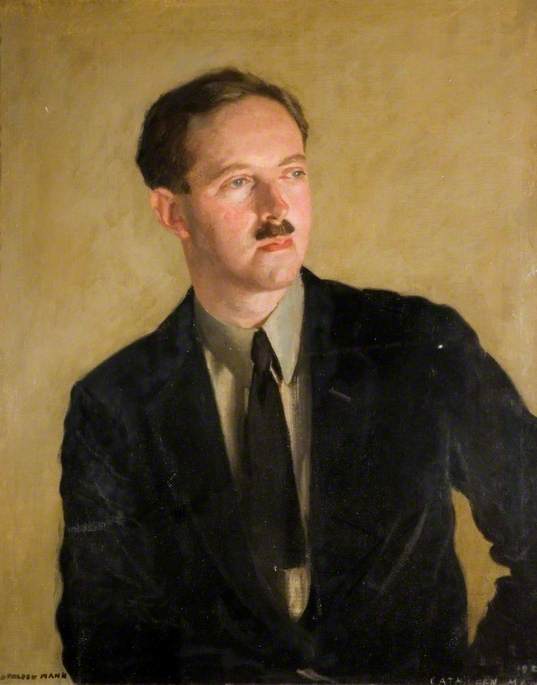
Portræt af Cathleen Sabine Mann

De 14 mest berømte Cathleen Sabine Mann-malerier, en galleriselektion

Opdateret november 2026 · rangeret efter vores popularitetsscore (søgninger, besøg og ordrer for hvert værk) · 14 værker af Cathleen Sabine Mann i vores katalog

Kort sagt

Af alle de originale værker, som Cathleen Sabine Mann efterlod, er det mest berømte Ballerina (1934). Lige efter følger Francis Brett Young (1884–1954) (1922) og Jane Posing (1931). Vores katalog indeholder 14 værker af Cathleen Sabine Mann; galleriet har bevaret de 14 værker, som verden beundrer mest, hver vist med sin dato, sit museum og sin historie.

1896 – 1959, Newcastle upon Tyne Flest værker: University of Birmingham

Cathleen Sabine Manns top 10 malerier: galleriets udvalg

1
Ballerina (1934) af Cathleen Sabine Mann

Ballerina

1934

The Ballerina painting by Cathleen Mann is a stunning example of artistic excellence, showcasing the artist's skill and attention to detail. Created in 1934, this oil on canvas masterpiece measures 91 x 71 cm and is currently housed at the Glasgow Museums Resource Centre in the United Kingdom. Artist Background Cathleen Mann was a talented artist known for her captivating portraits and figurative paintings. Her work often featured women and…

Cathleen Sabine Mann-udvalget fortsætter, fra 11 til 14

De museer, der udstiller Cathleen Sabine Manns originalværker

De 4 museer, der rummer flest af malerierne på denne side.

Museum By Værker af Cathleen Sabine Mann Malerier fra denne liste
University of Birmingham, BirminghamUniversity of Birmingham Birmingham 1 Francis Brett Young (1884–1954)
Ferens Art Gallery, HullFerens Art Gallery Hull 1 Diana Napier (1904–1982) (Mrs Richard Tauber)
National Trust, GranthamNational Trust Grantham 1 Peregrine Francis Adelbert Cust (1899–1978), 6th Baron Brownlow
Bolton Museum And Art Gallery, BoltonBolton Museum And Art Gallery Bolton 1 Flowers

Cathleen Sabine Mann årti for årti: det originale værk, der definerer hvert enkelt

Værker per årti

Vælg et årti for at se det originale værk, der definerer det.

Samleres spørgsmål om Cathleen Sabine Manns malerier

Hvilket værk er Cathleen Sabine Mann mest kendt for?Vis svaret

Ballerina (1934). Derefter følger Francis Brett Young (1884–1954) (1922) og Jane Posing (1931).

Hvor gammel var Cathleen Sabine Mann, da Ballerina blev skabt?Vis svaret

38 år gammel: Ballerina er fra 1934, og Cathleen Sabine Mann blev født i 1896.

Hvad er de ti mest berømte Cathleen Sabine Mann malerier?Vis svaret

Ballerina, Francis Brett Young (1884–1954), Jane Posing, Composition in Pink and Green, David Douglas, Viscount Drumlanrig (b.1929), Diana Napier (1904–1982) (Mrs Richard Tauber), Barrage Balloons over St James's Park, St James's Park, Evreux og Evan Frederick Morgan (1893–1949), 2nd Viscount Tredegar (2nd Creation). Ranglisten ovenfor viser det enkelte værks årstal og museum.

Hvor mange malerier efterlod Cathleen Sabine Mann?Vis svaret

Vores katalog indeholder 14 værker af Cathleen Sabine Mann, dateret fra 1922 til 1952.

I hvilke museer udstilles Cathleen Sabine Mann's mesterværker?Vis svaret

Primært i University of Birmingham (Birmingham), Ferens Art Gallery (Hull) og National Trust (Grantham). Museumslisten ovenfor viser dem alle.

I hvilke år malede Cathleen Sabine Mann sine mest berømte værker?Vis svaret

I 1940s: 6 af de 14 værker på denne side blev skabt dengang, herunder Barrage Balloons over St James's Park.

Hvad er de første og de sidste berømte originaler af Cathleen Sabine Mann?Vis svaret

På denne side er det tidligste Francis Brett Young (1884–1954) (1922) og det seneste Sir Eduardo Luigi Paolozzi (1952).

Cathleen Sabine Mann: liv og værk

A Life in Lines and Layers

Cathleen Mann began her days in Newcastle upon Tyne, born to parents who lived through the brush and pigment. Her father, Harrington Mann, and her mother, Florence Sabine Pasley, were both portraitists, providing a childhood shaped by the quiet work of the studio. She learned to paint within her father's London studio, receiving early lessons that would later lead her to the Slade School of Fine Art and eventually to Paris. These formative years were marked by the steadying influence of Ethel Walker, another painter who continued to guide her even as Cathleen pursued her own studies.

The rhythms of her life changed with the arrival of the First World War. The studio was left behind for the work of an ambulance unit, a period that placed her in the middle of a much larger, more chaotic reality. When she returned to her art, her focus remained on the human form and the quiet details of life. She became known for portraits and landscapes, often capturing women and children with a careful eye for the subtle shifts in emotion. Her work found homes in the Victoria and Albert Museum, the Musée du Luxembourg, and the Royal Glasgow Institute of the Fine Arts.

The Dual Path of Paint and Film

During the 1930s, her hands were busy with more than just canvas. She moved into the world of British film, working as a costume designer. This period saw her contributing to the visual fabric of films such as:

  • The Iron Duke (1935)
  • Things to Come (1937)
  • Backstage (1937)
  • Forbidden Music (1936)
  • The Show Goes On (1936)
  • Evensong (1934)
  • Chu Chin Chow (1934)
  • The Wandering Jew (1933)

Her design work left a physical trace in the collections of the Victoria & Albert Museum. At the same time, her painting continued to evolve. In 1934, she produced Ballerina, an oil on canvas that shows a woman on a couch with a black cat nearby. Her later years brought a shift toward abstraction. Influenced by Matthew Smith, she began experimenting with landscapes of increasing abstraction, nude drawings, and sculpture. This period of experimentation followed the personal losses of 1953, when her husband, John Robert Follett, passed away.

Service and Legacy

The Second World War brought a different kind of responsibility. Mann served as an official war artist, painting portraits of officers and Allied commanders. These works were seen in London and traveled to America, sometimes appearing in the pages of Time magazine. Beyond the canvas, she used her position as the Marchioness of Queensberry to assist others during the bombing of 1940. She worked to secure transport by road and rail to move people to safety in the dock district of south West Ham.

Her career was defined by a movement between the structured world of portraiture and the fluid experimentation of her later years. She held memberships in both the Royal Institute of Oil Painters and the Royal Society of Portrait Painters. Her portraits, such as those of Sir Matthew Smith and Sir Eduardo Paolozzi, remain in the National Portrait Gallery in London. She died in 1959 in her studio on Montpelier Walk, Brompton.