Portræt af Carl Blechen

De 94 mest berømte Carl Blechen-malerier, hver og en unik

Opdateret november 2026 · rangeret efter vores popularitetsscore (søgninger, besøg og ordrer for hvert værk) · 97 værker af Carl Blechen i vores katalog

Kort sagt

Sanssouci Palace (1830) er det maleri af Carl Blechen, der vækker mest opsigt; originalen findes på Nationalgalerie, Berlin. Derefter falder blikket på The Interior of the Palm House on the Pfaueninsel Near Potsdam (1834) og Afternoon on Capri (1829). Blandt de 97 værker af Carl Blechen i vores katalog er disse 94 de mest berømte, hver især et unikt originalværk præsenteret med sit årstal, sit museum og årsagen til dets tidløse betydning.

1798 – 1840, Cottbus Romantic industrialization Flest værker: Alte Nationalgalerie

Top 10 malerier af Carl Blechen, set gennem galleriets øjne

1
Sanssouci Palace (1830) af Carl Blechen

Sanssouci Palace

1830 · Oil On Canvas · Nationalgalerie, Berlin

Subject Carl Blechen’s 1830 canvas invites the viewer into a dramatic yet serene tableau of Sanssouci Palace, its stately gardens framed by a storm‑laden sky that breathes both tension and awe. The central fountain glistens beneath swirling clouds, while a lone horse stands poised in the midst of the park, an emblem of grace amid turmoil. Figures—families, couples, solitary wanderers—are scattered across the scene, their silhouettes hinting at stories untold.…

2
The Interior of the Palm House on the Pfaueninsel Near Potsdam (1834) af Carl Blechen

The Interior of the Palm House on the Pfaueninsel Near Potsdam

1834 · Oil On Canvas · Art Institute of Chicago, Chicago

The work before us is titled The Interior of the Palm House on the Pfaueninsel Near Potsdam, a significant oil on canvas by the German artist Carl Blechen. Created in 1834, this painting captures a specific moment of architectural and botanical splendor within the Prussian royal grounds. It offers a view into a space where the structured lines of design meet the untamed growth of tropical flora.

3
Afternoon on Capri (1829) af Carl Blechen

Afternoon on Capri

1829 · Oil On Canvas

The oil painting depicts a coastal scene on the island of Capri, captured from an elevated perspective. In the upper right, massive cliffs of ochre and sienna rise toward the center-left, their jagged surfaces textured by light and shadow. These geological formations descend toward a calm, blue sea that occupies the middle ground. A solitary figure sits upon a rocky outcrop in the lower left, positioned against the scale of…

4
Napoleon on Horseback, Surrounded by Generals and Troops (1823) af Carl Blechen

Napoleon on Horseback, Surrounded by Generals and Troops

1823 · Watercolor

In Napoleon on Horseback, Surrounded by Generals and Troops, Carl Blechen organizes a scene of profound historical and heroic weight. The composition is centered upon a prominent figure on horseback, presumably Napoleon, who commands the viewer's immediate attention. This central figure is encircled by a dense gathering of military personnel and troops, creating a sense of crowded, purposeful movement. Whether the scene depicts a moment of intense military engagement or…

5
Tarantella (1830) af Carl Blechen

Tarantella

1830 · Oil On Canvas · Städel Museum, Frankfurt

In this 1830 oil on canvas, we find ourselves drawn into a lively scene of folk celebration. A group of people has gathered for a traditional dance, the Tarantella, set against a picturesque coastal landscape. The composition is built around a central dancing figure, whose movement acts as a focal point for the seated observers and the figures drifting in the background. There is a sense of rhythm here, captured…

6
Two monks in the park of Terni (1830) af Carl Blechen

Two monks in the park of Terni

1830 · Oil On Canvas · Alte Nationalgalerie, Berlin

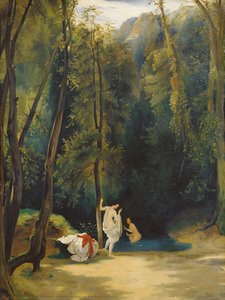
The painting, titled Two monks in the park of Terni, was executed by the German artist Carl Blechen in 1830. It is also known by the alternative title Parthie aus dem Park des Grafen Graziani bei Terni. This work captures a quiet moment within the Park of Count Graziani, situated in the Nera river valley at Terni. The scene focuses on two monks engaged in conversation, positioned beneath a leafy…

7
Two Ladies in the Park (1830) af Carl Blechen

Two Ladies in the Park

1830 · Oil · Bavarian State Painting Collections, München

This romanticized landscape painting, dating from 1830, captures a tranquil scene of two women enjoying a moment of quiet companionship within an elegant park. The composition is carefully balanced, featuring the two figures positioned slightly off-center. They are framed by lush greenery on the right, while the left side of the work offers a receding view of trees and water. The women are dressed in soft white and cream garments,…

8
"Tarantella" Merry-society at Italian shore (1823) af Carl Blechen

"Tarantella" Merry-society at Italian shore

1823 · Oil

"Tarantella" Merry-society at Italian shore is an oil painting by the German artist Carl Blechen. Executed about 1823, the work captures a lively social gathering set against a coastal landscape. The scene focuses on human interaction within a picturesque environment, featuring figures engaged in various activities, including dance and seated observation.

10
Fishermen on Capri (1834) af Carl Blechen

Fishermen on Capri

1834 · Oil On Canvas · Alte Nationalgalerie, Berlin

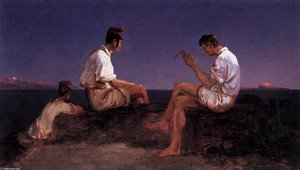
In Fishermen on Capri, Carl Blechen captures a quiet moment on a pebbled shore. The scene is a serene and atmospheric coastal landscape set against the dramatic natural backdrop of the Italian coast. A woman in a flowing white dress sits upon the rocks, leaning toward a man kneeling before her. Nearby, a second man stands with his back to the viewer, his red cap a sharp point of color…

Carl Blechens berømte malerier, nummer 11 til 94

11Shepherd boy (1832) af Carl BlechenShepherd boy1832 12Forest path near Spandau (1835) af Carl BlechenForest path near Spandau1835 · Alte Nationalgalerie 13Weathered Tree Trunks in a Park (recto), c. 1834 (1834) af Carl BlechenWeathered Tree Trunks in a Park (recto), c. 18341834 · Albertina 14Stormy Weather over the Roman Campagna (1829) af Carl BlechenStormy Weather over the Roman Campagna1829 · Nationalgalerie 15Galgenberg (1833) af Carl BlechenGalgenberg1833 · Galerie Neue Meister 16Italian Monastery Building on the Water's Edge (1832) af Carl BlechenItalian Monastery Building on the Water's Edge1832 · Alte Nationalgalerie 17Memorial Column in the Forest (1837) af Carl BlechenMemorial Column in the Forest1837 · Alte Nationalgalerie 18Sleeping Faun in the Reeds (1827) af Carl BlechenSleeping Faun in the Reeds1827 · Alte Nationalgalerie 19Gothic Church Ruins (1826) af Carl BlechenGothic Church Ruins1826 · Staatliche Kunstsammlungen Dresden 20Rocky Landscape with Monk (1825) af Carl BlechenRocky Landscape with Monk1825 · Alte Nationalgalerie 21View of Rooftops and Gardens (1835) af Carl BlechenView of Rooftops and Gardens1835 · Nationalgalerie 22The Woods near Spandau (1834) af Carl BlechenThe Woods near Spandau1834 · Nationalgalerie 23Grotto in the Gulf of Naples (1829) af Carl BlechenGrotto in the Gulf of Naples1829 · Wallraf-Richartz-Museum 24Woman Bathing in the Park of Terni (1829) af Carl BlechenWoman Bathing in the Park of Terni1829 · Städel Museum 25Italian Landscape (1829) af Carl BlechenItalian Landscape1829 · Alte Nationalgalerie 26Sleeping Faun (1820) af Carl BlechenSleeping Faun1820 27Romantic Painting with Ruins (1820) af Carl BlechenRomantic Painting with Ruins1820 · Westfälisches Landesmuseum 28Landscape with Hermit (1822) af Carl BlechenLandscape with Hermit1822 29Friedrich Wilhelm III's Palm Court (1832) af Carl BlechenFriedrich Wilhelm III's Palm Court1832 · Nationalgalerie 30In the Berliner Tiergarten / Forest Path with Water (1825) af Carl BlechenIn the Berliner Tiergarten / Forest Path with Water1825 31The Roman Forum (1829) af Carl BlechenThe Roman Forum1829 32Forest Gorge with Red Deer (1828) af Carl BlechenForest Gorge with Red Deer1828 · Niedersächsisches Landesmuseum 33View of Monte Castiglione in Capri (1829) af Carl BlechenView of Monte Castiglione in Capri1829 · Staatliche Kunsthalle Karlsruhe 34Young Oak Tree (1828) af Carl BlechenYoung Oak Tree1828 · National Gallery of Canada 35Fantasy Mountain Scene (1823) af Carl BlechenFantasy Mountain Scene1823 · Alte Nationalgalerie 36Ruins of Oybin Monastery (1823) af Carl BlechenRuins of Oybin Monastery1823 · Alte Nationalgalerie 37Track to Castle Gandolfo (1830) af Carl BlechenTrack to Castle Gandolfo1830 · Alte Nationalgalerie 38The Shattered Tower of Heidelberg Castle (1829) af Carl BlechenThe Shattered Tower of Heidelberg Castle1829 · Alte Nationalgalerie 39Trees at Sunrise in Autumn (1823) af Carl BlechenTrees at Sunrise in Autumn1823 · Alte Nationalgalerie 40Knight's castle at the fir pond (1823) af Carl BlechenKnight's castle at the fir pond1823 · Alte Nationalgalerie 41Campagna landscape (1830) af Carl BlechenCampagna landscape1830 · Berlinische Galerie 42Stormy sea with Lighthouse (1826) af Carl BlechenStormy sea with Lighthouse1826 · Hamburger Kunsthalle 43The Capuchin Convent at Amalfi (1829) af Carl BlechenThe Capuchin Convent at Amalfi1829 · National Gallery 44The Valley of Mills near Amalfi (1830) af Carl BlechenThe Valley of Mills near Amalfi1830 45boat at the coast (1823) af Carl Blechenboat at the coast1823 46Winterlandscape + wanderer (1823) af Carl BlechenWinterlandscape + wanderer1823 47landscape with figures (1823) af Carl Blechenlandscape with figures1823 48Winter- Landscape (1823) af Carl BlechenWinter- Landscape1823 49Mill Valley at Amalfi with Capuchin monk and farmer (1823) af Carl BlechenMill Valley at Amalfi with Capuchin monk and farmer1823 50Landscape with ruin, with motives of Webers "Freischütz" (1823) af Carl BlechenLandscape with ruin, with motives of Webers "Freischütz"1823 51Sleeping satyr in landscape (1823) af Carl BlechenSleeping satyr in landscape1823 52forest with pond + deers (1826) af Carl Blechenforest with pond + deers1826 53Gravestone (1823) af Carl BlechenGravestone1823 · Alte Nationalgalerie 54Mountain Gorge in Winter (1825) af Carl BlechenMountain Gorge in Winter1825 · Alte Nationalgalerie 55Mill in the valley near Amalfi (1829) af Carl BlechenMill in the valley near Amalfi1829 · Hamburger Kunsthalle 56Monastery of Saint Scholastica (1830) af Carl BlechenMonastery of Saint Scholastica1830 · Von der Heydt Museum 57Landscape (1823) af Carl BlechenLandscape1823 · Schloss Weimar 58Studie til en funerær monument (1824) af Carl BlechenStudie til en funerær monument1824 · Nationalgalerie 59Gorge at Amalfi (1831) af Carl BlechenGorge at Amalfi1831 · Alte Nationalgalerie 60Forest Path in the Harz (1833) af Carl BlechenForest Path in the Harz1833 61Waterfalls near Tivoli (1832) af Carl BlechenWaterfalls near Tivoli1832 · Alte Nationalgalerie 62In the park of Villa Borghese (1837) af Carl BlechenIn the park of Villa Borghese1837 · Alte Nationalgalerie 63Schloss Sanssouci (1833) af Carl BlechenSchloss Sanssouci1833 · Alte Nationalgalerie 64Forest Landscape at Dawn (1835) af Carl BlechenForest Landscape at Dawn1835 · Bavarian State Painting Collections 65Spinning women in Cervara (1835) af Carl BlechenSpinning women in Cervara1835 · Alte Nationalgalerie 66Monk on Terrace (1835) af Carl BlechenMonk on Terrace1835 · Alte Nationalgalerie 67Mill in a valley (1833) af Carl BlechenMill in a valley1833 68Landscape in Winter at Moonlight (1836) af Carl BlechenLandscape in Winter at Moonlight1836 · Museum Behnhaus Drägerhaus 69In the Palm House in Potsdam (1832) af Carl BlechenIn the Palm House in Potsdam1832 · Hamburger Kunsthalle 70Girls on a Hill at the Beach (1840) af Carl BlechenGirls on a Hill at the Beach1840 71Fisherman (1839) af Carl BlechenFisherman1839 · Staatliche Kunsthalle Karlsruhe 72View of the Santa Scolastica Monastery near Subiaco (1832) af Carl BlechenView of the Santa Scolastica Monastery near Subiaco1832 · Staatliche Kunsthalle Karlsruhe 73In the Park at Terni af Carl BlechenIn the Park at TerniStaatsgalerie Stuttgart 74Alpepasset om vinteren med munkene (1833) af Carl BlechenAlpepasset om vinteren med munkene1833 · Staatliche Graphische Sammlung 75Bathers in Terni Park (1836) af Carl BlechenBathers in Terni Park1836 · Nationalgalerie 76Tivoli Gardens at the Villa d'Este (1831) af Carl BlechenTivoli Gardens at the Villa d'Este1831 · Nationalgalerie 77View of Assisi (1832) af Carl BlechenView of Assisi1832 · Neue Pinakothek 78Self-Portrait (1823) af Carl BlechenSelf-Portrait1823 · Nationalgalerie 79Scaffold in Storm (1833) af Carl BlechenScaffold in Storm1833 · Gemäldegalerie Alte Meister 80Forest landscape with flowing water and two hunters af Carl BlechenForest landscape with flowing water and two huntersKupferstichkabinett 81Hermit in a rocky landscape af Carl BlechenHermit in a rocky landscape 82The studio of the sculptor Rudolf Schadow af Carl BlechenThe studio of the sculptor Rudolf SchadowKunsthalle Bremen 83Resting Pilgrim in a Church's ruin af Carl BlechenResting Pilgrim in a Church's ruin 84Wooded landscape with castle af Carl BlechenWooded landscape with castle 85Tiberius rocks at Capri af Carl BlechenTiberius rocks at CapriNiedersächsisches Landesmuseum 86Rest in the Forest af Carl BlechenRest in the Forest 87Heidelberg Ruins af Carl BlechenHeidelberg RuinsKunsthalle Bremen 88The Waterfall af Carl BlechenThe WaterfallDetroit Institute of Arts 89Fishermen at the Gulf of Naples (1829) af Carl BlechenFishermen at the Gulf of Naples1829 · Nationalgalerie 90The Bay of Rapallo (1829) af Carl BlechenThe Bay of Rapallo1829 · Nationalgalerie 91Grotte im Park der Villa d’Este (1828) af Carl BlechenGrotte im Park der Villa d’Este1828 92Tower Ruins with Dragon (1827) af Carl BlechenTower Ruins with Dragon1827 · Alte Nationalgalerie 93Building the Devil's Bridge (1833) af Carl BlechenBuilding the Devil's Bridge1833 · Neue Pinakothek 94Rolling Mill (1834) af Carl BlechenRolling Mill1834 · Nationalgalerie

Carl Blechens berømte malerier, periode for periode

Motiverne, der fangede Carl Blechens blik

De fire motiver, der optræder hyppigst i disse originaler, hver med sit fineste eksempel.

De museer, der udstiller Carl Blechens originalværker

De 8 museer, der rummer flest af malerierne på denne side.

Museum By Værker af Carl Blechen Malerier fra denne liste
Alte Nationalgalerie, BerlinAlte Nationalgalerie Berlin 24 Two monks in the park of Terni, Pifferaro and Girls in Rome, Fishermen on Capri
Nationalgalerie, BerlinNationalgalerie Berlin 12 Sanssouci Palace, Stormy Weather over the Roman Campagna, View of Rooftops and Gardens
Staatliche Kunsthalle Karlsruhe, KarlsruheStaatliche Kunsthalle Karlsruhe Karlsruhe 3 View of Monte Castiglione in Capri, Fisherman, View of the Santa Scolastica Monastery near Subiaco
Hamburger Kunsthalle, HamborgHamburger Kunsthalle Hamborg 3 Stormy sea with Lighthouse, Mill in the valley near Amalfi, In the Palm House in Potsdam
Städel Museum, FrankfurtStädel Museum Frankfurt 2 Tarantella, Woman Bathing in the Park of Terni
Bavarian State Painting Collections, MünchenBavarian State Painting Collections München 2 Two Ladies in the Park, Forest Landscape at Dawn
Niedersächsisches Landesmuseum, HannoverNiedersächsisches Landesmuseum Hannover 2 Forest Gorge with Red Deer, Tiberius rocks at Capri
Neue Pinakothek, MünchenNeue Pinakothek München 2 View of Assisi, Building the Devil's Bridge

Carl Blechen gennem årtierne: ét unikt originalværk til hver

Værker per årti

Vælg et årti for at se det originale værk, der definerer det.

Carl Blechens malerier: spørgsmål til galleriet

Hvad er det mest berømte værk af Carl Blechen?Vis svaret

Sanssouci Palace (1830), Nationalgalerie, Berlin. Derefter følger The Interior of the Palm House on the Pfaueninsel Near Potsdam (1834) og Afternoon on Capri (1829).

Hvilken alder havde Carl Blechen, da Sanssouci Palace blev skabt?Vis svaret

32 år gammel: Sanssouci Palace er fra 1830, og Carl Blechen blev født i 1798.

Hvilke ti malerier af Carl Blechen er de mest berømte?Vis svaret

Sanssouci Palace, The Interior of the Palm House on the Pfaueninsel Near Potsdam, Afternoon on Capri, Napoleon on Horseback, Surrounded by Generals and Troops, Tarantella, Two monks in the park of Terni, Two Ladies in the Park, "Tarantella" Merry-society at Italian shore, Pifferaro and Girls in Rome og Fishermen on Capri. Ranglisten ovenfor viser det enkelte værks årstal og museum.

Hvor mange værker af Carl Blechen er kendt?Vis svaret

Vores katalog indeholder 97 værker af Carl Blechen, dateret fra 1820 til 1840.

Hvor kan de mest berømte originaler af Carl Blechen ses?Vis svaret

Primært i Alte Nationalgalerie (Berlin), Nationalgalerie (Berlin) og Staatliche Kunsthalle Karlsruhe (Karlsruhe). Museumslisten ovenfor viser dem alle.

I hvilken periode skabte Carl Blechen sine mest kendte malerier?Vis svaret

I 1820s: 43 af de 94 værker på denne side blev skabt dengang, herunder Afternoon on Capri.

Hvilket berømt maleri af Carl Blechen er det tidligste, og hvilket er det seneste?Vis svaret

På denne side er det tidligste Sleeping Faun (1820) og det seneste Girls on a Hill at the Beach (1840).

Hvilke motiver foretrak Carl Blechen?Vis svaret

Landscape (31), Sky (30) og Trees (26), fordelt på de 94 værker på denne side.

Hvilke materialer brugte Carl Blechen mest til sine malerier?Vis svaret

Oil On Canvas, for 46 af de 94 værker på denne side.

Hvilken stilart tilhører værkerne fra Carl Blechen?Vis svaret

Romantic industrialization og Romanticism, baseret på originalerne på denne side.

Hvilke originalværker af Carl Blechen kan jeg se på Alte Nationalgalerie?Vis svaret

Two monks in the park of Terni, Pifferaro and Girls in Rome og Fishermen on Capri: Alte Nationalgalerie, Berlin har 24 af værkerne på denne side.

Carl Blechen: et portræt af kunstneren

En Pioner inden for Romantisk Industrialisering: Carl Blechens Liv og Kunst

Carl Eduard Ferdinand Blechen, født i Cottbus, Tyskland, i 1798, indtager en unik og ofte overset position inden for landskabsmaleriet. Hans liv var præget af både kunstnerisk genialitet og personlig uro – en dualitet, der dybt formede hans stemningsfulde og banebrydende værker. Oprindeligt bestemt til en pragmatisk karriere i bankvæsenet på grund af familiens økonomiske situation, sejrede Blechens iboende kunstneriske tilbøjeligheder alligevel. Han studerede ved Berlins Kunstakademi i 1822 og begav sig ud på en vej, der skulle gøre ham til en af de første kunstnere, der tacklede de æstetiske udfordringer – og muligheder – som den tidlige industrialisering præsenterede.

Blechens formative år var gennemsyret af de romantiske idealer, der fejede hen over Europa. Men i modsætning til mange af sine samtidige, der udelukkende fokuserede på idealiseret naturskønhed eller historisk storhed, blev Blechens blik draget mod en foranderlig verden. En skelsættende rejse til Italien i 1828-1829 viste sig at være transformerende. Fordybelse i lyset og atmosfæren på den italienske landskab gav ham mulighed for at finpudse sine færdigheder i plein air-skitsering, hvor han fangede flygtige øjeblikke og dramatiske effekter med bemærkelsesværdig følsomhed. Disse skitser var ikke blot forberedende studier; de var gennemsyret af en levende energi, der skulle karakterisere hans modne stil. Han vendte tilbage til Berlin ikke kun som en teknisk dygtig maler, men som en kunstner med en distinkt vision – en vision, der søgte at forene naturens sublime skønhed med modernitetens indtrædende realiteter.

Navigering mellem Tradition og Forandring

Blechens kunstneriske output er karakteriseret af en overbevisende spænding mellem romantisk følsomhed og en spirende realisme. Han skyede ikke for at skildre det fremspirende industrielle landskab, men heller ikke ukritisk hylde det. Værker som Bau der Teufelsbrücke (Brobygningen over Djævlebroen), malet mellem 1830 og 1832, er et eksempel på denne tilgang. Maleriet glorificerer ikke ingeniørbedriften; i stedet præsenteres en scene med hårdt arbejde mod en dramatisk baggrund, der antyder både menneskelig ambition og potentialet for at forstyrre den naturlige orden. Denne villighed til at konfrontere sin tids kompleksitet adskiller ham fra mange af sine samtidige.

Hans landskaber er ofte gennemsyret af en melankolsk atmosfære, der afspejler ikke kun det foranderlige fysiske miljø, men også hans egne indre kampe. Waldweg bei Spandau (Skovstien nær Spandau) fremkalder for eksempel en følelse af ensomhed og eftertænksomhed, samtidig med at den viser Blechens beherskelse af lys og skygge. Han anvendte dygtigt atmosfærisk perspektiv til at skabe dybde og stemning, der trak beskueren ind i scenen og inviterede til kontemplation. Han nøjedes ikke med at registrere det, han så; han formidlede en følelsesmæssig reaktion på det.

En Plaget Geni og Varig Arv

På trods af sine kunstneriske præstationer blev Blechens liv tragisk forkortet af psykisk sygdom. Udpeget som professor i landskabsmaleri ved Berlins Akademi i 1831 – et vidnesbyrd om hans voksende ry – begyndte hans tilstand at forværres hurtigt efter 1835. Tvunget til orlov og til sidst indlagt på hospitalet, fortsatte han med at skabe kunst selv midt i sin lidelse og producerede gribende tegninger, der giver et glimt af hans plagede indre verden. Han døde i Berlin i 1840 i en alder af 41 år.

Selvom hans karriere var relativt kort, er Carl Blechens indflydelse på efterfølgende generationer af kunstnere uomtvistelig. Hans banebrydende skildringer af industrielle landskaber banede vejen for senere realistiske og impressionistiske malere, der søgte at fange modernitetens foranderlige ansigt. Han demonstrerede, at det var muligt at finde skønhed – og mening – selv midt i transformationen, en lektie, der fortsat inspirerer kunstnere i dag. Hans arbejde forbliver en kraftfuld påmindelse om det komplekse forhold mellem menneskeheden, naturen og fremskridtet.

Nøgle Værker & Samlinger

  • Im Berliner Tiergarten (Zoologisk Have i Berlin), 1825: Et tidligt eksempel på hans evne til at fange atmosfæriske effekter og hverdags scener med en romantisk følsomhed.
  • Waldweg bei Spandau (Skovstien nær Spandau): Et hjemsøgende landskab, der er et eksempel på hans beherskelse af lys, skygge og stemning.
  • Bau der Teufelsbrücke (Brobygningen over Djævlebroen), 1830–32: En banebrydende skildring af den tidlige industrialisering, der viser både menneskelig ambition og dens indvirkning på naturen.

I dag kan Blechens værker findes i fremtrædende museums samlinger over hele verden, herunder Kunsthalle Bielefeld i Tyskland, The Fitzwilliam Museum i Cambridge og National Gallery i London. Disse institutioner bevarer hans arv for fremtidige generationer og sikrer, at hans innovative vision fortsat inspirerer og udfordrer beskuere.