


1


Opdateret november 2026 · rangeret efter vores popularitetsscore (søgninger, besøg og ordrer for hvert værk) · 4 værker af Astrid Holm i vores katalog
Kort sagt
Rose Laying the Table (1914) er det maleri af Astrid Holm, der vækker mest opsigt; originalen findes på Statens Museum for Kunst, København. Derefter falder blikket på Two models (1915) og Interior in sunlight. (1903). Blandt de 4 værker af Astrid Holm i vores katalog er disse 4 de mest berømte, hver især et unikt originalværk præsenteret med sit årstal, sit museum og årsagen til dets tidløse betydning.
De 2 museer, der rummer flest af malerierne på denne side.
| Museum | By | Værker af Astrid Holm | Malerier fra denne liste |
|---|---|---|---|
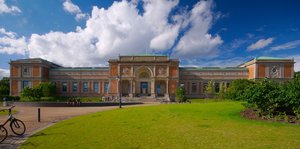 Statens Museum for Kunst |
København | 2 | Rose Laying the Table, View of Collioure |
 Fuglsang Art Museum |
Guldborgsund | 1 | Two models |
13 år adskiller Astrid Holms første og sidste daterede originaler vist her, 1903 og 1915: hvert år har sin plads nedenfor.
Vælg et årstal for at se de originale værker.


Rose Laying the Table (1914), Statens Museum for Kunst, København. Derefter følger Two models (1915) og Interior in sunlight. (1903).
38 år gammel: Rose Laying the Table er fra 1914, og Astrid Holm blev født i 1876.
Vores katalog indeholder 4 værker af Astrid Holm, dateret fra 1903 til 1915.
Primært i Statens Museum for Kunst (København) og Fuglsang Art Museum (Guldborgsund). Museumslisten ovenfor viser dem alle.
På denne side er det tidligste Interior in sunlight. (1903) og det seneste Two models (1915).
Rose Laying the Table og View of Collioure: Statens Museum for Kunst, København har 2 af værkerne på denne side.
In the vibrant tapestry of early twentieth-century Modernism, few threads are as luminous or as structurally significant as those woven by Astrid Valborg Holm. Born in Copenhagen in 1876, Holm emerged from a Danish tradition to become a pivotal figure who bridged the gap between Scandinavian sensibilities and the radical avant-garde movements of Paris. Her journey was not merely one of personal artistic evolution, but a profound cultural transmission; she acted as a vital conduit, bringing the revolutionary language of French Fauvism back to her homeland, forever altering the trajectory of Danish art.
Holm’s early training provided a rigorous foundation, beginning at the esteemed schools of Emilie Mundt and Marie Luplau before she transitioned to the Women's Art School. However, it was her departure for Paris in 1909 that would ignite her true creative spirit. It was here, under the direct tutelage of the legendary Henri Matisse, that Holm found her voice. As one of the rare Danish students to study under the master of color, she absorbed his approach to simplified forms and bold, expressive palettes. This period in Paris was transformative, allowing her to move away from traditional academic constraints toward a style characterized by heavy outlines, a lack of spatial depth, and an emotive use of color fields that echoed the very essence of Fauvism.
The breadth of Holm’s talent extended far beyond the canvas, revealing an artist who viewed the world through a lens of both painterly expression and structural design. While her oil paintings—ranging from intimate still lifes to sweeping landscapes—are celebrated for their vibrant energy, her later years saw a deep immersion into the tactile world of textiles. After studying tapestry art at the Manufacture des Gobelins in 1920, Holm began to explore the rhythmic possibilities of weaving and design.
Her artistic output can be viewed through several distinct yet interconnected lenses:
Astrid Holm’s significance lies not only in the beauty of her individual works but in her role as a pioneer for female artists and a catalyst for modern movements in Scandinavia. Her presence in the international art scene, particularly within the Scandinavian artist colony in Paris, allowed her to participate in a global dialogue of innovation. When she exhibited at Den Frie Udstilling in 1913, her modernist style caused a stir, challenging the established norms of the time and demanding a new way of seeing.
Even as she turned increasingly toward the structured discipline of weaving and tapestry design, the radical spirit of her Matisse-inspired youth remained present in her work. She fought for better educational opportunities for women in the arts, notably assisting in the arrangement of the Nordiske Kvindelige Kunstneres Udstilling in 1926. Though she passed away in 1937, the legacy of Astrid Holm remains etched in the bold colors and courageous lines of the modern era—a testament to an artist who dared to bring the light of Paris to the heart of Denmark.