


1

Alba de América (Dawn of America)
On October 12, 1492, Christopher Columbus’ 3 ships reached the coast of the West Indies. According to Christopher Columbus

Opdateret november 2026 · rangeret efter vores popularitetsscore (søgninger, besøg og ordrer for hvert værk) · 4 værker af Antonio de Brugada i vores katalog
Kort sagt
Af alle de originale værker, som Antonio de Brugada efterlod, er det mest berømte Alba de América (Dawn of America), som er en del af samlingen på Naval Museum i Madrid. Lige efter følger The Bullfight, Sevilla (1835) og Battle of Cape St. Vincent: the ship Pelayo comes to the aid of the ship Santísima Trinidad. Vores katalog indeholder 4 værker af Antonio de Brugada; galleriet har bevaret de 4 værker, som verden beundrer mest, hver vist med sin dato, sit museum og sin historie.
On October 12, 1492, Christopher Columbus’ 3 ships reached the coast of the West Indies. According to Christopher Columbus


This work depicts the Battle of Cape St. Vincent, a naval battle which took place on February 14, 1797 at Cape St. Vincent, off the Algarve coast in Portugal. Spain, allied with France, was pitted against England in the context of the French Revolutionary Wars. The painting depicts the moment when the ship Santísima Trinidad, flying under the flag of Córdoba, was attacked by the 98-gun Blenheim, the 74-gun Orion,…
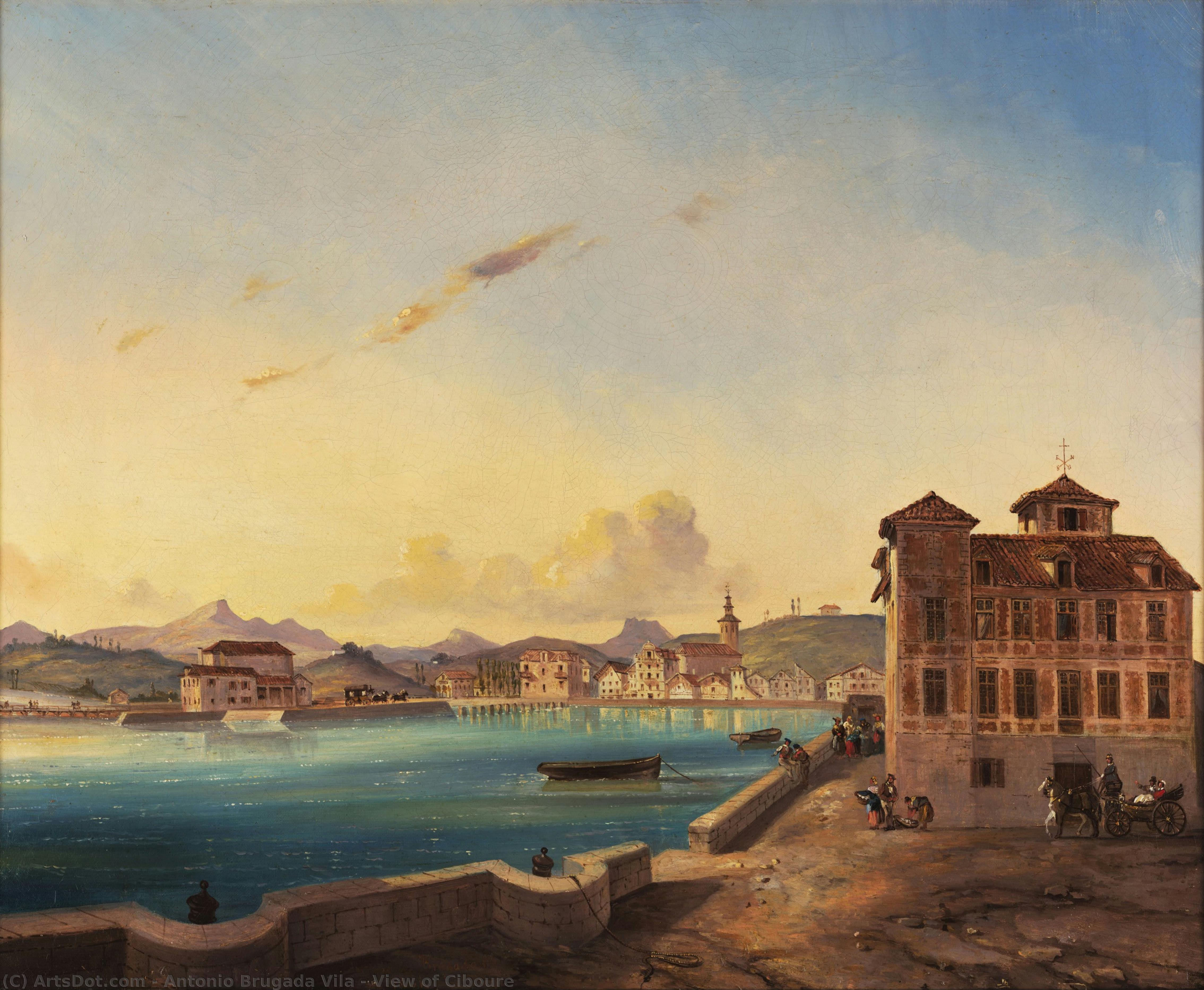
In the delicate brushstrokes of Antonio Brugada Vila’s View of Ciboure, we are transported to a moment of profound tranquility captured along the French coast. This exquisite landscape offers more than just a topographical record of a harbor; it serves as a window into the Romantic era's fascination with the interplay between man and nature. The scene, viewed from the harbor at Saint-JSON-de-Luz, presents the Maison de l’Infante in the…
De 3 museer, der rummer flest af malerierne på denne side.
| Museum | By | Værker af Antonio de Brugada | Malerier fra denne liste |
|---|---|---|---|
 Naval Museum |
Madrid | 2 | Alba de América (Dawn of America), Battle of Cape St. Vincent: the ship Pelayo comes to the aid of the ship Santísima Trinidad |
 Hispanic Society Museum - Library |
New York | 1 | The Bullfight, Sevilla |
 Gipuzkoa Heritage Collection Centre |
Irún | 1 | View of Ciboure |
1835 er året for hvert dateret Antonio de Brugada værk i dette udvalg: her er de, rangeret efter berømmelse.
Vælg et årstal for at se de originale værker.
Alba de América (Dawn of America), Naval Museum, Madrid. Derefter følger The Bullfight, Sevilla (1835) og Battle of Cape St. Vincent: the ship Pelayo comes to the aid of the ship Santísima Trinidad.
Vores katalog indeholder 4 værker af Antonio de Brugada.
Primært i Naval Museum (Madrid), Hispanic Society Museum - Library (New York) og Gipuzkoa Heritage Collection Centre (Irún). Museumslisten ovenfor viser dem alle.
Alba de América (Dawn of America) og Battle of Cape St. Vincent: the ship Pelayo comes to the aid of the ship Santísima Trinidad: Naval Museum, Madrid har 2 af værkerne på denne side.
In the annals of nineteenth-century Spanish art, few names evoke the turbulent beauty of the Atlantic as poignantly as Antonio Brugada Vila. Born in Madrid in 1804, Brugada’s life was a journey shaped by political upheaval and profound artistic encounters. His early years were defined by rigorous academic discipline at the prestigious School of Fine Arts of San Fernando in Madrid, where he studied between 1818 and 1821. This foundational training provided him with the technical mastery required to capture the raw, elemental power of nature. However, his path was not merely one of quiet study; from 1820 to 1823, Brugada served within the National Military of Madrid, an experience that likely instilled in him a sense of discipline and a keen eye for the structural grandeur found in both landscapes and maritime scenes.
The trajectory of his life shifted dramatically following the political shifts of 1823, when he sought asylum in France. Settling in Bordeaux, Brugada entered a transformative period of his career, characterized by his proximity to one of history's most formidable artistic shadows: Francisco Goya. This encounter was more than a mere meeting of contemporaries; Brugada played a vital role in the scholarly preservation of art history, assisting in the cataloging and identification of various mythological figures within Goya’s haunting Black Paintings series. This connection to the Spanish Romantic tradition deeply informed his sensibilities, infusing his later works with a sense of psychological depth and dramatic tension.
As Brugada matured as an artist, he moved away from the traditional constraints of his early training to embrace a style that was uniquely his own. He became a master of the seascape, a genre that allowed him to explore the intersection of light, motion, and chaos. His brushwork was often characterized by sweeping, energetic strokes and a bold use of color, designed to evoke the salt spray and the churning depths of the ocean. Inspired by his time spent observing the rugged coastlines, his paintings frequently feature stormy seas and dramatic, windswept cliffs that seem to vibrate with life.
His technical prowess was most evident in his meticulous attention to detail, particularly when rendering the complex rigging of ships or the delicate play of light on coastal sands. Some of his most celebrated contributions to the art world include:
The legacy of Antonio Brugada Vila resides in his ability to translate the ephemeral nature of the sea into permanent, emotive compositions. While he is often categorized within the Romantic movement, his work transcends simple period labeling through its intense focus on the elemental struggle between man and nature. He did not merely paint landscapes; he painted the very soul of the maritime experience.
Throughout the nineteenth century, Brugada stood as a bridge between the classical traditions of Madrid and the burgeoning Romanticism of France. His contributions to the study of Goya’s work ensure his place in the historical record as both a creator and a custodian of Spanish heritage. Today, his dramatic seascapes continue to resonate with modern audiences, offering a window into a period where art was used to confront the sublime, terrifying, and beautiful mysteries of the natural world.