The Soul of Spanish Renaissance Sculpture
Alonso González de Berruguete stands as a monumental figure in the history of Spanish art, recognized primarily for his profound impact on sculpture during the High Renaissance. He was not merely a craftsman; he was an artist who wrestled with theological concepts and translated them into emotionally charged forms that continue to resonate centuries later. Born in Paredes de Nava, Castile, around 1488, Berruguete's artistic journey began under the tutelage of his father, Pedro Berruguete, a respected painter whose lineage provided a foundation steeped in deep artistic tradition. This early exposure to the nuances of light and religious iconography would profoundly shape the creative vision that eventually defined a generation of Spanish art.
Following his father's untimely death in 1504, Berruguete embarked on an ambitious pilgrimage to Italy, driven by an unwavering desire to hone his skills and immerse himself in the burgeoning artistic fervor of Florence and Rome. This formative period witnessed him studying under the shadow of Michelangelo—a mentorship that undeniably influenced his stylistic sensibilities. From the Italian master, he absorbed a mastery of anatomical realism and an expressive dynamism that became the beacon guiding his own explorations into capturing human emotion with unparalleled intensity. His work began to reflect a Mannerist aesthetic, aligning him with contemporaries like Jacopo Pontorno and Rosso Fiorentino, as he prioritized psychological depth and spiritual tension over mere idealized beauty.
Mastery of Form and Emotion
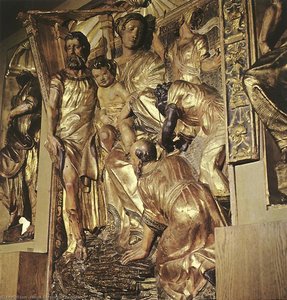
Upon returning to Spain in 1517, Berruguete swiftly ascended the ranks of Charles V’s court, securing the prestigious position of Court Painter and Sculptor. This unparalleled patronage afforded him access to the finest resources, allowing him to dedicate himself wholeheartedly to sculptural endeavors that would redefine Spanish religious art. His ability to manipulate medium—whether wood or stone—to convey divine presence is perhaps best seen in his relief works, such as the Choir-stall (detail) from 1539. In these intricate carvings, he utilized dramatic chiaroscuro and meticulous detail to breathe life into religious narratives, creating a sense of movement that feels almost supernatural.
His paintings, too, possess a haunting, emotive quality that bridges the gap between the earthly and the divine. In works like Salome, housed in Florence’s Uffizi Gallery, one can witness his mastery of poignant realism; the depiction of Salome with the head of John the Baptist is a masterpiece of tension and exquisite detail. Similarly, his Madonna and Child with the Young St John serves as an iconic testament to his ability to depict divine family unity through powerful, emotive facial expressions and graceful, elongated forms that suggest a spiritual transcendence beyond the physical realm.
A Lasting Legacy in Spanish Art
The significance of Alonso González de Berruguete lies in his unique synthesis of Italian Mannerism and Spanish devotional fervor. He did not simply import foreign styles; he transformed them to suit the intense, often somber religious temperament of the Iberian Peninsula. His achievements include:
- The Integration of Michelangelo’s Dynamism: Bringing a new sense of anatomical energy and muscular tension to Spanish sculpture.
- Development of Mannerist Aesthetics in Spain: Pioneering the use of elongated figures and psychological complexity to evoke spiritual awe.
- Mastery of Religious Narrative: Creating altarpieces and reliefs, such as those at Salamanca Cathedral, that served as profound tools for theological reflection.
- Elevation of the Sculptural Craft: Moving Spanish sculpture away from purely decorative traditions toward a high-art form capable of expressing deep human suffering and divine grace.
Through his hands, the cold stone and rigid wood of the Renaissance were imbued with a restless, searching spirit. Berruguete remains a cornerstone of the Spanish High Renaissance, an artist whose work continues to invite viewers into a profound dialogue between the beauty of the human form and the mysteries of the soul.
Spørgsmål & svar
Kan jeg udforske Alonso Gonzalez De Berruguetes værker via nøgleord?
Alonso Gonzalez De Berruguetes værker kan udforskes via nøgleord på kunstnerens Efter nøgleord-side. Hvert nøgleord grupperer de relaterede kunstværker.
Hvilke kunstværker af Alonso Gonzalez De Berruguete har flest visninger?
Siden Statistikker for Alonso Gonzalez De Berruguete præsenterer statistikker beregnet ud fra kunstnerens værker, som er listet på denne hjemmeside.
Hvor kan jeg se alle værker af Alonso Gonzalez De Berruguete?
Alle værker af Alonso Gonzalez De Berruguete på denne hjemmeside kan gennemses via kunstnerens Alle kunstværker-side.