Portræt af Albert Dunington

De 7 mest berømte Albert Dunington-malerier, hver og en unik

Opdateret november 2026 · rangeret efter vores popularitetsscore (søgninger, besøg og ordrer for hvert værk) · 7 værker af Albert Dunington i vores katalog

Kort sagt

The Queen on Board 'The Enchantress' at Trafford Wharf Ship Canal, Manchester (1894) er det maleri af Albert Dunington, der vækker mest opsigt; originalen findes på Salford Museum - Art Gallery, Greater Manchester. Derefter falder blikket på 'The Snowdrop' with the Directors of the Manchester Ship Canal Passing Barton Bridges, 7 December 1893 og Barton Aqueduct (1894). Blandt de 7 værker af Albert Dunington i vores katalog er disse 7 de mest berømte, hver især et unikt originalværk præsenteret med sit årstal, sit museum og årsagen til dets tidløse betydning.

1860 – 1941 Flest værker: Salford Museum - Art Gallery

Top 10 malerier af Albert Dunington, set gennem galleriets øjne

1
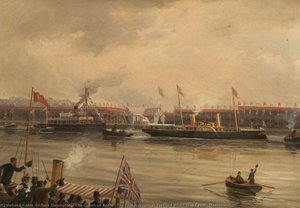
The Queen on Board 'The Enchantress' at Trafford Wharf Ship Canal, Manchester (1894) af Albert Dunington

The Queen on Board 'The Enchantress' at Trafford Wharf Ship Canal, Manchester

1894 · Watercolor · Salford Museum - Art Gallery, Greater Manchester

The scene captures a moment of regal dignity amidst the engineering marvels of the late nineteenth century. On the deck of the vessel The Enchantress, the Queen sits in a setting of quiet sophistication, surrounded by the movement of the Manchester Ship Canal. The composition balances the presence of the monarch with the bustling activity of the waterway, where several boats navigate the waters of Trafford Wharf. Flags flutter from…

2
'The Snowdrop' with the Directors of the Manchester Ship Canal Passing Barton Bridges, 7 December 1893 af Albert Dunington

'The Snowdrop' with the Directors of the Manchester Ship Canal Passing Barton Bridges, 7 December 1893

Oil On Canvas · Salford Museum - Art Gallery, Greater Manchester

The oil painting depicts a steamship named 'The Snowdrop' navigating through the waters beneath a canal bridge. The vessel occupies the foreground, its dark hull and structural lines cutting through the water. Above the ship, the arched architecture of the bridge spans the canal, creating a frame for the maritime activity. Smoke rises from the ship's funnel, drifting into an overcast sky. The scene is set against a landscape of…

4
Tintern Abbey (1894) af Albert Dunington

Tintern Abbey

1894 · Oil On Canvas · The Stirling Smith Art Gallery - Museum, Stirling

The scene captures a serene river landscape at sunset, where the sky is heavy with clouds that add depth to the horizon. A man rows a boat through the center of the water, his presence a quiet focal point amidst the vastness of the landscape. To the right, a bench sits empty, offering a silent invitation to observe the shifting light. The composition relies on the interplay of mountain silhouettes…

5
Lancing Mill, Sussex (1894) af Albert Dunington

Lancing Mill, Sussex

1894 · Oil On Canvas · The Stirling Smith Art Gallery - Museum, Stirling

In this 1894 oil on canvas, Albert Dunington depicts a working farm scene in Lancing, Sussex. The composition is centered on a field filled with hay bales, suggesting a period of harvest or grain storage. Five horses occupy the midground, some pulling carts and others being ridden by individuals. These animals move through the field alongside several people engaged in agricultural labor. In the background, a large windmill rises above…

6
Barton Aqueduct af Albert Dunington

Barton Aqueduct

Oil On Canvas · Salford Museum - Art Gallery, Greater Manchester

In this oil on canvas, we find ourselves observing a moment of stillness within a landscape defined by movement and engineering. The scene centers on a bridge spanning a river, a structure that anchors the composition and dictates the flow of the water below. Several boats rest upon the river, their presence suggesting the quiet rhythms of a working waterway. Figures move along the banks, their small scale emphasizing the…

7
Wick Harbour af Albert Dunington

Wick Harbour

· Wick Town Hall, Wick

The painting titled Wick Harbour is a work by the artist Albert Dunington. This piece measures 49 x 40 cm and depicts a harbor scene. The composition focuses on a maritime environment where several boats of various sizes are docked in the water. On the shore near these vessels, a group of people is positioned, appearing to attend to the ships or observe the surroundings.

Motiverne, der fangede Albert Duningtons blik

De fire motiver, der optræder hyppigst i disse originaler, hver med sit fineste eksempel.

De museer, der udstiller Albert Duningtons originalværker

De 3 museer, der rummer flest af malerierne på denne side.

Museum By Værker af Albert Dunington Malerier fra denne liste
Salford Museum - Art Gallery, Greater ManchesterSalford Museum - Art Gallery Greater Manchester 4 The Queen on Board 'The Enchantress' at Trafford Wharf Ship Canal, Manchester, 'The Snowdrop' with the Directors of the Manchester Ship Canal Passing Barton Bridges, 7 December 1893, Barton Aqueduct
The Stirling Smith Art Gallery - Museum, StirlingThe Stirling Smith Art Gallery - Museum Stirling 2 Tintern Abbey, Lancing Mill, Sussex
Wick Town Hall, WickWick Town Hall Wick 1 Wick Harbour

Albert Dunington gennem årene: de unikke originaler fra hver enkelt

Alle de daterede Albert Dunington-originaler, der vises her, tilhører et enkelt år, 1894: de er opstillet efter berømmelse.

Værker efter år

Vælg et årstal for at se de originale værker.

Albert Duningtons malerier: spørgsmål til galleriet

Hvad er det mest berømte værk af Albert Dunington?Vis svaret

The Queen on Board 'The Enchantress' at Trafford Wharf Ship Canal, Manchester (1894), Salford Museum - Art Gallery, Greater Manchester. Derefter følger 'The Snowdrop' with the Directors of the Manchester Ship Canal Passing Barton Bridges, 7 December 1893 og Barton Aqueduct (1894).

Hvilken alder havde Albert Dunington, da The Queen on Board 'The Enchantress' at Trafford Wharf Ship Canal, Manchester blev skabt?Vis svaret

34 år gammel: The Queen on Board 'The Enchantress' at Trafford Wharf Ship Canal, Manchester er fra 1894, og Albert Dunington blev født i 1860.

Hvor mange værker af Albert Dunington er kendt?Vis svaret

Vores katalog indeholder 7 værker af Albert Dunington.

Hvor kan de mest berømte originaler af Albert Dunington ses?Vis svaret

Primært i Salford Museum - Art Gallery (Greater Manchester), The Stirling Smith Art Gallery - Museum (Stirling) og Wick Town Hall (Wick). Museumslisten ovenfor viser dem alle.

I hvilken periode skabte Albert Dunington sine mest kendte malerier?Vis svaret

I 1894: 4 af de 7 værker på denne side blev skabt dengang, herunder The Queen on Board 'The Enchantress' at Trafford Wharf Ship Canal, Manchester.

Hvilke motiver foretrak Albert Dunington?Vis svaret

Boat (4), People (4) og Water (4), fordelt på de 7 værker på denne side.

Hvilke materialer brugte Albert Dunington mest til sine malerier?Vis svaret

Oil On Canvas, for 5 af de 7 værker på denne side.

Hvilke originalværker af Albert Dunington kan jeg se på Salford Museum - Art Gallery?Vis svaret

The Queen on Board 'The Enchantress' at Trafford Wharf Ship Canal, Manchester, 'The Snowdrop' with the Directors of the Manchester Ship Canal Passing Barton Bridges, 7 December 1893 og Barton Aqueduct: Salford Museum - Art Gallery, Greater Manchester har 4 af værkerne på denne side.

Albert Dunington: et portræt af kunstneren

The Visionary of the Victorian Canal

Albert Dunington (1860–1941) remains a singular and evocative figure in the annals of British watercolour and oil painting, a master who captured the very soul of a transforming nation. Born in Lewisham, Kent, Dunington emerged from the prestigious Slade School of Fine Art, where his artistic sensibilities were forged under the watchful eyes of titans such as Frederic Leighton and Joseph Noel Paton. This rigorous classical training provided him with a profound command over composition and anatomy, yet it was his unique ability to marry this academic precision with a Romantic sensibility that truly defined his legacy. His work does not merely document landscapes; it breathes life into the industrializing veins of late nineteenth-century Britain, offering a window into an era where the pastoral beauty of the countryside met the burgeoning might of engineering progress.

The essence of Dunington’s oeuvre lies in his unparalleled ability to render the atmospheric nuances of the British landscape. He possessed an almost scientific eye for the subtle interplay of light, mist, and shadow, techniques that allowed him to imbue even the most industrial scenes with an ethereal, dreamlike quality. Whether he was capturing the quiet ripples of the Worcestershire Canal or the dramatic sunset over a river landscape, his brushwork conveyed a deep emotional resonance. His dedication to realism was never hollow; rather, it was underpinned by a sophisticated understanding of colour theory that allowed him to recreate the textures of stone, water, and sky with breathtaking fidelity. In his hands, the damp air of an English morning or the golden warmth of a departing sun became palpable elements that the viewer could almost feel.

A Legacy of Progress and Pastoral Serenity

Dunington’s artistic journey was marked by a fascinating tension between the celebration of natural beauty and the documentation of human achievement. He was an artist who found profound meaning in the intersection of nature and industry, a theme most vibrantly expressed in his depictions of the Manchester Ship Canal. His celebrated work, ‘The Snowdrop’ with the Directors of the Manchester Ship Canal Passing Barton Bridges (1893), serves as a magnificent historical document, capturing the grandeur of steamships and the excitement of engineering marvels set against the timeless backdrop of the Sussex countryside. This ability to find beauty in the mechanical and the monumental allowed him to transcend simple landscape painting, turning his canvases into narratives of national identity and progress.

Beyond the industrial, Dunington’s repertoire extended into the deeply tranquil and the classically sublime. His paintings often invite a sense of quiet contemplation, as seen in works like Tintern Abbey, where he masterfully utilizes soft brushstrokes and muted tones to evoke a sense of peace. In these pieces, the artist explores the relationship between man and the environment, often placing solitary figures within vast, sweeping vistas to emphasize the grandeur of the natural world. His prolific output, which includes over 300 paintings, demonstrates a lifelong commitment to exploring these diverse themes:

  • The Industrial Landscape: Capturing the monumental scale of new canals and bridges, documenting the era of great engineering feats.
  • Rural Life: Detailed portrayals of agricultural scenes, such as Lancing Mill, Sussex, which offer a nostalgic glimpse into the rhythms of late Victorian farming.
  • Atmospheric Studies: A mastery of light and weather, from the heavy mists of river valleys to the dramatic clarity of mountain vistas.
  • Historical Documentation: Creating lasting visual records of specific events and landmarks that shaped the British landscape.

Today, the works of Albert Dunington continue to resonate within public collections across Britain and beyond. His significance lies not only in his technical virtuosity but in his role as a visual chronicler of a pivotal moment in history. He captured a world in transition—a world where the ancient traditions of the English landscape were being reshaped by the relentless march of the industrial revolution, leaving behind a legacy of art that is as much about the enduring spirit of nature as it is about the indelible mark of human progress.