The Genesis of Pure Form: From Cubist Foundations to Geometric Autonomy
To understand the profound impact of geometric abstraction, one must first look back at the fragmentation of reality that occurred at the dawn of the twentieth century. Before the canvas was liberated into pure, non-objective form, the world was still tethered to the recognizable. The Cubist movement, led by visionaries like Picasso and Braque, acted as the essential precursor, deconstructing the three-dimensional subject into a series of overlapping planes and multifaceted perspectives. This period did not merely change how we see objects; it fundamentally altered the relationship between the viewer and the pictorial plane.
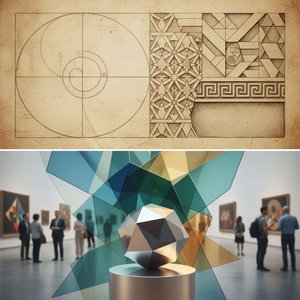
As these early experiments progressed, the focus shifted from representing a subject through geometric fragments to the creation of geometry as the subject itself. The tension between what is seen and what is felt began to dissolve, allowing artists to move beyond the imitation of nature. This evolution was not merely a technical shift in brushwork but a philosophical departure—a movement toward an autonomy where lines, circles, and squares possessed their own inherent weight and meaning, independent of any external reference point.
This transition marked the birth of a new visual language, one that promised to communicate universal truths through the most elemental components of sight. By stripping away the anecdotal and the descriptive, artists paved the way for a form of expression that was both intellectually rigorous and emotionally resonant, setting the stage for the radical revolutions that were to follow.
Suprematism and the Spiritual Void: The Revolutionary Vision of Kazimir Malevich
At the heart of this geometric revolution stands the monumental figure of Kazimir Malevich, the Ukrainian pioneer whose development of Suprematism redefined the boundaries of human perception. For Malevich, abstraction was not a mere stylistic choice but a spiritual necessity. He sought to reach what he termed the "supremacy of pure feeling," a state where art is no longer a slave to the material world but a vessel for profound, non-objective experience. His iconic works, such as the Black Square, were not intended to be empty; rather, they represented a zero point of painting—a descent into the void to find a new, unadulterated truth.
The Suprematist movement utilized geometric forms and vibrant, often stark colors to evoke a sense of cosmic depth. In works like Suprematist Composition, the arrangement of shapes suggests a weightlessness, as if the elements are floating in an infinite, white expanse. This use of space was revolutionary; it removed the horizon line and the traditional ground, forcing the collector to engage with the painting as a self-contained universe. The tension between the heavy, dark masses and the light, ethereal voids creates a rhythmic energy that vibrates with spiritual intensity.
To contemplate Malevich’s work is to confront the sublime. His ability to use the simplest of geometries—the square, the circle, the cross—to touch upon the infinite remains one of the most significant achievements in art history. Through Suprematism, the canvas became a site of metaphysical exploration, proving that the most minimal forms could carry the heaviest emotional and spiritual burdens.
The Architecture of Emotion: Analyzing Color, Balance, and Tension in Abstract Composition
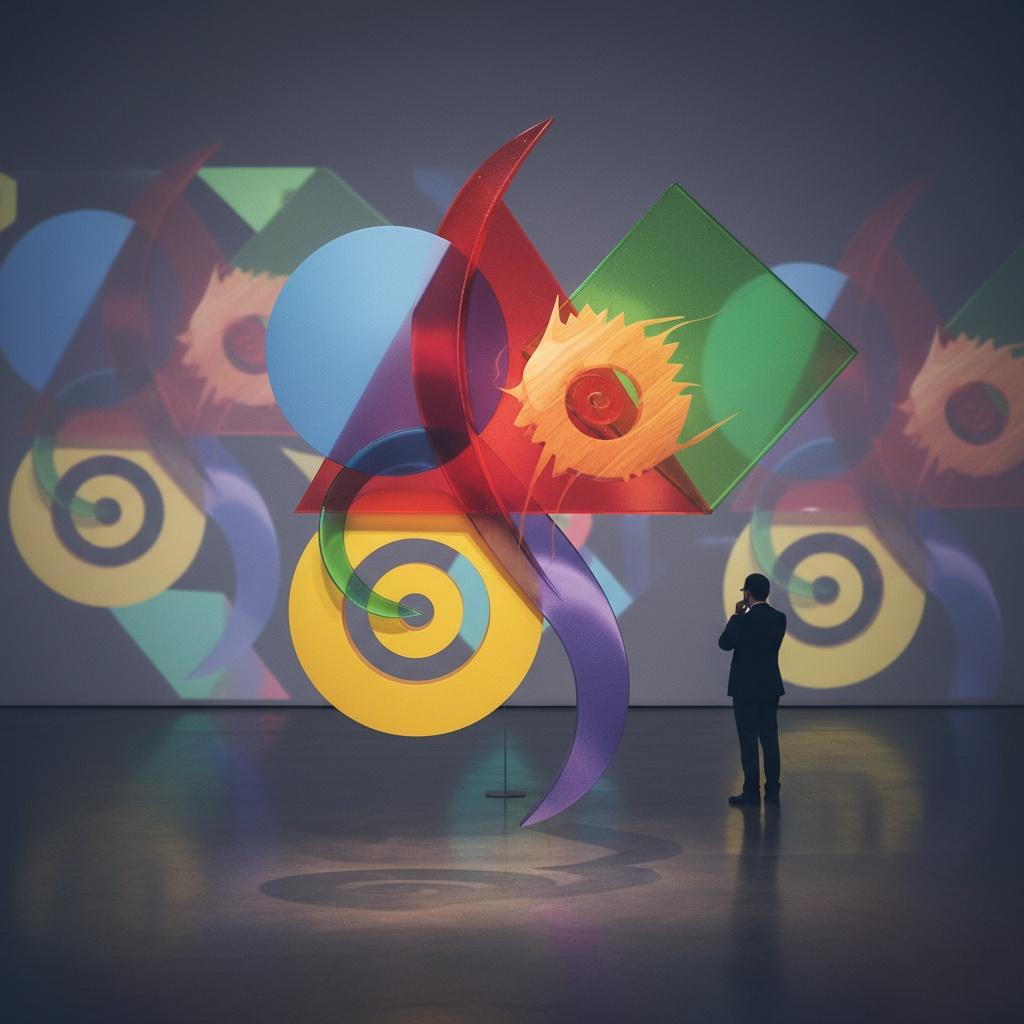
Beyond the historical narratives lies the technical mastery required to command a geometric composition. For the discerning collector, the allure of abstract art often resides in the subtle interplay of balance and tension. A successful abstract work does not rely on a central figure to guide the eye; instead, it utilizes the placement of shapes to create a visual equilibrium that is both dynamic and stable. When a large, dark mass is placed in opposition to a small, brightly colored dot, a psychological weight is created, pulling the viewer’s gaze across the canvas in a choreographed dance of perception.
Color plays an equally vital role in this architectural construction. In geometric abstraction, color is never merely decorative; it is structural. Bold, primary hues can provide a sense of permanence and strength, while softer, more translucent layers can introduce a sense of movement or atmospheric depth. The way colors interact—whether they clash to create visual friction or harmonize to produce a sense of serenity—dictates the emotional temperature of the piece. This is where the "soul" of the painting resides, in the silent dialogue between pigment and form.
Furthermore, the concept of tension is achieved through the careful management of negative space. The area surrounding a shape is just as critical as the shape itself. In a well-executed composition, the "empty" space feels pressurized, as if it is actively pushing against the geometric elements. This invisible pressure creates a sense of life and breath within the work, ensuring that even the most static arrangement of squares and lines possesses an underlying vitality that captivates the observer long after the initial encounter.
Constructivism and Beyond: The Legacy of Geometric Precision in Modern Design
As the twentieth century progressed, the principles of geometric abstraction migrated from the purely spiritual realms of Suprematism into the functionalist ideologies of Constructivism. Artists such as Paul Kelpe and others influenced by the Russian avant-garde began to view geometry through a more utilitarian lens. Here, the focus shifted toward the "construction" of art, treating the canvas as an engineered object. This movement emphasized the integration of art with industry, architecture, and graphic design, proving that the language of abstraction could be applied to the very fabric of modern life.
The legacy of this era is visible in the clean lines and structural clarity of contemporary design. The precision found in Constructivist works—characterized by intersecting planes and a sense of mechanical rhythm—laid the groundwork for much of the 20th-century aesthetic, from Bauhaus architecture to modern typography. This period demonstrated that geometric forms could communicate order, progress, and the excitement of a new, technological age.
Even in the hands of later artists like Gennady Zubkov, we see the echoes of this precision blended with more vibrant, expressive textures. The evolution of geometric abstraction is thus a continuous thread, moving from the radical deconstruction of reality to the sophisticated construction of a modern visual identity. It remains a cornerstone of our visual culture, influencing everything from the grand scale of urban murals to the intimate details of high-end product design.
Curating the Abstract: Integrating Geometric Masterpieces into Sophisticated Interiors
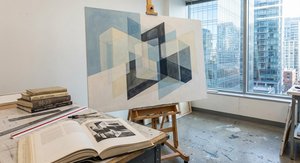
For the contemporary collector, incorporating geometric abstraction into a curated space requires an understanding of both aesthetic harmony and architectural impact. Unlike representational art, which often tells a specific story, abstract works act as atmospheric anchors. A large-scale, multi-panel geometric work can serve to expand the perceived boundaries of a room, while a singular, bold composition can act as a focal point that defines the character of an entire gallery or living space.
When selecting pieces for a sophisticated interior, consider the relationship between the artwork’s color palette and the surrounding environment. A minimalist room with neutral tones provides the perfect stage for a high-contrast Suprematist reproduction, allowing the bold blacks and reds to command attention. Conversely, an interior rich in texture and warmth can be complemented by works that utilize softer, more complex geometric arrangements, creating a sense of layered depth.
Ultimately, the goal of curating abstraction is to create a dialogue between the art and the architecture. Whether through the use of multi-panel layouts that span wide walls or the selection of textured oil paintings that provide tactile interest, these works bring a sense of intellectual rigor and timeless elegance to any collection. By embracing the power of pure form, one does not merely decorate a room; one elevates the entire experience of the space.
At OriginalUniqueArt.com, we specialize in preserving this profound artistic legacy. From meticulously handcrafted oil reproductions that capture the impasto texture of the masters to museum-quality Giclée prints, our mission is to make the power of geometric abstraction accessible to collectors worldwide. Whether you are seeking a bespoke commission or a transformative piece for your home, our expertise ensures that every work reflects the true spirit and depth of art history.