Introduction
The Dutch realist painters emerged from a profound desire to capture the unvarnished truth of existence, turning their gaze away from idealized mythology and toward the tangible reality of the everyday. Rooted in the cultural landscape of the Netherlands, these artists sought to document the dignity of manual labor, the quietude of domestic life, and the raw textures of the natural world. Rather than embellishing their subjects to meet classical standards of beauty, they embraced the honest imperfections of the human condition and the subtle, shifting light of the Low Countries.
During this movement, the canvas became a mirror for the social fabric of the time. These painters moved beyond the grand narratives of the past to find profound meaning in the mundane: a fisherman mending a net, a peasant at rest, or the weathered face of a laborer. This commitment to accuracy and sincerity allowed them to create works that resonate with a timeless, human quality, bridging the gap between the observer and the observed through meticulous detail and a deep respect for the subject matter.
Today, these masters remain vital for their ability to evoke empathy and provide a window into a vanished way of life. Their influence persists in the way we perceive light and texture, reminding us that there is inherent artistry in the simplest moments of life. In the following sections, we examine ten significant figures of this movement, including Jozef Israëls, Hendrik Willem Mesdag, and Evert Pieters, whose works exemplify the profound depth and technical mastery of Dutch realism."
Jozef Israëls
 Portrait of Samuel Juda Oppenheim (1785-1873) - Jozef Israëls
A pivotal moment in the life of Jozef Israëls occurred after a period of illness led him to the coastal town of Zandvoort. It was there, while observing the harsh, unvarnished realities of fishermen and their families, that his artistic focus shifted away from Romanticism toward a profound, emotive realism. This transition defined his legacy as a leading figure of the Hague School, where he dedicated his brush to the dignity of the common person.
His commitment to the Dutch realist movement is evident in his ability to depict ordinary existence without embellishment. In his Portrait of Samuel Juda Oppenheim (1785-1873), we see an early mastery of this psychological depth. Though painted during his formative years, the work demonstrates the technical refinement and somber tonal range that would later characterize his depictions of peasant life. Through a restrained palette of blacks and ochre tones, he captures a sense of intellectual gravity and quiet presence.
By focusing on the weathered textures of life and the subtle interplay of light and shadow, Israëls moved beyond mere likeness to capture the very temperament of his subjects, cementing his place among the most significant realist painters from the Netherlands.
Joos Vincent De Vos
 Peasant Woman Peeling Potatoes - Joos Vincent De Vos
In Peasant Woman Peeling Potatoes (1885), the quiet dignity of manual labor is captured through a focused, observational lens. The subject is immersed in the repetitive task of domestic sustenance, her posture and the tactile quality of the vegetables rendered with a grounded, earthy palette. This work exemplifies why Joos Vincent De Vos is a significant figure among Dutch realist painters; his art avoids idealization, choosing instead to document the physical reality of the working class and the solitude of daily chores.
Born in Zundert in 1853, De Vos received his foundational training at the Academy of Kortrijk under Philip De Witte and Edward Woutermaetens. While his technical skill allowed him to master genre scenes, he became most renowned for his unique brand of realism involving animals. He frequently depicted monkeys, dogs, and cats in human-like scenarios—often referred to as singeries—frequently placing these creatures within the solemn architecture of churches and monasteries. His ability to blend meticulous naturalistic detail with a subtle, satirical psychological insight allowed him to carve out a distinctive niche in 19th-century European art, bridging the gap between scientific observation and social commentary.
Otto Erelman
 Portrait of Anna Frederica Braak, wife of the painter - Otto Erelman
Otto Erelman (1839–1926) was a master of the observational truth that defines the Dutch realist movement. While many of his contemporaries sought the grandiosity of historical scenes, Erelman found profound dignity in the anatomical precision of animals. His technical mastery was forged at the Academie Minerva and refined at the Royal Academy of Fine Arts in Antwerp, eventually leading him to serve as a court painter to Queen Wilhelmina. This proximity to royalty required a level of accuracy that left no room for idealization, a hallmark of the realist approach.
In his 1881 work, Portrait of Anna Frederica Braak, wife of the painter, we see how his commitment to realistic detail extended beyond his famous equine and canine subjects to the human form. The painting is a masterclass in texture and light; the artist captures the heavy, tactile quality of lace and the subtle softness of skin against a somber, dark interior. By focusing on the quiet, material realities of a private life—the glint of a ring or the weight of a book—Eerelman remains a quintessential figure among Dutch realist painters, capturing the essence of his subjects through meticulous, unembellished observation.
Cornelius Krieghoff
 Indian Wigwam in Lower Canada - Cornelius Krieghoff
Cornelius Krieghoff represents a unique intersection of Dutch heritage and the North American frontier. Born in Amsterdam in 1815, his artistic foundation was shaped by the rigorous traditions of European training, yet his legacy is defined by his departure from them. He belongs to the Dutch realist painters group through his commitment to documenting the unvarnished realities of life as they were encountered, eschewing idealized romanticism in favor of precise, observational truth.
His work is characterized by a profound ability to capture the textures of daily existence and the specificities of landscape. In his 1848 work, Indian Wigwam in Lower Canada, this realist impulse is clearly evident. The piece avoids the grandiosity often found in colonial art, instead focusing on a quiet, intimate moment of community life. Through the depiction of a central wigwam, resting figures, and the presence of a dog and boats, Krieghoff provides a detailed ethnographic and environmental record. His ability to render the stillness of a gathering and the functional elements of the encampment demonstrates the core tenets of realism: the elevation of the ordinary and the meticulous documentation of a specific time and place.
Evert Pieters
 A Family Meal - Evert Pieters
Evert Pieters (1856–1932) exemplifies the Dutch realist movement through his profound commitment to depicting the unadorned beauty of everyday existence. His artistic foundation was uniquely tactile, beginning not in a studio but through a practical apprenticeship as a house painter in Amsterdam. This early exposure to the physical properties of pigments provided a grounded, sincere quality to his later brushwork. After refining his technique at the Academy of Amsterdam and studying under masters like Charles Verlat in Antwerp, Pieters developed a style that bridged classical structure with the atmospheric sensibilities of the Barbizon School.
His work is defined by a mastery of light and a deep connection to the earth, often focusing on rural landscapes, floral arrangements, and intimate domestic scenes. In his 1894 masterpiece, A Family Meal, Pieters captures the quietude of a rustic interior. Through a careful use of chiaroscuro, he illuminates a woman and children gathered around a wooden table, transforming a simple, repetitive moment of domestic life into a study of stability and light. By eschewing the grandiose in favor of these sincere, lived-in moments, Pieters secured his place among the significant realist painters of the Netherlands.
Adrianus Eversen
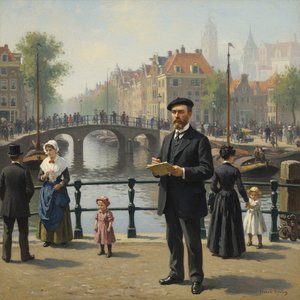
 scene in a street - Adrianus Eversen
When standing before a work by Adrianus Eversen, you are immediately transported into the atmospheric heart of the 19th-century Netherlands. His paintings are instantly recognizable by their masterful command of light and their ability to evoke a profound sense of nostalgia through detailed urban and village scenes. Unlike those who sought to dramatize history, Eversen found his purpose in the quiet, everyday essence of Dutch life, making him a quintessential figure among Dutch realist painters. He focused on the tangible reality of his surroundings, capturing the textures of architecture and the gentle movement of daily life without embellishment.
In his representative work, <scene in a street>, executed around 1843, we see the artist's early mastery of structured perspective and architectural detail. This piece showcases his ability to organize a bustling street through a receding line of gabled buildings, creating a deep sense of space. Trained under Hendrik Gerrit ten Cate, Eversen developed a unique approach that often blended real architectural fragments with a touch of imagination. This ability to balance faithful observation with an idealized, atmospheric vision allowed him to transform ordinary townscapes into evocative windows into the past.
Constantin Guys
 The sultan's carriage - Constantin Guys
Constantin Guys stands as a vital figure among Dutch realist painters due to his ability to document the raw, unvarnished pulse of nineteenth-century life. Born in Vlissingen in 1802, he moved beyond idealized subjects to capture the grit of military campaigns and the shifting social hierarchies of urban environments. His work is characterized by a journalistic precision that aligns him with the realist movement, focusing on the authentic mechanics of daily existence rather than romanticized grandeur. His background in anatomy and his lived experiences in the cavalry provided him with a profound understanding of movement and human form, allowing him to depict the world exactly as it unfolded.
In his representative work, The sultan's carriage, this realist sensibility is masterfully expressed through watercolor. The composition avoids heavy textures in favor of precise lines and tonal gradations to illustrate a bustling scene of social interaction and transit. He captures a complex arrangement of thirteen figures and horses, emphasizing the structural reality of the large, multi-tiered carriage. Through subtle color shifts, Guys documents the varied textures of clothing and the anatomical vitality of the animals, creating a vivid, immediate snapshot of organized movement and the social order of the era.
Johannes Frederik Hulk
 An Irish Setter - Johannes Frederik Hulk
Johannes Frederik Hulk (1829–1913) stands as a quintessential figure among Dutch realist painters due to his unwavering commitment to the authentic rhythms of daily life. Eschewing the grandiosity of historical allegories, Hulk focused his lens on the tangible, unadorned realities of the Netherlands, from the bustling activity of Amsterdam’s canals to the quietude of domestic interiors. His work embodies the core tenets of Realism by portraying the world with a clarity and honesty that celebrates the ordinary over the idealized.
His technical precision was forged at the prestigious Rijksakademie in Amsterdam, following early guidance from his brother, the marine painter Abraham Hulk Senior. This formal training allowed him to master the subtle interplay of light and atmosphere, a skill evident in his ability to capture spontaneous, unposed moments. In his representative work, An Irish Setter, this realist sensibility is applied to a singular, spirited subject. Rather than a static portrait, the painting captures a dog in mid-stride, its brown and white coat textured by movement as it races through a grassy field. By focusing on the unbridled joy and physical energy of a simple animal in nature, Hulk demonstrates the movement's dedication to finding profound beauty in the immediate and the everyday.
Hendrik Willem Mesdag
 Fishing Boats from Scheveningen Anchored - Hendrik Willem Mesdag
Hendrik Willem Mesdag stands as a cornerstone of Dutch realist painters due to his unflinching dedication to the atmospheric truths of the North Sea. Eschewing the idealized landscapes of previous eras, Mesdag embraced the raw, unbridled energy of the coast, capturing the rhythmic power of tides and the salt-stained reality of maritime life. His commitment to depicting the natural world exactly as it appeared—unadorned and monumental—firmly places him within the realist tradition of the Hague School.
In his work Fishing Boats from Scheveningen Anchored, this realist sensibility is profoundly evident. The painting avoids dramatic artifice, focusing instead on a moment of stillness where heavy vessels rest against the shoreline. Through a muted, tonal palette of soft greys and pale blues, Mesdag captures the diffused light of an overcast sky, grounding the scene in a tangible, lived-in reality. The composition, defined by a low horizon and the verticality of masts against the vast expanse of the sky, emphasizes the quiet, heavy atmosphere of the Dutch coast. By documenting the intersection of sand, tide, and labor, Mesdag transforms a mundane maritime scene into a profound study of environmental truth.
Oene Romkes De Jongh
 The Fortified City Castle Oudaen On The Oude Gracht In Winter - Oene Romkes De Jongh
Oene Romkes De Jongh (1812–1896) stands as a significant figure among Dutch realist painters due to his commitment to capturing the unvarnished atmosphere of the nineteenth-century Netherlands. Born in Makkum, Friesland, his artistic development was deeply shaped by his training in Haarlem, where he studied under the influential Anton Mauve. This lineage connected him to the Hague School, instilling in him a meticulous approach to color blending and a profound ability to render the subtle interplay of light and shadow.
De Jongh’s work is defined by its dedication to the realistic depiction of winter cityscapes, particularly the frozen canals and snowy streets of Amsterdam. Rather than idealizing these scenes, he focused on the quiet, often melancholic reality of urban life during the winter months. His masterpiece, The Fortified City Castle Oudaen On The Oude Gracht In Winter, exemplifies this mastery. In this work, he captures a frozen silence, using a disciplined precision to render the way snow clings to rooftops and how silvery, overcast light interacts with heavy, dark architecture. By documenting these mundane yet atmospheric moments of daily life, De Jongh secured his place as a specialist in the realist tradition.
Conclusion
The legacy of these Dutch realist painters lies in their profound ability to find dignity in the mundane. From the atmospheric maritime scenes of Hendrik Willem Mesdag to the intimate, everyday struggles captured by Jozef Israëls, these artists moved away from idealized mythology to embrace the raw, unvarnished truth of human existence and the natural world. Whether through the meticulous detail of landscape or the somber tones of social portraiture, each master contributed a unique layer to a movement that celebrated the beauty of the ordinary.
For those looking to bring this sense of historical depth and quiet contemplation into their own living spaces, OriginalUniqueArt.com offers a way to connect with these masters. Our full collection allows you to explore a vast array of Dutch heritage. We specialize in creating museum-quality, hand-painted oil reproductions that capture the authentic texture and soul of these original works, allowing you to live with the profound honesty of Dutch Realism every day.