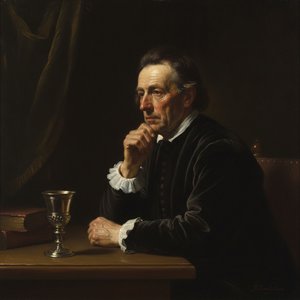
The Genesis of Shadow: Rembrandt’s Early Years and the Influence of Leiden
A Life Illuminated: The World of Rembrandt van Rijn Rembrandt Harmenszoon van Rijn, a name synonymous with the Dutch Golden Age and a master of light and shadow, was born in Leiden, Netherlands, on July 15, 1606. He wasn’t simply a painter; he was a ...
To understand the profound weight of a Rembrandt masterpiece, one must first wander through the cobblestone streets of 17th-century Leiden. Born in 1606, Rembrandt Harmenszoon van Rijn entered a world where the Dutch Republic was beginning to breathe with the newfound vitality of the Golden Age. His upbringing, rooted in the comfortable stability of a middle-class family—the son of a miller—provided him with the intellectual foundation necessary to pursue classical learning at Leiden’s Latin School. Yet, it was not through dusty manuscripts alone that his genius took shape, but through the tactile reality of light filtering into the studios of his mentors.
His early apprenticeship under Jacob van Swanenburg planted the initial seeds of observation, but it was his transformative period in Amsterdam under Pieter Lastman that truly ignited his spirit. Lastman, a master of dramatic historical narratives, introduced the young artist to the power of movement and the importance of theatrical composition. This era of formation was not merely about learning to hold a brush; it was an immersion into a culture of storytelling where every shadow could whisper a secret and every highlight could proclaim a truth. As he moved from the academic rigor of Leiden to the bustling, commercial heart of Amsterdam, Rembrandt began to synthesize these influences, preparing to redefine the very boundaries of what a canvas could convey.
Chiaroscuro Defined: The Dramatic Interplay of Light and Dark
 Chiaroscuro
In art, chiaroscuro (English: kee-AR-ə-SKOOR-oh, -SKURE-, Italian: [ˌkjaroˈskuːro]; lit. 'light-dark') is the use of strong contrasts between light and dark, usually bold contrasts affecting a whole composition. It is also a technical term used by a...
In the lexicon of art history, few terms carry as much evocative weight as chiaroscuro. Derived from the Italian words for light and dark, this technique is far more than a mere stylistic choice; it is a fundamental manipulation of perception. While many of his contemporaries used contrast to define form, Rembrandt elevated it to a spiritual dimension. He did not simply illuminate a subject; he orchestrated a symphony of tension where the darkness was as vital as the light itself. This bold use of strong contrasts allowed him to achieve a sense of three-dimensional volume, making figures emerge from the gloom with an almost startling physical presence.
The brilliance of his approach lies in the way he directs the viewer's gaze. By plunging large portions of his compositions into deep, velvety shadows, he forces the eye to seek out the illuminated fragments—a glint on a ring, the curve of a cheek, or the moisture in an eye. This technique creates a focused intensity, a visual spotlight that strips away the unnecessary and leaves only the essential. It is a controlled drama, where the darkness acts as a silent stage, allowing the light to perform its most poignant narratives. Through this mastery, Rembrandt transformed the flat surface of a canvas into a profound space of depth and mystery.
The Soul in the Shadows: Psychological Depth and Narrative Innovation
 Rembrandt's Masterpieces: Explore 25 Iconic Paintings & Prints | OriginalUniqueArt
Introduction To gaze upon Rembrandt van Rijn’s canvases is to encounter not merely paintings, but windows into the very soul of humanity. This collection—a curated selection of twenty-five masterpieces—represents the breadth and depth of an artist wh...
Beyond the technical brilliance of his lighting lies the true heart of Rembrandt’s legacy: his unparalleled ability to capture the human condition. Unlike the idealized, often distant figures found in Renaissance art, Rembrandt’s subjects are profoundly, even vulnerably, human. He was a visual storyteller who looked past the surface of his sitters to find the quiet dignity and the internal struggles etched into their faces. Whether he was painting a wealthy merchant or a biblical figure, there is an unmistakable sense of psychological intimacy that transcends time.
This emotional resonance is achieved through his innovative use of light as a narrative device. He used highlights not just to show shape, but to reveal emotion—the flicker of doubt in a brow, the warmth of compassion in a smile. His portraits, including his nearly one hundred self-portraits, serve as a lifelong diary of aging, loss, and resilience. By embracing the imperfections of reality—the wrinkles, the weary eyes, the weathered skin—he created works that resonate with an enduring truth. He understood that the most profound stories are often found in the quietest moments, hidden within the interplay of light and the vast, unexplored territories of the shadow.
Beyond the Canvas: The Legacy of Rembrandt Lighting in Modern Visual Arts
Rembrandt lighting is a standard lighting technique that is used in studio portrait photography and cinematography; it is also used in contrast with butterfly lighting It can be achieved using one light and a reflector, or two lights, and is popular ...
The influence of Rembrandt’s hand extends far beyond the gilded frames of the 17th century. His aesthetic DNA is woven into the very fabric of modern visual storytelling. In the realm of studio portrait photography and cinematography, the term "Rembrandt lighting" remains a standard of excellence. This specific technique, characterized by the small, illuminated triangle of light beneath the eye on the shadowed side of the face, continues to be used to create images that feel both natural and compelling. It provides a sense of depth and character that flat lighting simply cannot replicate.
This legacy is a testament to his understanding of how light shapes our emotional response to an image. From the dramatic noir films of the mid-20th century to the high-contrast aesthetics of contemporary digital photography, the principles of Rembrandt’s chiaroscuro continue to guide creators in capturing the essence of their subjects. He taught us that shadow is not an absence of information, but a tool for focus, and that by controlling what we hide, we can more powerfully reveal what we wish to show.
A Golden Age of Texture: The Technical Mastery of Pigment and Glaze
To truly appreciate the depth of a Rembrandt, one must look closely at the physical substance of the paint itself. His technique was a masterclass in the alchemy of pigments. He was known for his incredible ability to layer glazes—thin, translucent applications of oil—to create a luminous quality that seems to emanate from within the painting. This layering allowed him to build up complex tones, where light travels through multiple strata of color before reflecting back to the viewer, creating a sense of inner radiance.
Furthermore, his use of texture, or impasto, provided a tactile dimension to his work. In certain areas, he applied paint so thickly that it stood in relief from the canvas, catching actual light and casting its own miniature shadows. This interplay between the smooth, glass-like glazes and the rugged, textured highlights created a sensory experience that engaged both the eye and the imagination. It is this meticulous attention to the chemistry of his materials—the careful selection of oils and the precise application of pigment—that ensures his works remain vibrant and structurally sound, preserving the visceral energy of his brushstrokes for centuries to come.
At OriginalUniqueArt.com, we share this profound reverence for the masters of light and shadow. Our mission is to bring the breathtaking beauty of the Old Masters into the modern home through exquisite, hand-painted oil reproductions. Each piece is a labor of passion, meticulously crafted by artists trained in the finest academic traditions to ensure every brushstroke and every glint of light honors the original's soul. Whether you seek to transform a personal memory into a masterpiece or wish to adorn your space with the dramatic elegance of the Dutch Golden Age, we invite you to explore our collection and experience the enduring power of art.