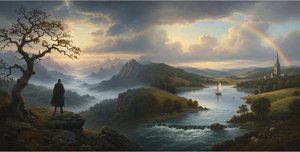
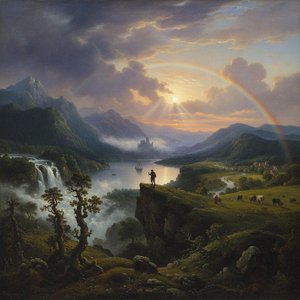
The Dawn of Feeling: Romanticism's Rejection of Enlightenment Rationality The late 18th century witnessed a seismic shift in intellectual and artistic currents, a turning away from the cool precision of the Enlightenment towards a fervent embrace of ...
The late eighteenth century arrived with a profound sense of clarity, anchored by the principles of the Enlightenment. This era celebrated the measurable, the observable, and the structured symmetry of Neoclassicism, where logic and scientific inquiry provided a stable framework for understanding the world. European thought was a sunlit landscape of reason, yet beneath this surface, a deep spiritual discontent began to take root. As the Industrial Revolution introduced the soot of burgeoning factories and the alienation of crowded, expanding cities, the clinical order of the age felt increasingly insufficient to capture the true complexity of human experience.
This tension finds its historical echo in the German Sturm und Drang movement. Before Romanticism became a widespread aesthetic, this "Storm and Stress" period challenged the Enlightenment's claim that humans could comprehend everything through rationality alone. It championed intuition and the raw power of individual feeling. This intellectual rebellion paved the mathematical perfection of classical forms with a new, more visceral truth. Artists began to seek refuge in the subjective, turning away from the instructional line toward an art that prioritized the internal landscape of the soul.
Defining the Sublime: The Intersection of Terror and Beauty
The Rejection of Reason: The Intellectual Origins of Romanticism The Evocative Brushstroke: Exploring Emotion, Individuality & the Sublime in Romanticism's Artistic Landscape The Dawn of Feeling: Romanticism's Rejection of Enlightenment Rationality T...
To understand the Romantic era, one must grasp the distinction between the beautiful and the sublime. While beauty is often associated with proportion, smoothness, and a calming effect on the nerves, the sublime operates on a much more intense frequency. It is a quality of greatness that exceeds all possibility of calculation or measurement. As the British statesman Edmund Burke articulated in his 1757 treatise, the sublime involves a certain degree of terror. It is found in the vastness of space, the infinity of the ocean, and the overwhelming scale of mountain ranges—elements that possess the power to compel and even destroy us.
This philosophical distinction finds its parallel in the ancient rhetorical traditions of Longinus. Centuries before the Romantics, Longinus described the sublime as an elevated or lofty quality of thought and language that inspires awe and veneration. While his focus was on the power of rhetoric to move an audience, the Romantic painters adopted this sense of "uplifted" emotion and applied it to the physical world. They sought to create works that did not merely please the eye but struck the soul with a sense of profound, often unsettling, greatness.
Nature’s Uncontrollable Power: Landscapes of Chaos and Majesty
The Shipwreck: A Romantic Vision of Nature's Fury William Turner’s "The Shipwreck," created in 1805, stands as a quintessential representation of the Romantic movement in art. This oil on canvas masterpiece, measuring 171 x 240 cm and currently resid...
In Romantic art, nature was rarely depicted as a peaceful, pastoral retreat. Instead, it became a stage for the display of uncontrollable power and cataclysmic extremes. Artists sought to capture the unpredictable energy of shipwrecks, violent storms, and jagged peaks. These scenes were not mere topographical records; they were meditations on vulnerability. The recurring imagery of turbulent seas and swirling vortices served as a reminder of humanity's fragility when confronted with the elemental forces of the earth.
We see this dramatic tension clearly in the works of J.M.W. Turner, particularly in his depiction of The Shipwreck. In this work, the sea is not a calm surface but a chaotic force of destruction, where dark skies and churning waves swallow the light. This mirrors the earlier aesthetic observations made by travelers crossing the Alps, such as Joseph Addison, who noted that the mountains could fill the mind with an "agreeable kind of horror." The landscape becomes a living entity, capable of both immense majesty and sudden, terrifying upheaval.
The Solitary Observer: Individualism and the Human Scale
A Window into the Sublime: Exploring Caspar David Friedrich’s *Rocky Ravine* Caspar David Friedrich's *Rocky Ravine*, painted in 1822, is a quintessential example of German Romanticism – a movement that prioritized emotional experience and the awe-in...
A central tenet of Romanticism is the elevation of the individual experience. This movement moved away from grand, collective historical narratives to focus on the solitary figure—the wanderer lost in thought or the observer dwarfed by the infinite. By placing a small, often isolated human figure within a vast landscape, artists could emphasize the tension between human insignificance and geological permanence. The viewer is invited to step into the shoes of this protagonist, sharing in their moment of quiet contemplation or spiritual yearning.
This focus on the individual is masterfully executed in the works of Caspar David Friedrich, such as The Wanderer above the Sea of Fog. Here, the figure stands as a focal point for introspection, looking out over a landscape that feels both reachable and infinitely distant. This approach finds an echo in the later, more intimate works of artists like Friedrich Carl Albert Schreuel, who utilized softer palettes and diffused light to explore themes of solitude and spiritual reflection. In both cases, the human presence serves as a bridge between the terrestrial world and the divine mystery of the landscape.
Technique and Atmosphere: Light, Shadow, and the Expressive Brushstroke
Abraham Johannes Couwenberg (1806-1844): A Pioneer of Romantic Landscape Painting Abraham Johannes Couwenberg, born in Delft in 1806, was a Dutch painter who left an indelible mark on the artistic landscape of his era. His formative years were steepe...
The emotional weight of Romantic art is carried by its technical execution. To convey movement, chaos, and atmosphere, artists moved away from the smooth, finished surfaces of Neoclassicism in favor of more expressive, loose brushwork. The use of chiaroscuro—the dramatic interplay between light and deep shadow—was essential for heightening emotional impact. Light was often treated as a transformative element, capable of breaking through heavy cloud cover to bathe a scene in a celestial or melancholic glow, much like the crepuscular rays found in the works of Jacques Villedieu.
This technical evolution finds its roots in the earlier traditions of atmospheric perspective, pioneered by artists such as Claude Lorrain and later adapted by landscape painters like Abraham Johannes Couwenberg. By layering colors and manipulating light, these artists created an illusion of depth that pulled the spectator into the very heart of the composition. The visible texture of the paint, particularly in the works of Turner or Géricault, adds a tactile dimension to the emotion, ensuring that the viewer does not just see the storm or the mountain, but feels its physical presence through the energy of the brush.
The Enduring Legacy: How the Sublime Shapes Modern Perception
A Portal to a Bygone Era: The Soul of Spanish Romanticism To step through the doors of the Museo Romantico in Madrid is to do far more than enter an art gallery; it is to undergo a temporal displacement. Located at Calle de $\text{San Mateo 13}$, thi...
While the peak of the Romantic movement passed by the mid-nineteenth century, its influence remains deeply embedded in our cultural consciousness. The rise of Realism and Naturalism eventually challenged the perceived illusions of Romanticism, yet the core fascination with the sublime persists. Today, we see the echoes of this era in everything from the sweeping scores of modern cinema to our contemporary environmental movements, which continue to find a profound connection to the awe-inspiring power of the natural world.
This legacy is preserved in institutions like the Museo Romantico in Madrid or the Sammlung Schack in Munich, where the spirit of the era can still be felt within curated, historical environments. As we look back at these works, we are reminded that art has always been a tool for navigating the tension between our rational minds and our untamed emotions. Whether through a hand-painted oil reproduction or a digital exploration, the encounter with the sublime remains a vital part of the human experience. For those seeking to bring this profound sense of history into their own lives, OriginalUniqueArt.com offers meticulously crafted reproductions that honor the technical mastery and emotional depth of these legendary artists.
Journey through the sublime beauty of Romantic landscape paintings. Explore 10 iconic masterpieces by legends like Turner and Friedrich. Find inspiration for your decor with museum-quality art reproductions. Discover all masterpieces on OriginalUniqueArt.com.
Journey through the sublime beauty of Romantic landscape painting. Explore 10 iconic masterpieces by legends like Turner and Friedrich. Find inspiration for your decor with museum-quality art reproductions. Discover all masterpieces on OriginalUniqueArt.com.
Journey through the sublime beauty of Romantic landscape paintings. Explore 10 iconic masterpieces, from Caspar David Friedrich to dramatic nature scenes, perfect for museum-quality decor. Discover the stories and techniques behind these timeless works on OriginalUniqueArt.com.
Journey through the sublime beauty of Romantic landscape paintings. Explore 10 iconic masterpieces by legends like Turner and Friedrich that capture nature's raw emotion. Find museum-quality art reproductions for your decor. Discover all masterpieces on OriginalUniqueArt.com.
Experience the sublime emotion of Romantic landscape art. From Friedrich’s dramatic vistas to Turner’s atmospheric seascapes, explore 10 timeless masterpieces and find museum-quality reproductions for your home decor. Discover all masterpieces on OriginalUniqueArt.com.

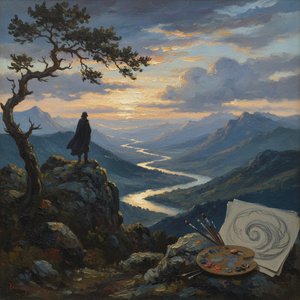 The Evocative Brushstroke: Exploring Emotion, Individuality & the Sublime in Romanticism's Artistic Landscape
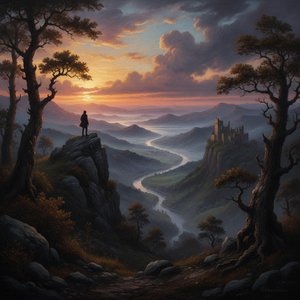 The Power of Emotion: A Definitive Guide to the Sublime and Soulful Art of Romanticism
 The Shipwreck
 Rocky Ravine
 Abraham Johannes Couwenberg
 Museo Romantico