Introduction
Imagine stepping into a space where the boundary between the canvas and your own reality begins to hyper-focus. There is a specific kind of magic that happens when an artist masters the visible world—not merely to mimic life, but to amplify its most striking, visceral truths. This is the heartbeat of Contemporary Realism .
While much of the modern art landscape has been defined by the loud abstractions of the past century and the digital flicker of our screens, Contemporary Realism emerged as a powerful reclamation of the tangible. It is a movement rooted in the profound ability to capture light, texture, and human emotion with a precision that feels almost surreal. It bridges the gap between the grit of street culture and the polished execution of classical mastery, finding beauty in the overlooked details of our modern existence—from the way light hits a rain-slicked pavement to the quiet intensity of a portrait.
These masterpieces remain essential today because they offer us something our digital feeds cannot: presence . In an era of fleeting pixels and AI-generated imagery, these works demand that we slow down, look closer, and feel the weight of the brushstroke. They serve as anchors to the physical world, reminding us of the raw, unedited beauty found in the here and now.
In the following selection, we are diving deep into ten definitive works that pushed the boundaries of perception, redefined what it means to be "real," and continue to command attention in the most vibrant galleries across the globe. Prepare to see the world through a lens of unparalleled clarity.
Freedom from want - Norman Rockwell
 Freedom from want - Norman Rockwell
Owning Freedom from Want by Norman Rockwell isn’t a mere purchase; it is an inheritance. Its spot in the Top 10 is a legacy, a handshake across centuries. It’s not just art; it’s a lineage of taste . In this quintessential piece of contemporary realism, Rockwell captures more than a holiday meal; he renders a sanctuary of hope amidst the global shadows of World War II. The composition draws us into a warm, semi-circular embrace, where the glistening texture of a roasted turkey and the soft, diffused light evoke an overwhelming sense of abundance. Inspired by FDR’s vision of economic security, every meticulous detail—from the crisp linens to the faces of expectant family members—celebrates the dignity of human connection. To bring this work into your space is to invite a moment of timeless gratitude onto your walls, where every glance becomes a profound nod to the masters.
Reflection with Two Children (Self-Portrait) - Lucian Freud
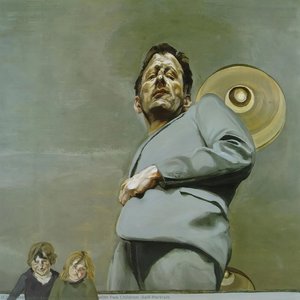 Reflection with Two Children (Self-Portrait) - Lucian Freud
Legend has it that Lucian Freud would endure grueling, months-long sittings to capture not just a likeness, but the very weight of his subjects' existence. In Reflection with Two Children (Self-Portrait) , this obsession with psychological truth reaches a visceral peak. As a cornerstone of the Contemporary Realism movement, this 1965 masterpiece moves beyond mere representation, utilizing thick, heavy impasto to sculpt flesh and emotion directly onto the canvas. The composition is hauntingly unbalanced; Freud’s defensive, crossed-arm posture creates an intense psychological tension, while the two children appear as spectral reflections within a muted, olive-green landscape. This isn't just paint on canvas—it is a tactile exploration of isolation and identity. Integrating such a profound, heavy-hitting work into a modern home office or study provides a powerful anchor of intellectual gravity, cultivating an atmosphere of deep focus and sophisticated introspection.
First Steps - Georgios Jakobides
 First Steps - Georgios Jakobides
Before the brush even touched the canvas, Georgios Jakobides was already obsessed with the weight of light. In his 1892 masterpiece, First Steps , he captures more than a milestone; he captures the very soul of the Munich School’s realism. The technical brilliance lies in his ability to render the tactile—the rough grain of stone walls meeting the delicate, sun-drenched fabrics of a child's clothing. This profound command over texture and light is exactly why this work stands as one of the top 10 masterpieces that defined the contemporary realism movement . The composition, guided by a soft, directional glow from an unseen window, creates a sanctuary of stillness. For the modern professional, integrating such a piece into a home office or study does more than decorate; it anchors the space with a sense of enduring stability and quiet, focused intention, turning a workspace into a gallery of profound contemplation.
Benefits Supervisor Sleeping (also known as Big Sue) - Lucian Freud
 Benefits Supervisor Sleeping (also known as Big Sue) - Lucian Freud
Lucian Freud’s Benefits Supervisor Sleeping stands as a visceral confrontation with the truth of the human condition. In this 1995 monumental work, Freud strips away the veneer of classical idealization, replacing it with an unflinching, heavy-set reality. Through his signature thick impasto , the flesh of "Big Sue" becomes a landscape of palpable texture—a rhythmic interplay of muted earth tones and deep, shadowed folds that demand a sensory response from every viewer.
As a cornerstone of the Contemporary Realism movement, the painting’s power lies in its refusal to look away. Freud captures a profound vulnerability within the subject's massive, reclining form, turning the gaze toward the raw physicality of existence and the weight of the body. In our current era of digital perfection and highly curated aesthetics, this masterpiece resonates with a renewed intensity. It serves as a vital cultural touchstone for modern dialogues surrounding body authenticity and the rejection of filtered beauty, proving that true artistic impact lies not in the polished, but in the profoundly real.
Automat - Edward Hopper
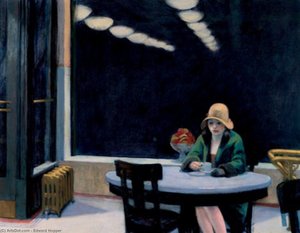 Automat - Edward Hopper
What story does the shadowy, window-lit corner of Automat by Edward Hopper tell? It is a narrative of urban solitude, capturing the quiet ache of anonymity within the burgeoning American cityscape of 1927. As a cornerstone of the Top 10 Masterpieces That Defined the 'Contemporary Realism' Art Movement , this work moves beyond simple observation to explore the psychological weight of modern life. The composition is a masterclass in tension, where stark, directional light pierces through deep, melancholic blues to illuminate a lone figure and a solitary bowl of fruit. There is a cinematic stillness found in the sharp, geometric lines of the window frames that feels both heavy and haunting. For the modern collector, integrating this piece into a home offers more than just decor; it provides a curated escape—a way to invite a sense of historical depth and quiet, contemplative mystery into a contemporary living space.
The Gross Clinic - Thomas Eakins
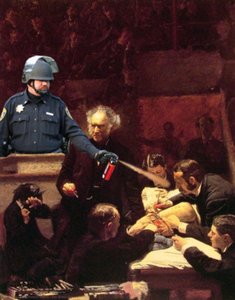 The Gross Clinic - Thomas Eakins
Imagine stepping into a dimly lit 19th-century operating theater, where the air is thick with tension and the sharp scent of clinical urgency. In The Gross Clinic , Thomas Eakins captures this visceral moment with unparalleled intensity. This masterpiece of Contemporary Realism isn't just a depiction of surgery; it is a cinematic explosion of light and shadow. Using a dramatic, almost monochromatic palette of deep earthy tones and striking chiaroscuro, Eakins pulls the viewer directly into the surgical fray.
The painting’s power lies in its uncompromising anatomical precision and the heavy, emotional weight of the figures. Every brushstroke contributes to an atmosphere of gravity and scientific discovery. For the modern collector looking to anchor a room, this piece serves as a profound conversation starter. Integrating such a high-impact work into a contemporary interior adds a layer of historical soul and dramatic edge, turning a standard living space into a curated gallery of human endurance.
Gas - Edward Hopper
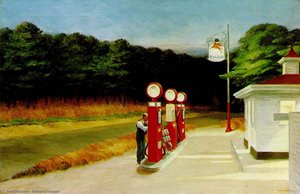 Gas - Edward Hopper
Edward Hopper’s Gas (1940) stands as a haunting pillar within the Top 10 Masterpieces That Defined the Contemporary Realism Art Movement . More than a mere depiction of a roadside stop, the painting captures the profound, unsettling stillness of the American landscape. The gas pumps, stark and solitary against muted greens and earthy browns, serve as symbols of transient existence—a momentary pause in an endless journey. Hopper masterfully utilizes light and shadow to evoke deep introspection, turning a mundane setting into a cinematic exploration of solitude.
In today’s hyper-connected world, this piece resonates with a growing cultural fascination with liminal spaces and minimalist aesthetics. Its ability to command attention through quietude makes it a vital talking point in modern, curated interiors, where the tension between vast emptiness and structured realism provides a sophisticated emotional anchor. This work remains an essential study of how light can illuminate the loneliness inherent in the human condition.
Chop Suey - Edward Hopper
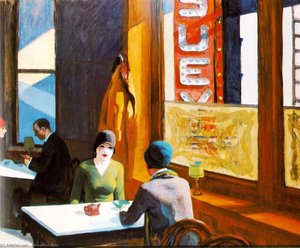 Chop Suey - Edward Hopper
In Chop Suey by Edward Hopper , the composition hits with the precision of a masterfully executed graphic. The painting is anchored by sharp, geometric diagonals—the sweeping lines of large windows and architectural edges that slice through the frame to create a rhythmic, balanced tension. This structural harmony provides a sense of timeless perfection, cementing its status within the Top 10 Masterpieces That Defined the 'Contemporary Realism' Art Movement .
The interplay between the heavy, blocky forms of the diner and the electric glow of the "SUE" neon sign creates a high-contrast atmosphere that feels incredibly modern. This balance of light and shadow mirrors the core principles of contemporary minimalist design, where clean lines and intentional negative space ground a bold aesthetic. By blending the saturated yellows and deep blues of an urban night with a structured, almost architectural layout, Hopper delivers a piece that is both cinematic and strikingly relevant to today’s design-conscious interiors.
Office at Night - Edward Hopper
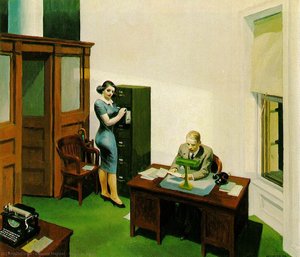 Office at Night - Edward Hopper
While many artists sought grand historical dramas, Edward Hopper found his most profound truths in the quiet, overlooked corners of urban life. In Office at Night (1940), he transforms a mundane mid-century workspace into a hauntingly beautiful stage for human solitude. This masterpiece stands as a pillar of the Contemporary Realism movement, not through action, but through the masterful manipulation of light and shadow. The way a single, striking blue dress pierces through a muted palette of heavy greens and browns creates a visual tension that is impossible to ignore.
Hopper’s technical genius lies in his ability to use geometric stability—the rigid lines of filing cabinets and desks—to frame the emotional weight of isolation. The stillness of the scene, punctuated only by the rhythmic ghost of a typewriter, invites a deep, contemplative focus. For the modern professional, bringing such an evocative atmosphere into a home study or office can inspire a similar sense of disciplined, sophisticated productivity, turning any workspace into a sanctuary for thought.
Summertime - Edward Hopper
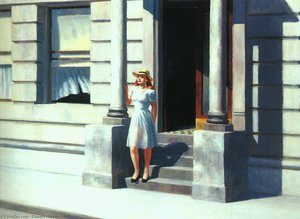 Summertime - Edward Hopper
There’s a gaze in Summertime by Edward Hopper that follows you—not with judgment, but with understanding . This isn’t merely a portrait; it is a mirror . Within this 1943 masterpiece, the sharp geometric lines of classical architecture and heavy, sun-drenched shadows evoke a profound sense of urban isolation central to the Contemporary Realism movement. Hopper captures that specific, quiet tension of modern life—the moment where anticipation meets solitude on a sunlit staircase.
The way light interacts with the stone steps and the soft texture of her straw hat creates a palpable atmosphere of stillness and introspection. Now, imagine that gaze in your space. Not watching you, but reminding you : you are seen. You are part of the story. This work stands as a pillar of its era because it makes the invisible emotions of the city visible, turning a fleeting summer moment into an eternal, shared experience of human existence.
Conclusion
These masterpieces do more than just occupy space on a gallery wall; they breathe. They are living, pulsing fragments of our shared human experience, capturing the light, the grit, and the quiet intimacy of reality in a way that transcends the era they were born in. To look at them is to feel a connection to a truth that remains unchanged by time. As we close this journey through the depths of Contemporary Realism, we invite you to bring that same profound resonance into your own space. At OriginalUniqueArt.com , every masterpiece can be reborn as a hand-painted reproduction, crafted by skilled artists who honor the original's soul and detail. Whether you are seeking a focal point for a modern interior or a window into another era, you can discover these enduring legacies within our full collection , where the tactile magic of the brush meets the timelessness of the human spirit.