The Genesis of Movement: Calder’s Early Influences & Artistic Breakthrough
Modernism was an early 20th-century movement in literature, visual arts, performing arts, and music that emphasized experimentation, abstraction, and subjective experience. Philosophy, politics, architecture, and social issues were all aspects of thi...
Alexander Calder, a name synonymous with kinetic art, didn't emerge from a vacuum. His journey toward inventing the mobile – and fundamentally altering our perception of sculpture – was a gradual unfolding, rooted in early fascination with form, mechanics, and a burgeoning modernist sensibility. Born into a family of artists—his father was a sculptor, his mother a painter—Calder initially pursued engineering at Stevens Institute of Technology. This technical grounding proved unexpectedly crucial. It wasn’t merely about building; it was about understanding balance, tension, and the inherent poetry of motion. After graduating in 1919, he briefly worked as an engineer before dedicating himself to art, a transition marked by early experiments with wire sculpture and wood carvings. These initial works, though static, hinted at his future preoccupation with three-dimensional space and the interplay of lines and volumes. A pivotal moment arrived during a 1930 visit to Piet Mondrian’s studio in Paris. The Dutch artist's rigorously abstract compositions, defined by black lines and primary colors, profoundly impacted Calder. He sought to translate Mondrian’s static order into dynamic form, leading him to explore works that actively engaged with the surrounding environment.
Equilibrium and Abstraction: Deconstructing the Mobile Form
 Red Mobile
Experience 'Red Mobile' by Alexander Calder – a dynamic 1930s kinetic sculpture! Explore its vibrant red triangles & biomorphic design. A unique, captivating art piece.
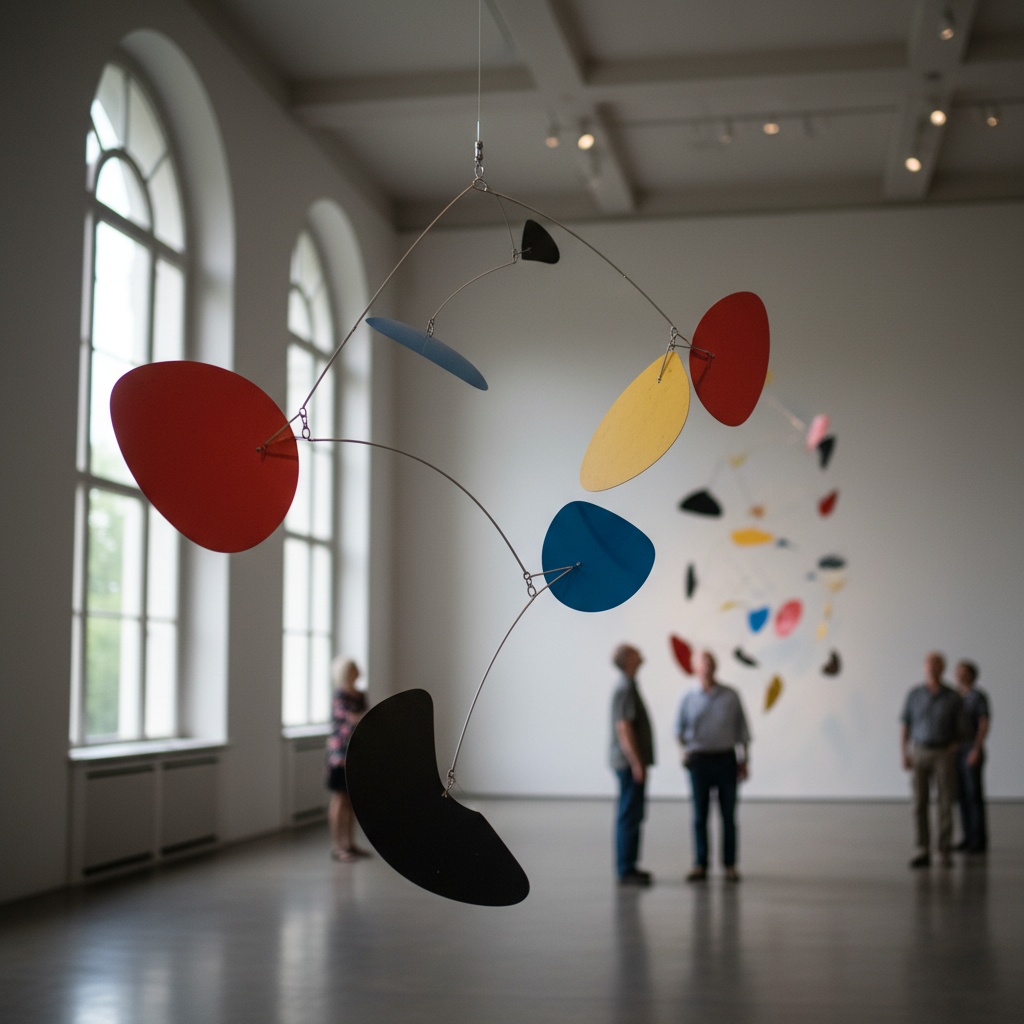
The true breakthrough came with Calder's invention of the mobile – a term coined by Marcel Duchamp. These weren’t simply sculptures *in* space; they were sculptures *of* space, defined by their delicate dance and ever-shifting equilibrium. Unlike traditional sculpture which occupies space, the mobile inhabits it, responding to unseen currents of air with graceful fluidity. The core principle is deceptively simple: a series of balanced rods, suspended from strings, supporting abstract shapes. Yet, achieving this balance required an almost intuitive understanding of physics and weight distribution. Calder’s mobiles are not random arrangements; they are meticulously calibrated systems where each element contributes to the overall harmony. He stripped away representational forms, embracing pure abstraction – circles, triangles, biomorphic shapes—allowing the focus to shift entirely to the interplay of line, color, and movement. The 1930s saw a proliferation of these works, often crafted from sheet metal painted in vibrant hues. Red Mobile, for example, exemplifies this period: its dynamic red triangles seem to float effortlessly, captivating viewers with their subtle shifts and changes.
Calder's 'Constellations': A Dialogue Between Art, Space, and Chance
 Wikipedia: Mobile (sculpture)
A mobile (UK: , US: ) is a type of kinetic sculpture constructed to take advantage of the principle of equilibrium. It consists of a number of rods, from which weighted objects or further rods hang. The objects hanging from the rods balance each othe...
The ‘Constellations’ series, developed in the early 1940s, represents a particularly refined expression of Calder’s artistic vision. These works, often larger in scale than earlier mobiles, evoke celestial bodies suspended in space. The title itself suggests a connection to the cosmos, hinting at the inherent order and mystery of the universe. However, these aren't literal depictions of constellations; rather, they are abstract interpretations that capture the *feeling* of vastness and movement. Calder’s use of black backgrounds further enhances this effect, creating a sense of depth and allowing the brightly colored shapes to appear as if floating in an infinite void. Crucially, chance plays a significant role in the experience of these works. Each mobile is unique, its movements dictated by unpredictable air currents. This element of randomness introduces a layer of spontaneity, ensuring that no two viewings are ever quite the same. Four Wings, from 1972, beautifully illustrates this principle – a serene composition of red forms that seems to breathe and evolve with each passing moment.
Beyond Sculpture: The Broader Impact of Kinetic Art – Rickey, Chadwick & Others
 George Rickey
George Rickey (1907-2002) was a pioneering American kinetic sculptor renowned for his geometric, wind-powered steel sculptures. Explore his Constructivist roots & innovative art that blends engineering with graceful movement.
Calder’s influence extended far beyond his own studio. He single-handedly legitimized kinetic art as a serious artistic pursuit, paving the way for a generation of sculptors who explored movement and space in innovative ways. Artists like George Rickey, known for his geometric steel sculptures powered by wind, built upon Calder’s foundations, emphasizing precision engineering and mathematical principles. Rickey's works often possess a more rigorous, architectural quality than Calder’s, yet they share the same fascination with balance and dynamic form. Similarly, Lynn Chadwick incorporated movement into his semi-abstract bronze figures, exploring themes of tension, balance, and what he termed the “Geometry of Fear.” While Chadwick's sculptures are less overtly playful than Calder’s, they demonstrate a shared interest in capturing the human condition through abstract form. These artists, along with others like Jean Tinguely and Alexander Liberman, expanded the vocabulary of kinetic art, pushing its boundaries and challenging traditional notions of sculpture.
Collecting Calder: Considerations for Acquisition and Preservation
Acquiring a work by Alexander Calder is an investment not only in artistic beauty but also in a significant piece of art history. Given their delicate nature and inherent complexity, careful consideration must be given to both acquisition and preservation. Authenticity is paramount; provenance – the documented history of ownership—is crucial for establishing legitimacy. The market for Calder’s work is robust, with prices ranging significantly depending on size, scale, and historical importance. Smaller tabletop mobiles are more accessible than large-scale installations, but even these require careful handling. Preservation involves protecting the sculpture from excessive dust, humidity, and direct sunlight. Regular cleaning with a soft cloth is recommended, avoiding harsh chemicals or abrasive materials. The environment in which the mobile is displayed also plays a vital role; drafts and strong air currents can affect its movement, while stable temperatures and humidity levels are essential for preventing damage. Consulting with an art conservator specializing in kinetic sculpture is highly advisable.
The Enduring Legacy: Calder’s Influence on Contemporary Art and Design
Calder's impact resonates deeply within contemporary art and design. His exploration of movement, space, and chance continues to inspire artists across various disciplines. From large-scale public installations to intimate studio works, his influence is palpable. Beyond sculpture, Calder’s aesthetic principles have permeated fields such as architecture, graphic design, and even jewelry making. The playful simplicity of his forms and the vibrant use of color remain remarkably relevant today. His mobiles are not merely objects; they are experiences—dynamic compositions that invite contemplation and evoke a sense of wonder. Untitled, from 1937, with its striking black and white base punctuated by bursts of red and yellow, exemplifies this enduring appeal. It’s a testament to Calder's genius that his work continues to captivate audiences decades after its creation, solidifying his position as one of the most important artists of the 20th century. At OriginalUniqueArt.com, we are proud to offer exceptional hand-painted reproductions of Alexander Calder’s iconic works, allowing you to bring a touch of this timeless artistry into your own space.