
What materials and techniques did Andy Warhol use?
Andy Warhol utilized a diverse range of media including silkscreen printing, photography, and film. His toolkit featured acrylic paint, oils, watercolor, and ink. He frequently employed Polaroid photographs and 16mm film as source material, often using stencils made of thin paper or film to block out specific areas on a screen.
Warhol's practice was highly varied across several decades. In the 1940s and 1950s, he worked with hand-drawn ink and watercolor. During his time as a commercial illustrator in New York, he developed the "blotted-line" technique, which involved pressing a clean sheet of paper onto wet ink or watercolor to create a spontaneous image.
His technical repertoire included:
- Silkscreen printing for mass reproduction
- Collage using layered images and printed materials
- Film production, including over 600 films such as Empire (1965)
- Sculpture using materials like plywood boxes
- The use of calligraphy by his mother, Julia Warhola
For his Torsos series in 1977, Warhol utilized 47 rolls of film and 1,664 Polaroid photographs to create his compositions. This series, which included 94 silkscreened canvases and more than 40 drawings, focused on the human anatomy through a mechanical, repetitive lens.
How did silkscreen printing differ from traditional painting?
Silkscreen printing differed from traditional painting by prioritizing mechanical reproduction and flatness over unique brushwork and depth. While traditional painting emphasizes the artist's hand and individual texture, Warhol’s silkscreen technique used stencils and ink to create multiple versions of an image, intentionally rejecting traditional perspective to mirror mass media.
Warhol's approach challenged the concept of the "one-of-a-kind" masterpiece. By using industrial-style processes, he embraced repetition and a graphic, commercial quality. This method allowed for the creation of multiple identical prints from a single stencil, often resulting in a tonal uniformity that contrasted with the expressive movements of his era.
The technical distinctions include:
- Process: Transferring ink through stencils rather than applying paint with brushes.
- Aesthetic: Achieving a flat, two-dimensional look instead of traditional depth.
- Intent: Focusing on the repetition of icons rather than individual artistic intervention.
In works like Hammer and Sickle (Special Edition) (1977), the process involved layering color blocks—such as red, gray, and gold—to reproduce an initial sketch. This method ensured the image maintained a consistent, mechanical finish across the edition.
Why did he use commercial inks and acrylics in his Pop Art style?
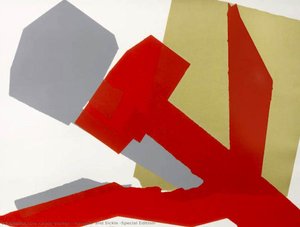 Hammer and Sickle (Special Edition)
, Andy Warhol
Warhol used commercial inks and acrylics to achieve a vibrant, modern look that emphasized the flatness and graphic quality of Pop Art. These materials allowed him to mimic the aesthetic of advertising and mass media, stripping away original contexts to imbue mundane objects or celebrities with new meanings.
The use of these specific media supported his goal of mechanical reproduction. By utilizing opaque or transparent inks, he could layer colors to create a specific visual impact. For example, in his Hammer and Sickle (Special Edition) (1977), the layering of specific colors helped reproduce the initial sketch with a consistent, industrial finish.
His choice of materials served several functions:
- Visual Impact: Acrylics provided a bright, contemporary appearance.
- Consistency: Commercial inks allowed for the repetition of images across multiple prints.
- Thematic Alignment: The materials mirrored the industrial production of the consumer culture he depicted.
This technical approach ensured that the resulting images were not merely reproductions, but intentional constructions of icons. By adopting the tools of commercial design, Warhol successfully bridged the gap between high art and the mass-produced imagery of the 20th century.
Frequently asked questions
How much did The Silver Car Crash (Double Disaster) sell for?
The Silver Car Crash (Double Disaster) sold for $105 million in 2013.
When was Marilyn Diptych created?
Marilyn Diptych was created in 1962.
How many canvases were in the Torsos series?
The Torsos series included 94 silkscreened canvases.
When was Hammer and Sickle (Special Edition) made?
Hammer and Sickle (Special Edition) was created in 1977.
Learn more
- 1928 – 1987Andy Warhol BiographyDiscover the fascinating life and artistic movements of Andy Warhol.
- Andy Warhol · 1977Hammer and Sickle (Special Edition)See how unique screenprinting techniques create this iconic aesthetic.


