Expressionism
Aragon (Rafael Barradas)
Rafael Barradas (1890–1929) har skabt Aragon. Det tilhører Expressionism-bevægelsen. Den er udført i Oil On Canvas.
- Oil On Canvas

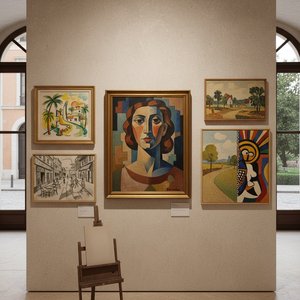
 Se i rummet

 Håndmalet oliemalerie
 Del som kort
 Del
 Faktablad


 Download
 Lignende værker
 Røntgenundersøgelse
 Diasshow
 Spørgsmål og svar

 Statistikker
Aragon kort fortalt
- Titel
- Aragon
- Kunstner
- Rafael Barradas (1890–1929)
- Kunstner født i
- Montevideo, Uruguay
- Materiale
- Oil On Canvas
- Bevægelse
- Expressionism
- Periode
- Modern
- Motiv
- portrait, religious figures, expressionism, geometric forms, shadows, texture
Hvad forestiller Aragon?
The Subject and Artist of Aragon
Aragon is a work by Rafael Barradas, an Uruguayan modernist painter and graphic artist. The piece presents a group portrait of three figures, rendered in a distinctly Expressionistic style. These subjects, appearing as clergymen or religious officials, are defined by bold, angular lines and simplified forms. Their attire, including collars and hats, suggests a position of religious authority.
Barradas, born in Montevideo, Uruguay, in 1890, developed a unique visual language through his immersion in European avant-garde movements. His approach often synthesized the dynamism of Futurism and the structural deconstruction of Cubism. In this work, the artist prioritizes emotional impact over accurate representation, utilizing sharp edges to construct the faces and torsos of the subjects.
The composition focuses entirely on the heads and upper bodies of the three men against a dark, textured background. This tight cropping, combined with the severe and detached expressions of the figures, creates a sense of solemnity. The artist’s method emphasizes the physical presence of the subjects through heavy, layered application of paint.
Composition and Visual Elements
The composition is tightly cropped, focusing exclusively on the heads and upper torsos of the three figures. This close framing eliminates environmental context, pushing the subjects toward the viewer. Bold, angular lines define the faces, utilizing sharp edges to construct the features. The arrangement relies on a geometric vocabulary; squares, rectangles, and triangles are used to build the forms of the figures rather than following naturalistic contours.
A single, unseen light source casts heavy shadows across the subjects. These shadows accentuate the structural planes of the faces, heightening the dramatic tension. The perspective is intentionally flattened, rejecting any sense of receding space or depth. Against this lack of spatial dimension, the background remains dark and heavily textured, providing a stark contrast to the geometric subjects.
Technique and Artistic Materials
The work is executed in oil paints on canvas. The application of pigment is heavy, utilizing a thick impasto that creates a palpable, rough surface. This layered approach builds a physical texture across the pictorial plane, emphasizing the material presence of the paint itself.
Visible brushwork defines the forms, rejecting smooth transitions in favor of direct, gestural marks. These strokes contribute to the structural clarity of the figures, using sharp edges and angularity to construct the subjects. The interplay of light and shadow is achieved through this deliberate, uneven application, which accentuates the planes of the faces and adds a sense of weight to the composition.
Højopløselige billeder af Aragon
Public domain: kunstneren døde i 1929.
Rafael Barradas, Aragon. Frit tilgængelig
Spørgsmål om Aragon besvaret
Hvilket medie er "Aragon" af Rafael Barradas udført i?
"Aragon" af Rafael Barradas er udført i Oil On Canvas. Reproduktionerne har til formål at gengive denne tekniks visuelle udtryk.
Hvad forestiller "Aragon" af Rafael Barradas?
Motiverne i "Aragon" er portrait, religious figures, expressionism, geometric forms, shadows, texture, clergy, angular.
Er billedet af "Aragon" af Rafael Barradas frit tilgængeligt i det offentlige domæne?
Hvad angår ophavsret, er "Aragon" i det offentlige domæne – ophavsretten er udløbet.
Hvem er kunstneren bag "Aragon"?
"Aragon" blev skabt af Rafael Barradas. Informationen på denne side beskriver Rafael Barradass originale værk.
Hvilken stilart tilhører "Aragon"?
"Aragon" er et værk fra Expressionism. Denne stilart angiver den kunstneriske tradition, som værket indgår i.
Hvor i Rafael Barradass karriere placerer "Aragon" sig?
"Aragon" tilhører Mature Period i Rafael Barradass karriere. Denne klassificering knytter værket til kunstnerens udvikling.
Er "Aragon" af Rafael Barradas i det offentlige domæne, og hvorfor?
"Aragon" af Rafael Barradas er i det offentlige domæne – ophavsretten er udløbet. Ophavsretten beregnes ud fra kunstnerens dødsår, og Rafael Barradas døde i 1929.
Hvad deler "Aragon" med resten af Rafael Barradass produktion?
I Rafael Barradass samlede værk placerer "Aragon" sig i Expressionism-stilen, sammen med temaerne omkring futurist & cubist echoes, uruguayan religious themes, spanish exile reflections, aragon – a stark portrait, barradas' intense vision, early expressionistic style, short career, bold impact.
Er "Aragon" typisk for det, som Rafael Barradas normalt skabte?
Rafael Barradass gennemgående temaer inkluderer futurist & cubist echoes, uruguayan religious themes, spanish exile reflections, aragon – a stark portrait, barradas' intense vision, early expressionistic style, short career, bold impact; "Aragon" fokuserer på portrait, religious figures, expressionism, geometric forms, shadows, texture, clergy, angular.
Om kunstneren, Rafael Barradas

1890–1929, Uruguay
Rafael Barradas
En Livsnerve af Vibration: Rafael Barradas’ Kunstneriske Rejse Rafael Pérez Giménez Barradas, født i Montevideo, Uruguay, i 1890, fremstod som en central figur i den spirende modernistiske bevægelse i det tidlige 20. århundrede. Hans historie er en fortælling om rastløs kunstnerisk udforskning, en levende fusion af uruguayanske rødder og europæiske avantgarde-sensibiliteter. Fra sine tidligste dage, omgivet af en familie gennemsyret af kunstnerisk udtryk – en pianist søster, en digterbror og en malerfar – absorberede Barradas en æstetisk følsomhed, der skulle definere hans livsværk.
Om Rafael Barradas Bemærkelsesværdige værker af Rafael Barradas
Også af Rafael Barradas
 Barcelona Street at 1 pm1918
 The Tango1913
 Playa Ramirez (on the terrace)
 Hospitalet de Llobregat
Essays om Aragon
 Rafael Barradas: Bridging Brazilian Modernism with European InfluencesExplore the life & art of Rafael Barradas, a pioneering Uruguayan modernist who blended European influences with vibrant local heritage. Di…
 20th century Argentine painters20th-century Argentine painters like Lucio Fontana, Antonio Berni, and Marta Minujín defined a movement. Find museum-quality reproductions …
 Spontaneity and Matter: Distinguishing CoBrA from Art InformelMaster the differences between CoBrA and Art Informel with our expert guide. Learn to identify these post-war movements today.