Naive Art · 1915
Pipe (Niko Pirosmani, 1915)
Niko Pirosmani (1862–1918) har skabt Pipe. Det er fra 1915. Det tilhører Naive Art-bevægelsen. Den er udført i Oil On Canvas. Det opbevares på Art Museum of Georgia i Tbilisi, Georgien. Målene er 63 × 97 cm.
- 1915
- Oil On Canvas
- 63 × 97 cm
- Art Museum of Georgia, Tbilisi

 Se i rummet

 Håndmalet oliemalerie
 Del som kort
 Del
 Faktablad


 Download
 Lignende værker
 Røntgenundersøgelse
 Diasshow
 Spørgsmål og svar

 Statistikker
Pipe kort fortalt
- Titel
- Pipe
- Kunstner
- Niko Pirosmani (1862–1918)
- Kunstner født i
- Mirzaani, Georgien
- Dato
- 1915
- Medium
- Oil On Canvas
- Dimensioner
- 63 × 97 cm
- Hvor det kan ses
- Art Museum of Georgia, Tbilisi, Georgien
- Bevægelse
- Naive Art
- Periode
- Modern
- Motiv
- people, table, food, drink, trees, building
Hvad forestiller Pipe?
Identification of the Artwork and Artist
Pipe is a work by the Georgian artist Niko Pirosmani. Created in 1915, the painting emerged during a period when the artist was navigating the social fringes of Tbilisi. Pirosmani’s life was marked by a self-taught approach to his craft, developing a visual language independent of formal academic training.
Born in 1862 in Mirzaani, Georgia, Pirosmani spent much of his existence in the capital, often working in various trades to sustain himself. His output was frequently tied to the immediate needs of local commerce, such as painting signboards for shopkeepers. He remained an active creator until his death in 1918.
Visual Composition and Subject Matter
A central grouping of figures occupies the middle ground, seated around a long table laden with food and drink. This gathering suggests an outdoor feast or a communal scene from rural life. To the left, a small building is partially obscured by the surrounding trees. On the right, a smaller group of figures stands near what appears to be a fountain or a well.
The background is composed of rolling hills beneath a cloudy sky. The arrangement of elements creates a sense of a social event unfolding within a natural landscape. The figures are rendered with distorted proportions and elongated limbs, contributing to an unsettling and dreamlike atmosphere. This composition avoids traditional perspective, resulting in a flattened space where objects and people appear disproportionate to one another.
Artistic Style and Visual Characteristics
The work is characterized by a naive and somewhat unsettling aesthetic, reminiscent of primitive or outsider art. A dreamlike or hallucinatory quality emerges from the use of distorted proportions, which disrupts the natural order of the scene. The composition relies on simple, unrefined lines that contribute to this raw, direct expression. Rather than following academic conventions, the artist utilizes a flattened approach where perspective is notably absent. Objects do not diminish in size with distance, creating a sense of spatial ambiguity.
The color palette is dominated by earthy tones, providing a grounded foundation for the composition. These muted hues are interrupted by splashes of brighter colors that draw attention to specific details. The overall effect is one of psychological disturbance or altered perception, achieved through the unconventional arrangement of forms and the lack of traditional depth. The visual language remains focused on essential shapes rather than meticulous detail.
Technique and Material Composition
Executed on a canvas measuring 63 x 97 cm, the work utilizes oil paints to define its forms. The application is straightforward, employing simple brushstrokes that prioritize direct expression over meticulous detail. This approach results in a relatively smooth texture across the surface, lacking the heavy impasto or tactile depth found in more layered works.
The lighting is characterized by a diffused and even quality. There are no strong highlights or deep shadows to create dramatic contrast, contributing to a flattened visual field. This even illumination maintains a consistent tone across the composition, reinforcing the work's specific aesthetic character.
Related Works by Niko Pirosmani
The artist's exploration of communal gatherings is reflected in other compositions from the early twentieth century. Feast with Barrel Organist Datico, dated about 1906, shares a similar interest in social scenes. Another significant work from this period is The feast in vintage, also from about 1906. This piece is held within the collection of the Art Museum of Georgia in Tbilisi.
Beyond these social assemblies, the artist demonstrated a unique focus on the natural world. He was the only Georgian animalist, a distinction that set his subject matter apart from his contemporaries. His ability to render the essence of beasts and birds through a primitive lens remains a defining characteristic of his output.
Hvilket museum udstiller Pipe?
Art Museum of Georgia
Tbilisi, Georgien
Et fristed for sjæl og sten Gemt i det pulserende og levende hjerte af Tbilisi står Art Museum of Georgia som et dybtgående vidnesbyrd om en nations vedvarende kunstneriske sjæl. Indhyllet i en smukt bevaret neoklassisk bygning, der engang genlød af de lærde studier ved Tbilisi Teologiske Seminarium, tilbyder museet meget mere end blot et gallerirum; det er et fristed, hvor historie og kreativitet smelter sammen. At træde gennem dets døre er at påbegynde en rejse gennem tiden, fra de hellige hvisken i middelalderens manuskripter til de dristige, ekspressive penselstrøg fra de moderne mestre.


Højopløselige billeder af Pipe

Public domain: kunstneren døde i 1918.
Andre størrelser, beskæringer og kildehenvisning →Niko Pirosmani, Pipe (1915), Art Museum of Georgia. Public domain
Spørgsmål om Pipe besvaret
Hvilket museum udstiller det originale "Pipe"?
Du kan se det originale værk "Pipe" på Art Museum of Georgia, Tbilisi, Georgien.
Hvornår er "Pipe" af Niko Pirosmani skabt?
"Pipe" af Niko Pirosmani er dateret til 1915.
Hvilket medie er "Pipe" af Niko Pirosmani udført i?
Niko Pirosmani brugte Oil On Canvas-teknikken til "Pipe". Teknikken definerer det originale værks materielle karakter.
Hvad er målene på det originale "Pipe" af Niko Pirosmani?
Det originale værk "Pipe" af Niko Pirosmani måler 63 x 97 cm.
Hvad forestiller "Pipe" af Niko Pirosmani?
"Pipe" af Niko Pirosmani forestiller: people, table, food, drink, trees, building, hills, sky.
Er "Pipe" af Niko Pirosmani i det offentlige domæne?
Ophavsretsstatus for "Pipe" af Niko Pirosmani: værket er i det offentlige domæne – ophavsretten er udløbet. Dette afgør, om der frit må foretages reproduktioner af billedet.
Hvem har skabt "Pipe"?
"Pipe" tilskrives Niko Pirosmani.
Hvilken stilart tilhører "Pipe"?
"Pipe" er et værk fra Naive Art. Denne stilart angiver den kunstneriske tradition, som værket indgår i.
Hvor i Niko Pirosmanis karriere placerer "Pipe" sig?
"Pipe" tilhører Late Period i Niko Pirosmanis karriere. Denne klassificering knytter værket til kunstnerens udvikling.
Om kunstneren, Niko Pirosmani
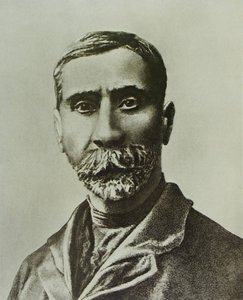
1862–1918, Georgien
Niko Pirosmani
Tidligt liv, familie og dannelse Historien om Niko Pirosmani begynder i landsbyen Mirzaani, beliggende i Kakheti-provinsen i Georgien. Han blev født omkring 1862 som den yngste af fire børn af Aslan Pirosmanashvili og Tekle Toklikishvili. Hans tidlige år blev formet af de jævne rytmer i en bondefamilie, men hjemmets stabilitet var kortvarig. Efter sine forældres død stod drengen tilbage som forældreløs, hvilket tvang ham til at navigere i en verden, der tilbød meget lidt i form af hverken sikkerhed eller formel vejledning.
Om Niko Pirosmani Bemærkelsesværdige værker af Niko Pirosmani
Også af Niko Pirosmani
 Giraffe1905
 Workers with a barrel (diptych)1912
 Queen Tamar
 Still Life (detail)
Essays om Pipe
 Niko Pirosmani: A Georgian Visionary – Life, Legacy, and the Poetics of Outsider ArtDiscover the captivating life & art of Niko Pirosmani, Georgia’s celebrated primitivist painter. Explore his unique oilcloth paintings, las…
 Decoding Impasto: The Emotional Power and Texture of Van Gogh's BrushstrokesExplore the profound emotional depth of Van Gogh's impasto technique. Discover how his sculptural brushstrokes and textured oil layers defi…
 The Pulse of Presence: Impressionist Interpretations of Urban Crowds and Mass GatheringsExplore how Pissarro and Hassam captured the energy of urban crowds through Impressionism. Discover the art of human movement today.