Northern Renaissance · 1512
Two Bishops (Saint Ulrich? and Saint Blasius) (Jacob Cornelisz van Oostsanen, 1512)
Jacob Cornelisz van Oostsanen (1472–1533) har skabt Two Bishops (Saint Ulrich? and Saint Blasius). Det er fra 1512. Det tilhører Northern Renaissance-bevægelsen. Den er udført i Black and White Photography. Det opbevares på Kunstmuseum Basel i Basel, Schweiz.
- 1512
- Black and White Photography
- Kunstmuseum Basel

 Håndmalet oliemalerie
 Del som kort
 Del
 Faktablad


 Download
 Lignende værker
 Diasshow
 Spørgsmål og svar

 Statistikker
Two Bishops (Saint Ulrich? and Saint Blasius) kort fortalt
- Titel
- Two Bishops (Saint Ulrich? and Saint Blasius)
- Kunstner
- Jacob Cornelisz van Oostsanen (1472–1533)
- Kunstner født i
- Oostzaan, Holland
- Dato
- 1512
- Medium
- Black and White Photography
- Hvor det kan ses
- Kunstmuseum Basel, Basel, Schweiz
- Bevægelse
- Northern Renaissance
- Periode
- Renaissance
- Motiv
- people, figures, wool, textiles, indoor setting, fabric
Hvad forestiller Two Bishops (Saint Ulrich? and Saint Blasius)?
The Artist and His Artistic Context
Jacob Cornelisz van Oostsanen lived through a season of profound change. Born in Oostzaan, Netherlands, in 1472, he watched the old world of the Middle Ages begin to dissolve into the new light of the Renaissance. His hands, trained in the precision of a woodcut designer or perhaps a goldsmith, moved between these two eras. In "Two Bishops (Saint Ulrich? and Saint Blasius)", created about 1512, the artist captures a moment of transition. He was a man of the North, a painter and designer who bridged the gap between the heavy traditions of the past and the emerging spirit of a new age.
The brushwork of Jacob Cornelisz van Oostsanen carries the weight of two distinct lineages. He absorbed the luminous color palettes and the elongated, graceful proportions of Geertgen tot Sint Jans. Yet, he also looked toward the sharp, disciplined lines of Albrecht Dürer. This duality allowed him to navigate the shifting tides of Amsterdam's artistic landscape. He was a craftsman of the transition, holding the steady grip of Gothic tradition while reaching for the clarity of the Renaissance. His life, which ended in 1533, remains etched in the wood and pigment of his era.
The Artistic Style and Technique
The brushwork moves with a newfound freedom, shedding the rigid formalism of earlier traditions. Instead of stiff, unyielding lines, the paint flows in a looser technique. This approach allows for a sense of movement within the composition. Luminous color harmonies settle over the figures, catching the light in a way that feels both soft and intentional. The proportions are simplified, stripping away unnecessary complexity to focus on the essential form of the subjects.
Light and shadow define the presence of the two figures. These stylistic innovations reflect a shift toward a more contemporary way of seeing. The artist uses these visual tools to create a direct connection with the viewer. For the Catholic patrons of the time, such works functioned as clear, visual representations of faith. The imagery is grounded in established iconography, yet it breathes with a modern sensibility. Every stroke serves the purpose of making the sacred tangible through light and color.
The Versatile Oeuvre of Jacob Cornelisz
The artist’s output spans a vast range of media, comprising approximately 200 woodcuts and 27 paintings. His prints are defined by meticulous detail, adhering to the strict conventions of the North Netherlandish tradition. In the growing urban center of Amsterdam, his workshop functioned as a hub for experimentation. He moved through the city's expanding streets, establishing a presence that mirrored the rapid growth of the town itself.
His hands navigated the sharp precision of the woodcut and the fluid application of paint. This duality allowed him to capture both the fine lines of a graphic design and the luminous depth of a canvas. He worked during a period of significant transition, bridging the gap between the old ways and new perspectives. His studio was a place of constant motion and shifting styles.
The breadth of his production reflects a life spent mastering different tools. Whether carving into wood or layering pigment, the focus remained on narrative clarity. His work remains a record of a craftsman navigating a changing landscape.
Hvilket museum udstiller Two Bishops (Saint Ulrich? and Saint Blasius)?
Kunstmuseum Basel
Basel, Schweiz
Oprindelsen og historien bag Kunstmuseum Basel Historien om Kunstmuseum Basel har sine rødder i erhvervelsen af Amerbach-samlingen. Denne samling, som udgjorde selve fundamentet for institutionen, blev købt af byen Basel og Universitetet i Basel i 1671. Beslutningen om at gøre disse værker tilgængelige for offentligheden cementerede museets status som den første offentlige kunstsamling af sin art.


Højopløselige billeder af Two Bishops (Saint Ulrich? and Saint Blasius)

Public domain: kunstneren døde i 1533.
Andre størrelser, beskæringer og kildehenvisning →Jacob Cornelisz van Oostsanen, Two Bishops (Saint Ulrich? and Saint Blasius) (1512), Kunstmuseum Basel. Public domain
Spørgsmål om Two Bishops (Saint Ulrich? and Saint Blasius) besvaret
Hvor kan jeg se det originale værk "Two Bishops (Saint Ulrich? and Saint Blasius)" af Jacob Cornelisz van Oostsanen?
Originalen af "Two Bishops (Saint Ulrich? and Saint Blasius)" af Jacob Cornelisz van Oostsanen opbevares på Kunstmuseum Basel, Basel, Schweiz. En reproduktion gør det muligt at udstille værket i hjemmet.
I hvilket år blev "Two Bishops (Saint Ulrich? and Saint Blasius)" af Jacob Cornelisz van Oostsanen skabt?
"Two Bishops (Saint Ulrich? and Saint Blasius)" af Jacob Cornelisz van Oostsanen blev skabt i 1512.
Hvilket medie er "Two Bishops (Saint Ulrich? and Saint Blasius)" af Jacob Cornelisz van Oostsanen udført i?
"Two Bishops (Saint Ulrich? and Saint Blasius)" er udført i Black and White Photography.
Hvad forestiller "Two Bishops (Saint Ulrich? and Saint Blasius)" af Jacob Cornelisz van Oostsanen?
Motiverne i "Two Bishops (Saint Ulrich? and Saint Blasius)" er people, figures, wool, textiles, indoor setting, fabric, clothing.
Er "Two Bishops (Saint Ulrich? and Saint Blasius)" af Jacob Cornelisz van Oostsanen i det offentlige domæne?
Ophavsretsstatus for "Two Bishops (Saint Ulrich? and Saint Blasius)" af Jacob Cornelisz van Oostsanen: værket er i det offentlige domæne – ophavsretten er udløbet. Dette afgør, om der frit må foretages reproduktioner af billedet.
Hvilken kunstner tilskrives "Two Bishops (Saint Ulrich? and Saint Blasius)"?
Hvilken kunstretning tilhører "Two Bishops (Saint Ulrich? and Saint Blasius)" af Jacob Cornelisz van Oostsanen?
Kunstretningen forbundet med "Two Bishops (Saint Ulrich? and Saint Blasius)" af Jacob Cornelisz van Oostsanen er Northern Renaissance. Denne klassificering placerer værket blandt relaterede kunstnere og kunstværker.
Hvilken periode i Jacob Cornelisz van Oostsanens karriere tilhører "Two Bishops (Saint Ulrich? and Saint Blasius)"?
"Two Bishops (Saint Ulrich? and Saint Blasius)" repræsenterer Jacob Cornelisz van Oostsanens Mature Period.
Hvor gammel var Jacob Cornelisz van Oostsanen, da "Two Bishops (Saint Ulrich? and Saint Blasius)" blev skabt i 1512?
Jacob Cornelisz van Oostsanen var 40 år gammel, da vedkommende skabte "Two Bishops (Saint Ulrich? and Saint Blasius)" i 1512. Alderen er beregnet ud fra kunstnerens fødselsår, 1472.
Om kunstneren, Jacob Cornelisz van Oostsanen
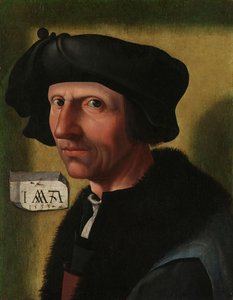
1472–1533, Holland
Jacob Cornelisz van Oostsanen
Jacob Cornelisz van Oostsanen: Brobygger mellem Gotik og Renæssance i Amsterdam Jacob Cornelisz van Oostsanen (ca. 1470 – 1533) står som en skelsættende skikkelse i nordnederlandsk kunst, der markerede den endelige overgang fra middelalderlige traditioner til den spirende renæssanceånd i den pulserende by Amsterdam. På trods af manglen på detaljerede biografiske oplysninger – hvor forskere primært må støtte sig til Karel van Manders Schilder-boeck og arkivdokumenter – har kunsthistorikere omhyggeligt rekonstrueret hans liv og kunstneriske rejse. Dette har afsløret en håndværker, der var dybt forankret i Haarlems gotiske arv, men som samtidig blev gennemgribende påvirket af de nyskabelser, der strømmede fra Firenze og Nürnberg.
Om Jacob Cornelisz van Oostsanen Bemærkelsesværdige værker af Jacob Cornelisz van Oostsanen
Også af Jacob Cornelisz van Oostsanen
 Donor Portraits of the Korsgen Elbertzen - van der Schelling Family (right part)1509
 Hieronymus altarpiece1511
 The donors Korsgen Elbertzen, his sons Dirck and Albert on left half, with female donors on the right1509
 Virgin and child with angel musicians1510

Essays om Two Bishops (Saint Ulrich? and Saint Blasius)
 25 Masterpieces by Pieter Bruegel the Elder: The Ultimate Guide to a Northern Renaissance LegendExplore 25 iconic Northern Renaissance masterpieces by Bruegel the Elder. Discover museum-quality art on OriginalUniqueArt.com.
 Masterpieces of the Dutch Soul: Top 25 Must-See Artworks in Amsterdam's RijksmuseumEmbark on a journey through the Dutch Golden Age. From Rembrandt's drama to Vermeer's light, explore 25 iconic Rijksmuseum masterpieces and…
 The Two Johns: Distinguishing the Iconography of Saint John the Baptist and the Evangelist in Western ArtMaster the subtle iconography of Saint John the Baptist and the Evangelist. Explore these Renaissance masters with our expert guide.