Neoclassicism · 1784
Samuel Blodget (John Trumbull, 1784)
John Trumbull (1756–1843) har skabt Samuel Blodget. Det er fra 1784. Det tilhører Neoclassicism-bevægelsen. Den er udført i Oil On Canvas. Det opbevares på National Portrait Gallery i Washington, D.C., USA. Målene er 71 × 92 cm.
- 1784
- Oil On Canvas
- 71 × 92 cm
- National Portrait Gallery, Washington, D.C.

 Se i rummet

 Håndmalet oliemalerie
 Del som kort
 Del
 Faktablad


 Download
 Lignende værker
 Røntgenundersøgelse
 Diasshow
 Spørgsmål og svar

 Statistikker
Samuel Blodget kort fortalt
- Titel
- Samuel Blodget
- Kunstner
- John Trumbull (1756–1843)
- Kunstner født i
- Lebanon, USA
- Dato
- 1784
- Medium
- Oil On Canvas
- Dimensioner
- 71 × 92 cm
- Hvor det kan ses
- National Portrait Gallery, Washington, D.C., USA
- Bevægelse
- Neoclassicism
- Periode
- Early Modern
- Motiv
- portrait, wealth, status, authority, neoclassical, formal
Hvad forestiller Samuel Blodget?
The Portrait of Samuel Blodget
In this 1784 portrait, John Trumbull captures Samuel Blodget seated within an opulent setting. The subject rests in a draped chair, his presence anchored by the weight of his attire. He wears a gold waistcoat and a brown coat, accented by a white shirt with delicate lace details. A red stocking provides a sharp note of color against the darker tones of the room. He holds a document, a quiet symbol of the authority or legal matters that defined his life.
The man gazes directly at the viewer with a sense of dignified composure. His posture is steady, projecting a quiet confidence. The setting around him is formal and structured, designed to reflect his status and intellect. Light falls from an unseen source to the left, casting shadows that define the folds of his clothing and the contours of his face. He remains a figure of stillness amidst the heavy textures of fabric and wood.
Trumbull renders the subject with a focus on realistic depiction. Every detail, from the lace at the collar to the texture of the waistcoat, is placed with precision. The composition centers entirely on the man, making his direct engagement the focal point of the work. He sits as a man of substance, caught in a moment of profound, silent authority.
Composition and Visual Elements
The figure occupies the center of the frame, anchored by a draped chair. He sits in a formal posture, his gaze fixed directly upon the viewer. A document rests in his hands, a pale weight against the darker tones of his attire. He wears a brown coat over a gold waistcoat, the fabric catching the light. Below, red stockings provide a sharp punctuation of color against the shadows.
Light enters from an unseen source to the left, carving the subject out of a dark, receding background. This directional glow illuminates the white lace details of his shirt and the texture of his clothing. The composition relies on a steady, linear structure. It defines the folds of the drapery and the sharp edges of the man's features. The arrangement is quiet and controlled. A sense of stillness holds the room.
Technique and Artistic Materials
Oil paints meet the weave of the canvas to build this figure. The artist employs a method of layering paint, applying glazes to develop depth in the shadows and a luminous quality in the highlights. Each layer of pigment settles into the fabric, constructing a sense of weight and presence. This approach allows for a slow accumulation of color and tone, defining the subtle shifts in the subject's skin and the heavy folds of his clothing.
The work adheres to the principles of neoclassical realism. Precision guides the hand, focusing on the meticulous rendering of fine details. Every texture, from the crispness of the lace to the smooth surface of the document, is captured through controlled brushwork. The light falls from the side, creating a sharp interplay between illuminated surfaces and deep, receding darkness. It is a study of form and light held within the structure of the paint.
Hvilket museum udstiller Samuel Blodget?
National Portrait Gallery
Washington, D.C., USA
National Portrait Gallery i Washington, D.C. Beliggende i Washington, D.C., USA, er National Portrait Gallery en integreret del af Smithsonian Institution. Siden åbningen i 1968, efter institutionens grundlæggelse i 1962, har museet fungeret som et vidnesbyrd om det amerikanske folks visuelle historie.


Højopløselige billeder af Samuel Blodget
Public domain: kunstneren døde i 1843.
John Trumbull, Samuel Blodget (1784), National Portrait Gallery. Public domain
Spørgsmål om Samuel Blodget besvaret
Hvor kan man i dag se "Samuel Blodget" af John Trumbull udstillet?
Originalen af "Samuel Blodget" af John Trumbull opbevares på National Portrait Gallery, Washington, D.C., USA. En reproduktion gør det muligt at udstille værket i hjemmet.
I hvilket år blev "Samuel Blodget" af John Trumbull skabt?
"Samuel Blodget" stammer fra 1784. Datoen placerer værket i John Trumbull's karriere og dets tidsalder.
Hvilket medie er "Samuel Blodget" af John Trumbull udført i?
John Trumbull brugte Oil On Canvas-teknikken til "Samuel Blodget". Teknikken definerer det originale værks materielle karakter.
Hvad er målene på det originale "Samuel Blodget" af John Trumbull?
"Samuel Blodget" måler 92 x 71 cm i sin oprindelige form. De originale dimensioner er en nyttig reference, når du skal vælge størrelsen på en reproduktion.
Hvad forestiller "Samuel Blodget" af John Trumbull?
Motiverne i "Samuel Blodget" er portrait, wealth, status, authority, neoclassical, formal, document, 18th century.
Er "Samuel Blodget" fri for ophavsret?
Hvad angår ophavsret, er "Samuel Blodget" i det offentlige domæne – ophavsretten er udløbet.
Hvem er kunstneren bag "Samuel Blodget"?
Kunstneren bag "Samuel Blodget" er John Trumbull. Værket er katalogiseret under John Trumbulls navn.
Hvilken kunstretning tilhører "Samuel Blodget" af John Trumbull?
"Samuel Blodget" af John Trumbull tilhører Neoclassicism-bevægelsen. Denne bevægelse giver den stilistiske kontekst for værket.
Hvor i John Trumbulls karriere placerer "Samuel Blodget" sig?
"Samuel Blodget" repræsenterer John Trumbulls Mature Period.
Om kunstneren, John Trumbull

1756–1843, USA
John Trumbull
A Life Etched in Revolution: The World of John Trumbull John Trumbull, a name synonymous with the visual narrative of America’s birth, was more than just a painter; he was a witness, a soldier, and a chronicler of a nation forging its identity. Born in Lebanon, Connecticut, in 1756, into a family steeped in patriotic fervor – his father, Jonathan Trumbull, served as governor throughout the Revolutionary War – young John’s destiny seemed intertwined with the unfolding drama of independence. A childhood accident tragically cost him the use of one eye, yet this perceived limitation may have paradoxically sharpened his observational skills, contributing to the meticulous detail that would become a hallmark of his artistic style. His early education at Harvard College further cultivated a mind primed for both intellectual rigor and creative expression.
Også af John Trumbull
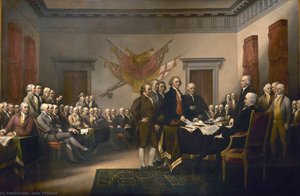 Uafhængighedserklæringen1817
 Lord Cornwalls overgivelse1819
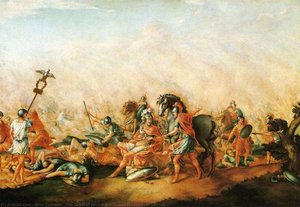 The Death of paulus Aemilius at the Battle of Cannae1773
 The Declaration of Independence, July 4, 17761787
Essays om Samuel Blodget
 The Weight of Asymmetry: Mastering Visual Tension and Dynamic Equilibrium in Fine ArtMaster the principles of visual weight and asymmetrical balance through iconic works. Explore the mechanics of fine art composition now.
 American artworks of the 1810s1810s American art by Gilbert Stuart, John Trumbull, and Rembrandt Peale. Find museum-quality reproductions on OriginalUniqueArt.com.
 American artworks of the 1800sIconic American works by Gilbert Stuart and John Trumbull define an era. Explore the full collection online at OriginalUniqueArt.com.