Neoclassicism · 1786
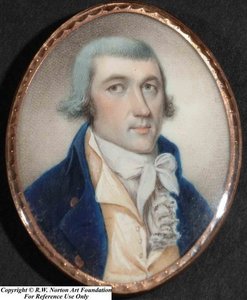
Thomas Witter (John Ramage, 1786)
John Ramage (1748–1802) har skabt Thomas Witter. Det er fra 1786. Det tilhører Neoclassicism-bevægelsen. Den er udført i Watercolor. Det opbevares på Metropolitan Museum of Art i New York, USA. Målene er 4 × 4 cm.
- 1786
- Watercolor
- 4 × 4 cm
- Metropolitan Museum of Art, New York

 Se i rummet

 Håndmalet oliemalerie
 Del som kort
 Del
 Faktablad


 Download
 Lignende værker
 Røntgenundersøgelse
 Diasshow
 Spørgsmål og svar

 Statistikker
Thomas Witter kort fortalt
- Titel
- Thomas Witter
- Kunstner
- John Ramage (1748–1802)
- Kunstner født i
- Dublin, Irland
- Dato
- 1786
- Medium
- Watercolor
- Dimensioner
- 4 × 4 cm
- Hvor det kan ses
- Metropolitan Museum of Art, New York, USA
- Bevægelse
- Neoclassicism
- Periode
- Early Modern
- Motiv
- man, portrait, mustache, white hair, cravat, grayscale
Hvad forestiller Thomas Witter?
Identification of the Portrait of Thomas Witter
The gaze of Thomas Witter meets the viewer through this intimate watercolor portrait, a work that captures a quiet moment of reflection. Painted by John Ramage in 1786, the piece presents a man caught in a state of contemplation. He appears as a gentleman of his era, his presence rendered with a delicate touch that suggests a life of dignity and perhaps a touch of melancholy. The portrait focuses closely on his head and shoulders, creating a sense of immediate, personal encounter.
This small-scale watercolor painting offers a glimpse into the character of the subject. Ramage, an artist known for his ability to capture individual presence, uses the medium to define the contours of Witter's face and the subtle textures of his attire. The man's white hair and prominent mustache are rendered with precision, framing a face that seems to hold a silent story. Every line and shade works to preserve the likeness of Thomas Witter, ensuring his image remains present and palpable.
Composition and Visual Elements
The portrait centers on the head and shoulders of the subject, all contained within the gentle curves of an oval frame. He gazes downward, his eyes cast toward something unseen, wearing an expression of quiet melancholy or deep contemplation. His white hair is styled with neat precision, and a prominent mustache defines his face. He wears a formal suit, the details of which are anchored by a tie or cravat wrapped carefully around his neck.
A grayscale palette governs the entire scene, moving through a full range of tones from the deepest blacks to the brightest whites. This monochromatic approach creates a sense of stillness. Soft, diffused lighting washes over the man, illuminating his features evenly and avoiding any harsh or jarring shadows. The light settles upon his face, revealing the subtle contours of his features and the texture of his clothing without disrupting the calm atmosphere of the moment.
Technique and Artistic Materials
The artist works within a delicate 4 x 4 cm space, utilizing watercolor on paper to build a quiet, grayscale world. Through the careful layering of gray paint washes, a sense of volume emerges from the flat surface. These tonal variations create a soft, diffused light that settles across the subject, building depth through subtle shifts in shadow rather than harsh lines. The monochromatic palette relies entirely on these gradations to define the form of the man's face and the structure of his attire.
Fine, deliberate lines define the character of the portrait. The artist uses precise strokes to render the details of the mustache and the subtle wrinkles of the skin, capturing a sense of lived experience. These same linear techniques extend to the clothing, where lines trace the heavy folds of the fabric. A tactile contrast exists between the different surfaces; the skin appears smooth under the light, while the texture of the clothing feels slightly more rugged and coarse.
Hvilket museum udstiller Thomas Witter?
Metropolitan Museum of Art
New York, USA
Oprindelse og historie for Metropolitan Museum of Art Metropolitan Museum of Art begyndte med en vision, der blev delt af en gruppe forretningsmænd, finansfolk samt førende kunstnere og tænkere. Efter institutionens stiftelse i 1870 søgte museet efter et permanent hjem til at huse sine stadigt voksende erhvervelser. Før det fandt sin nuværende placering, havde museet kortvarigt residens på Douglas Mansion-ejendommen på West 14th Street.


Højopløselige billeder af Thomas Witter
Public domain: kunstneren døde i 1802.
John Ramage, Thomas Witter (1786), Metropolitan Museum of Art. Public domain
Spørgsmål om Thomas Witter besvaret
Hvilket museum udstiller det originale "Thomas Witter"?
"Thomas Witter" af John Ramage er udstillet på Metropolitan Museum of Art, New York, USA. Museets fortegnelse henviser til det originale værk og ikke til reproduktioner.
I hvilket år blev "Thomas Witter" af John Ramage skabt?
"Thomas Witter" af John Ramage er dateret til 1786.
Hvilken teknik er "Thomas Witter" udført med?
John Ramage brugte Watercolor-teknikken til "Thomas Witter". Teknikken definerer det originale værks materielle karakter.
Hvad er målene på det originale værk "Thomas Witter"?
"Thomas Witter" måler 4 x 4 cm i sin oprindelige form. De originale dimensioner er en nyttig reference, når du skal vælge størrelsen på en reproduktion.
Hvad forestiller "Thomas Witter"?
Temaerne i "Thomas Witter" af John Ramage omfatter man, portrait, mustache, white hair, cravat, grayscale, som tilsammen udgør værkets motivverden.
Er "Thomas Witter" af John Ramage i det offentlige domæne?
"Thomas Witter" af John Ramage er i det offentlige domæne – ophavsretten er udløbet. Denne status bestemmer, hvordan billedet af værket må reproduceres.
Hvem har skabt "Thomas Witter"?
"Thomas Witter" tilskrives John Ramage.
Hvilken kunstretning tilhører "Thomas Witter" af John Ramage?
Kunstretningen forbundet med "Thomas Witter" af John Ramage er Neoclassicism. Denne klassificering placerer værket blandt relaterede kunstnere og kunstværker.
Hvor i John Ramages karriere placerer "Thomas Witter" sig?
Inden for John Ramages karriere tilhører "Thomas Witter" perioden Mature Period, hvilket gør det muligt at sammenligne værket med kunstnerens øvrige værker.
Om kunstneren, John Ramage
1748–1802, Irland
John Ramage
A Life Bridging Worlds: The Story of John Ramage John Ramage’s life unfolded as a remarkable confluence of artistic passion and historical circumstance, transporting him from the refined elegance of Dublin goldsmithing to the burgeoning dynamism of colonial America. Details concerning his early familial origins remain shrouded in obscurity—however, it is established that he received formal instruction at the Dublin Society of Artists in 1763, establishing a foundational understanding of drawing and painting techniques destined to shape his future endeavors. Ramage’s initial vocation proved remarkably versatile; he seamlessly blended the precision demanded by goldsmithing with the delicate artistry inherent in miniaturist pursuits—a reflection of his innate aptitude for meticulous detail and decorative arts. This formative period instilled within him not merely technical proficiency but also a profound appreciation for craftsmanship that would characterize his artistic output throughout his life.
Også af John Ramage
 Gilbert Van Cortlandt1785
 Portrait of a Gentleman1780
 Governor George Clinton1785
 Major Greene, B.A1777
Essays om Thomas Witter
 25 Masterpieces by Jean-Antoine Watteau: The Essence of Rococo EleganceExplore 25 iconic Rococo masterpieces by Jean-Antoine Watteau. Discover the full collection online at OriginalUniqueArt.com.
 Hollandsk Barok: Top 10 Mesterværker der Definerede en Æra – Kunst til Dit HjemOplev Hollandsk Barok's 10 mest ikoniske værker! Rembrandt, Vermeer & co. – dyk ned i historien bag mesterværkerne og find inspiration til …
 Monochromatic Form: Integrating Black, White, and Gray Abstract Art into Modern Architectural SpacesMaster the art of integrating monochromatic abstraction into modern architecture with expert curation. Elevate your space today.