Neoclassicism
Wesley (John Jackson)
John Jackson (1778–1831) har skabt Wesley. Det tilhører Neoclassicism-bevægelsen. Den er udført i Oil On Canvas.
- Oil On Canvas

 Se i rummet

 Håndmalet oliemalerie
 Del som kort
 Del
 Faktablad


 Download
 Lignende værker
 Røntgenundersøgelse
 Diasshow
 Spørgsmål og svar

 Statistikker
Wesley kort fortalt
- Titel
- Wesley
- Kunstner
- John Jackson (1778–1831)
- Kunstner født i
- Lastingham, Storbritannien
- Materiale
- Oil On Canvas
- Bevægelse
- Neoclassicism
- Periode
- Early Modern
- Motiv
- portrait, clergy, dignified, formal, neoclassical, authority
Hvad forestiller Wesley?
Identification of the Portrait of Wesley
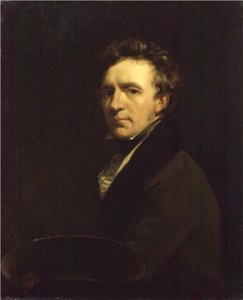
In this portrait, titled Wesley, the artist John Jackson presents a formal and dignified depiction of his subject. The work focuses on an elderly man, whose presence suggests the weight of a significant role, likely that of a clergyman or a judge. There is a quiet authority in his steady, contemplative expression, which meets the viewer with a sense of seasoned wisdom. The portrait captures a moment of stillness, focusing on the character and intellect of the sitter through a direct and serious gaze.
The subject is rendered in traditional clerical attire, which provides immediate insight into his social standing and professional life. He wears a long white wig and a black robe, accented by a stole that emphasizes his religious or judicial vocation. This specific choice of clothing, combined with the formal composition, establishes the sitter as a man of importance and discipline. The dark, indistinct background ensures that the viewer's attention remains fixed entirely upon the man and the textures of his garments.
Composition and Visual Elements
The composition is centered on the subject's head and shoulders, creating an immediate sense of presence. This focused arrangement draws the eye directly to the man's face, where a serious and contemplative expression suggests a life of deep thought. He is dressed in traditional clerical attire, characterized by a long white wig and a black robe that anchors the figure within the frame. The background remains dark and indistinct, a murky expanse that prevents distraction and pushes the subject into the foreground.
Lighting is used with a deliberate, dramatic intent. Strong highlights strike the face and the folds of the robes, carving out the form against the shadows. This chiaroscuro effect provides a sense of volume and weight to the figure. While the portrait feels intimate, the perspective is linear, utilizing subtle converging lines to suggest a sense of depth within the space. The interplay of light and shadow defines the contours of the clothing and the texture of the hair, grounding the figure in a tangible, physical reality.
Technique and Artistic Materials
The work is executed in oil paints on canvas, a choice that allows for a profound sense of depth and presence. Jackson employs a meticulous technique, characterized by careful observation and skillful brushwork that defines the contours of the face and the heavy folds of the clerical attire. There is a deliberate precision in how the light is handled, creating a sense of solidity through the careful application of pigment.
The texture of the piece is notably rich and layered. Through the use of impasto techniques, the artist has built up the surface to create a tangible quality, particularly visible in the rendering of the white wig and the heavy robes. This tactile approach provides a physical weight to the subject, ensuring that the interplay of light and shadow feels grounded and real rather than merely painted.
Related Works by John Jackson
Beyond this portrait, Jackson’s oeuvre reveals a consistent interest in the psychological depth of his subjects. His catalog includes Reginald Macdonald, a work that reflects his ability to handle formal portraiture. He also produced several self-portraits, which offer a more intimate look at the artist himself, providing a glimpse into his own character and the introspective nature of his practice. These works demonstrate his capacity to move between the public persona of a sitter and the private reality of the individual.
The artist’s technical range is further evidenced by his various studies, such as Flaxman. In these pieces, one can observe his command over oil textures and his specific approach to directional lighting. His ability to manipulate light and shadow is a recurring element across his various commissions. Whether working on a formal portrait or a focused study, Jackson maintained a commitment to capturing the essential presence of the person before him.
Højopløselige billeder af Wesley
Public domain: kunstneren døde i 1831.
John Jackson, Wesley. Frit tilgængelig
Spørgsmål om Wesley besvaret
Hvilket medie er "Wesley" af John Jackson udført i?
"Wesley" af John Jackson er udført i Oil On Canvas. Reproduktionerne har til formål at gengive denne tekniks visuelle udtryk.
Hvad forestiller "Wesley"?
Temaerne i "Wesley" af John Jackson omfatter portrait, clergy, dignified, formal, neoclassical, authority, wisdom, religious, som tilsammen udgør værkets motivverden.
Er billedet af "Wesley" af John Jackson frit tilgængeligt i det offentlige domæne?
"Wesley" af John Jackson er i det offentlige domæne – ophavsretten er udløbet. Denne status bestemmer, hvordan billedet af værket må reproduceres.
Hvem er kunstneren bag "Wesley"?
Kunstneren bag "Wesley" er John Jackson. Værket er katalogiseret under John Jacksons navn.
Hvilken kunstretning tilhører "Wesley" af John Jackson?
Kunstretningen forbundet med "Wesley" af John Jackson er Neoclassicism. Denne klassificering placerer værket blandt relaterede kunstnere og kunstværker.
Hvilken fase af John Jacksons kunstneriske udvikling repræsenterer "Wesley"?
Inden for John Jacksons karriere tilhører "Wesley" perioden Mature Period, hvilket gør det muligt at sammenligne værket med kunstnerens øvrige værker.
Er "Wesley" af John Jackson i det offentlige domæne, og hvorfor?
"Wesley" af John Jackson er i det offentlige domæne – ophavsretten er udløbet. Ophavsretten løber fra kunstnerens dødsår, som var 1831.
Hvad deler "Wesley" med resten af John Jacksons produktion?
"Wesley" deler med John Jacksons øvrige værker sin Neoclassicism-stil og de gennemgående temaer: reflects jackson's skill, demonstrates mastery, typical of his portraits, established style, classical ideals, roman portraiture, neoclassical style, formal composition.
Hvordan relaterer motivet i "Wesley" sig til John Jacksons sædvanlige temaer?
John Jacksons gennemgående temaer inkluderer reflects jackson's skill, demonstrates mastery, typical of his portraits, established style, classical ideals, roman portraiture, neoclassical style, formal composition; "Wesley" fokuserer på portrait, clergy, dignified, formal, neoclassical, authority, wisdom, religious.
Om kunstneren, John Jackson
1778–1831, Storbritannien
John Jackson
Tidligt liv og læretid: En modvillig begyndelse John Jackson, født i den idylliske Yorkshire-landsby Lastingham den 31. maj 1778, påbegyndte en rejse, der lå langt fra hans oprindelige skæbne. Hans far, en praktisk skrædder, forestillede sig et lignende håndværk for sin søn, og unge John blev indskrevet i lære derefter. Men selv midt iblandt stoffer og sømme spirede en ubestridelig kunstnerisk lyst i ham.
Også af John Jackson
 Portrait of a Man1822
 Reverend William Holwell Carr1827
 Portrait of a Gentleman1810
 Frederick, Duke of York (1763-1827)1822
Essays om Wesley
 The Artistry and Process of Bespoke Oil Painting: From Concept to CanvasMaster the technical artistry of bespoke oil painting from glazing to impasto. Discover the secrets of fine art commissions today.
 25 Essential Portraits by François Clouet: A Guide to His Finest WorksExplore 25 iconic François Clouet portraits from the French Renaissance. Discover the full collection online at OriginalUniqueArt.com.
 25 Essential John Collier Paintings: Iconic Portraits and Narrative ScenesExplore 25 iconic John Collier paintings and Pre-Raphaelite portraits. Discover the full collection online at OriginalUniqueArt.com.