Expressionism
Prophet (Emil Nolde)
Emil Nolde (1867–1956) har skabt Prophet. Det tilhører Expressionism-bevægelsen. Den er udført i Woodcut.
- Woodcut

 Se i rummet

 Håndmalet oliemalerie
 Del som kort
 Del
 Guide


 Download
 Lignende værker
 Røntgenundersøgelse
 Diasshow
 Spørgsmål og svar

 Statistikker
Prophet: det vigtigste
- Titel
- Prophet
- Kunstner
- Emil Nolde (1867–1956)
- Kunstner født i
- Nolde, Danmark
- Medium
- Woodcut
- Bevægelse
- Expressionism
- Periode
- Modern
- Motiv
- man, face, beard, black and white, portrait, eyes
Hvad forestiller Prophet?
The Portrait of Prophet by Emil Nolde
In Prophet, the German Expressionist painter Emil Nolde captures a man who exists between the physical and the divine. The subject is a portrait of a man likely intended to represent a prophet, a figure carved from shadow and light. His beard and hairstyle suggest a man from a distant past or a religious leader, a person shaped by the weight of revelation. The face is a landscape of heavy lines and stark contrasts.
The man’s intense gaze pierces through the grain of the medium. A furrowed brow carries the imprint of deep emotion, perhaps a mixture of sadness, concern, or a singular, driving determination. This is not a likeness of a person in repose, but a study of a soul under pressure. The features are simplified, stripped of unnecessary detail to reveal the raw essence of the subject's internal state.
Emil Nolde uses the starkness of the form to emphasize this spiritual tension. Every line serves the gravity of the man's expression. The eyes do not merely look; they witness. The stillness of the portrait holds a quiet, heavy ache.
Composition and Visual Elements
The man's face occupies the center, a heavy presence that fills most of the frame. His head tilts slightly, caught in a moment of quiet anguish or deep contemplation. Around him, the background remains largely empty, a void that forces the eye back to the subject's features. There is no horizon, only the weight of the gaze.
Bold, thick lines carve the anatomy of the man. They define the coarse texture of his beard, the sharp ridge of his nose, and the deep-set hollows of his eyes. These lines are not smooth; they are angular and sharp, cutting through the space to shape his hair and facial structure. The geometry is simplified, reducing the man to essential, striking forms.
The color palette is stripped of all distraction. It exists in a narrow world of black and white, bridged only by subtle shades of grey. This lack of color heightens the dramatic tension, turning the portrait into a study of light and shadow. The starkness leaves no room for anything but the raw emotion of the expression.
Technique and Artistic Medium
The work emerges from the physical resistance of wood. This woodcut print relies on the deliberate act of carving lines into a solid block to define its form. Each stroke is a subtraction, a removal of material that leaves behind a sharp, angular topography. The artist works with wood, ink, and paper to translate a vision into a permanent, tactile presence.
Ink meets the paper through the pressure of the press. This contact creates a grainy texture across the surface, a subtle roughness that speaks of the material's origin. The depth of the shadows and the brightness of the highlights depend entirely on the variation of the lines. Thicker cuts hold more ink to create heavy shadows, while thinner, delicate lines allow the paper to breathe through the composition. The result is a stark, high-contrast landscape of light and dark.
The medium demands a directness of hand. There is no blending here, only the immediate impact of the carved edge. The grain of the wood and the weight of the ink settle into the fibers of the paper, creating a surface that feels both raw and finished. It is a quiet collision of tool and grain.
Prophet i høj opløsning
Public domain: kunstneren døde i 1956.
Emil Nolde, Prophet. Public domain
En digital ekspert kontrollerer farverne i forhold til det originale maleri og retoucherer filen, så den er tro mod kunstnerens penselstrøg.
Køb billedet i høj opløsningSpørgsmål om Prophet
Hvem er ophavsmanden til "Prophet", og hvilken kunstretning tilhører værket?
"Prophet" blev skabt af Emil Nolde i Expressionism-stil. Kunstneren og stilen identificerer værkets tradition.
Hvor lys er "Prophet" overordnet set?
Den oplevede lysstyrke i "Prophet" af Emil Nolde er deep_shadow. Den kan tilpasses lyset i det tiltænkte rum.
Er farverne i "Prophet" kraftige eller dæmpede?
Farven på "Prophet" har en mætning på Muted og en intensitet på Monochromatic.
Hvor placerer "Prophet" sig blandt Emil Noldes gennemgående motiver?
Emil Noldes gennemgående temaer inkluderer post-impressionism, die brücke, religious themes, expressionist style; "Prophet" fokuserer på man, face, beard, black and white, portrait, eyes.
Hvor mange ser "Prophet"?
Statistikker for "Prophet" af Emil Nolde findes på værkets Besøgsstatistik-side: månedlige besøg på værket, besøg på kunstnerens øvrige værker samt en opdeling af de seneste besøgende efter land og sprog.
Hvor og til hvilket formål anbefales "Prophet"?
"Prophet" anbefales til Conversation, og det ideelle rum er et Living Room.
Hvilken lysstyrke har "Prophet" af Emil Nolde?
Luminansen registreret for "Prophet" af Emil Nolde er Soft Shadow.
Hvor kan jeg se en forhåndsvisning af "Prophet"?
Se en forhåndsvisning af "Prophet" af Emil Nolde på værkets Forhåndsvisning-side.
Hvilken kunstretning tilhører "Prophet" af Emil Nolde?
"Prophet" er et værk fra Expressionism. Denne stilart angiver den kunstneriske tradition, som værket indgår i.
Om kunstneren, Emil Nolde
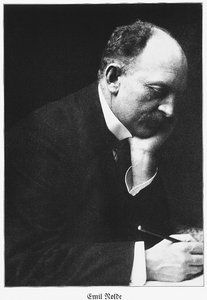
1867–1956, Danmark
Emil Nolde
Livet og identiteten bag Emil Nolde Født som Hans Emil Hansen den 7. august 1867, voksede manden, der senere skulle blive kendt som Emil Nolde, op nær landsbyen Nolde i hertugdømmet Slesvig. Hans tidlige år var præget af familiens landlige og agrare livsførelse, men han valgte med tiden at bevæge sig væk fra denne sti og søgte i stedet mod arbejdet som træskærer og møbeldekoratør. Dette taktile og fysiske håndværk dannede fundamentet for hans senere skift mod maleri og grafisk kunst.
Også af Emil Nolde
 Sunset
 Sea with Red Sky
 Couple on the beach1903
 Masks1911
Essays om Prophet
 Egon Schiele: Top 25 Kunstværker – En Dybdegående Guide til Mesteren af EkspressionismenOplev Egon Schiele's 25 mest ikoniske kunstværker. Dyk ned i ekspressionismens intensitet, portrætter og nøgenkunst. Find inspiration til d…
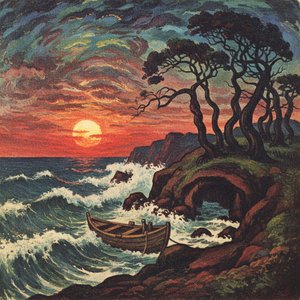 Emile Nolde: A Journey into Expressionist Nature & the Primal SelfExplore the powerful Expressionism of Emile Nolde – a pioneer of emotive landscapes & spiritual themes. Discover his journey, influences, a…
 Master of Emotion: The 25 Greatest Artworks by Rogier van der WeydenImmerse yourself in the profound emotion of Rogier van der Weyden. Explore 25 iconic Early Netherlandish masterpieces, from intricate textu…