Expressionism
Sea (Emil Nolde)
Emil Nolde (1867–1956) har skabt Sea. Det tilhører Expressionism-bevægelsen. Den er udført i Oil On Canvas.
- Oil On Canvas

 Se i rummet

 Håndmalet oliemalerie
 Del som kort
 Del
 Faktablad


 Download
 Lignende værker
 Røntgenundersøgelse
 Diasshow
 Spørgsmål og svar

 Statistikker
Sea kort fortalt
- Titel
- Sea
- Kunstner
- Emil Nolde (1867–1956)
- Kunstner født i
- Nolde, Danmark
- Medium
- Oil On Canvas
- Bevægelse
- Expressionism
- Periode
- Modern
- Motiv
- sea, sky, waves, clouds, blue, orange
Hvad forestiller Sea?
Identification of the Artwork and Artist
The artwork titled Sea is a painting by Emil Nolde. The artist was born in 1867 in Nolde, Denmark. He became a prominent figure in German expressionism, a movement characterized by the use of color and form to convey internal states rather than objective reality.
This specific work, Sea, focuses on a seascape. The composition centers on the interaction between a dramatic sky and the water below. The artist's approach to the subject matter emphasizes the movement of the elements through the application of pigment. The visual presentation relies on the contrast between the tones used for the clouds and those used for the undulating surface of the water.
Composition and Visual Elements
The composition is organized into distinct horizontal bands that establish a layered perspective. The upper portion of the canvas is occupied by a turbulent sky, which transitions into a middle band representing the water’s surface. At the bottom, a suggestion of a distant shoreline or horizon line provides a boundary to the scene. This arrangement creates a sense of depth through the stacking of color and form rather than through traditional linear perspective.
The color palette relies on high-contrast temperature shifts. The sky is dominated by warm yellows and oranges, while the clouds within this upper section contain strokes of purple and red. Below the sky, the sea is rendered in cool blues and greens. These colors are applied in thick, visible strokes that create a palpable texture across the surface. The water is depicted as undulating waves, formed by broad, heavy brushstrokes that emphasize the movement of the liquid surface.
Artistic Style and Technique
The work is executed in an Expressionistic style. The application of paint relies on an impasto technique, where thick layers of pigment are built up on the surface. These layers create a palpable texture that remains visible across the canvas. The paint is not smoothed or blended into a flat plane; instead, the material maintains a physical presence that defines the forms of the sky and the water.
Bold and expressive brushstrokes characterize the entire composition. In the sky, large, amorphous forms are created through the application of color rather than through the use of precise lines or defined outlines. The sea is rendered with broad, undulating strokes that suggest the movement of waves. These strokes are thick and visible, contributing to the overall tactile quality of the surface. The interaction between the light and the heavy pigment creates a sense of luminosity, as the light appears to emanate from behind the cloud forms.
The Artist and His Artistic Movement
Emil Nolde was a German painter and printmaker who emerged as one of the first Expressionists. His practice involved a tactile connection to his materials, a quality stemming from his early years working as a woodcarver and furniture decorator. He was a member of the Die Brücke group, a collective that sought to move away from academic traditions by searching for a new pictorial language. His approach often prioritized the internal sensation of a subject over its literal likeness, focusing on the psychological and the primal through the use of color and form.
The artist explored color extensively in both oil painting and watercolor. In his oil works, he often utilized heavy, golden yellows and deep reds to provide a sense of weight to the surface. From the 1930s until his death, watercolor became a primary medium for him. He found that this medium allowed him to translate his concepts to the paper with greater speed than oil painting. His watercolors often feature vivid, brooding storm-scapes and brilliant florals, where the color functions as the substance of the shape itself.
- Autumn Sea (about 1908)
- The Mocking of Christ (1909)
- Masks (about 1906-1907)
Related Works by Emil Nolde
The artist's exploration of maritime themes continues in several other compositions. Autumn Sea presents a turbulent seascape where deep reds, magenta, and pink appear in the foreground waves against a sky of yellow and orange. In Sea and ship in the sunset, an oil on canvas, the composition features a large expanse of sky transitioning from yellow to orange above a body of water that reflects these specific tones. This work includes a solitary vessel drifting toward the horizon.
Other works demonstrate a focus on atmospheric conditions and different mediums. Sea with Red Sky is an expressionist painting where the sky is rendered in a deep, saturated red. In Light Sea Mood, the scene depicts the ocean at sunset with a beach in the foreground and clouds forming a backdrop. The water meets the shore in a manner described as calm and serene, featuring two people standing upon the sand.
The artist also utilized watercolor to capture movement. Stormy Sea is a watercolor landscape painting from 1930. This piece contains organic lines and uses bright colors, specifically blues and oranges. The work includes two boats on the horizon and a steam boat positioned off to the right side. The orange light in the sky contrasts with the dark blue waters, and white pigment is used to indicate the crests of moving waves.
Højopløselige billeder af Sea
Public domain: kunstneren døde i 1956.
Emil Nolde, Sea. Public domain
Spørgsmål om Sea besvaret
Hvilken teknik er "Sea" udført med?
"Sea" er udført i Oil On Canvas.
Hvad forestiller "Sea" af Emil Nolde?
Temaerne i "Sea" af Emil Nolde omfatter sea, sky, waves, clouds, blue, orange, yellow, horizon, som tilsammen udgør værkets motivverden.
Er billedet af "Sea" af Emil Nolde frit tilgængeligt i det offentlige domæne?
Hvad angår ophavsret, er "Sea" i det offentlige domæne – ophavsretten er udløbet.
Hvem er kunstneren bag "Sea"?
"Sea" tilskrives Emil Nolde.
Hvilken kunstretning tilhører "Sea" af Emil Nolde?
Kunstretningen forbundet med "Sea" af Emil Nolde er Expressionism. Denne klassificering placerer værket blandt relaterede kunstnere og kunstværker.
Hvilken fase af Emil Noldes kunstneriske udvikling repræsenterer "Sea"?
"Sea" tilhører Mature Period i Emil Noldes karriere. Denne klassificering knytter værket til kunstnerens udvikling.
Hvorfor er ophavsretsstatus for "Sea" som den er?
Ophavsretsstatus for "Sea" – i det offentlige domæne – ophavsretten er udløbet – følger af kunstnerens død i 1956.
Hvad deler "Sea" med resten af Emil Noldes produktion?
I Emil Noldes samlede værk placerer "Sea" sig i Expressionism-stilen, sammen med temaerne omkring post-impressionism, die brücke, expressionism, subjective emotion, nature's raw power.
Er "Sea" typisk for det, som Emil Nolde normalt skabte?
Emil Noldes gennemgående temaer inkluderer post-impressionism, die brücke, expressionism, subjective emotion, nature's raw power; "Sea" fokuserer på sea, sky, waves, clouds, blue, orange, yellow, horizon.
Om kunstneren, Emil Nolde
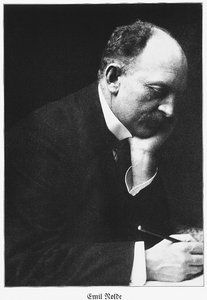
1867–1956, Danmark
Emil Nolde
Livet og identiteten bag Emil Nolde Født som Hans Emil Hansen den 7. august 1867, voksede manden, der senere skulle blive kendt som Emil Nolde, op nær landsbyen Nolde i hertugdømmet Slesvig. Hans tidlige år var præget af familiens landlige og agrare livsførelse, men han valgte med tiden at bevæge sig væk fra denne sti og søgte i stedet mod arbejdet som træskærer og møbeldekoratør. Dette taktile og fysiske håndværk dannede fundamentet for hans senere skift mod maleri og grafisk kunst.
Også af Emil Nolde
 Sunset
 Sea with Red Sky
 Couple on the beach1903
 Masks1911
Essays om Sea
 18th century German painters18th century German painters like Caspar David Friedrich and Johann Zoffany defined an era of artistry. View these masterpieces on Original…
 Emil Nolde: The 25 Most Powerful Expressionist MasterpiecesExplore 25 iconic Emil Nolde masterpieces. Discover the soul of Expressionism through his vibrant colors. Explore the full collection onlin…
 Expressionism vs. New Objectivity: Emotion vs. Precision in German ArtMaster the tension between Expressionist emotion and New Objectivity precision. Explore the soul of German modern art now.