Portræt af Johann Michael Rottmayr

De 38 mest berømte Johann Michael Rottmayr-malerier, en galleriselektion

Opdateret november 2026 · rangeret efter vores popularitetsscore (søgninger, besøg og ordrer for hvert værk) · 38 værker af Johann Michael Rottmayr i vores katalog

Kort sagt

Af alle de originale værker, som Johann Michael Rottmayr efterlod, er det mest berømte Decoration of the dome (1716), som er en del af samlingen på Melk Abbey i Melk. Lige efter følger Diana and Endymion (1692) og The Deposition from the Cross (1712). Vores katalog indeholder 38 værker af Johann Michael Rottmayr; galleriet har bevaret de 38 værker, som verden beundrer mest, hver vist med sin dato, sit museum og sin historie.

1654 – 1730, Laufen Baroque Flest værker: Liechtenstein Museum

Johann Michael Rottmayrs top 10 malerier: galleriets udvalg

1
Decoration of the dome (1716) af Johann Michael Rottmayr

Decoration of the dome

1716 · Fresco · Melk Abbey, Melk

Perched majestically atop the Austrian Danube hills, the Benedictine Abbey of Melk serves as a breathtaking sanctuary of Baroque grandeur, but its true soul resides within the soaring heights of its dome. Here, Johann Michael Rottmayr’s "Decoration of the Dome" unfolds as a monumental symphony of light and faith. Completed in 1716, this masterpiece is far more than mere architectural adornment; it is an immersive spiritual experience designed to lift…

2
Diana and Endymion (1692) af Johann Michael Rottmayr

Diana and Endymion

1692 · Oil On Canvas · Art Institute of Chicago, Chicago

The air feels heavy with the scent of night as Diana leans over the sleeping form of Endymion. A profound stillness grips the scene, broken only by the silent, rhythmic breathing of the mortal prince. He lies reclined, his muscular anatomy rendered in pale, luminous flesh that seems to glow against the dark, turbulent backdrop of a cloudy sky. Diana, the goddess of the hunt, descends from the shadows, her…

3
The Deposition from the Cross (1712) af Johann Michael Rottmayr

The Deposition from the Cross

1712 · Oil On Canvas · Walters Art Museum, Baltimore

The Deposition from the Cross is an oil sketch by the Austrian artist Johann Michael Rottmayr. Created about 1712, this work captures a moment of heavy, downward motion. It was conceived as a preliminary study for a larger canvas intended for a private chapel within the monastery of Kremsmünter in Austria. The sketch holds the weight of its intended purpose, acting as a blueprint for the sacred drama to follow.

4
Jove casts his Thunderbolts at the Rebellious Giants (1692) af Johann Michael Rottmayr

Jove casts his Thunderbolts at the Rebellious Giants

1692 · Oil On Canvas · Art Institute of Chicago, Chicago

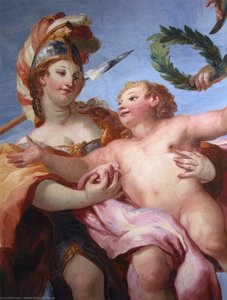
In this oil on canvas, a muscular figure of Jove lunges from the upper right quadrant of the composition. He is draped in voluminous red and gold fabric that billows behind him, following the diagonal momentum of his descent. His body is tensed, arms positioned to strike, as he directs his power toward the lower left. From the upper left corner, golden bolts of lightning cut through a turbulent sky…

5
Venus and Cupid at the Forge of Vulcan (1692) af Johann Michael Rottmayr

Venus and Cupid at the Forge of Vulcan

1692 · Oil · Art Institute of Chicago, Chicago

A dramatic Baroque composition unfolds through a series of powerful diagonal movements. Venus reclines across the foreground, her pale skin illuminated by a theatrical light source that cuts through a turbulent, dark atmosphere. Her body forms a sweeping curve, guiding the eye toward Cupid and the birds above. Below this celestial movement, muscular figures labor within a dark, fiery cave, working at a glowing anvil. The scene captures a moment…

6
Lot and His Daughters (1696) af Johann Michael Rottmayr

Lot and His Daughters

1696 · Oil · Bavarian State Painting Collections, München

In this oil painting, titled Lot and His Daughters, Johann Michael Rottmayr captures a moment of profound human frailty. The scene unfolds around a central male figure, his face turned upward in a state of distress or intoxication. He is flanked by two women who press close to him. One woman holds a shallow bowl, while the other leans her weight against his side. The figures are locked in a…

7
David with the Head of Goliath (1692) af Johann Michael Rottmayr

David with the Head of Goliath

1692 · Oil · Bavarian State Painting Collections, München

In David with the Head of Goliath, Johann Michael Rottmayr captures the immediate aftermath of a biblical triumph. The composition centers on a muscular, semi-nude young man, the hero David, whose body is caught in a dynamic, slightly twisting pose. This movement creates a visual path for the eye, pulling the gaze from the severed head of Goliath in the lower left upward toward David’s contemplative face. He looks off…

8
The Holy Family with the Christ Child John (1692) af Johann Michael Rottmayr

The Holy Family with the Christ Child John

1692 · Oil · Bavarian State Painting Collections, München

In this 1692 oil painting, we find ourselves drawn into a private, somber moment of intimacy. The composition is tightly grouped, pulling the viewer into the immediate foreground to witness a scene of profound tenderness. Mary sits at the center, her gaze cast downward in a serene expression as she holds an open book. On her lap, the Christ Child reaches out toward an elderly Joseph, while to the left,…

9
Lamentation of Abel (1692) af Johann Michael Rottmayr

Lamentation of Abel

1692 · Oil On Canvas

The scene captures the immediate aftermath of the first murder, focusing on the profound grief of Eve and Adam. They are positioned around the lifeless body of Abel, their forms arranged in a dynamic, pyramidal composition. This structural arrangement directs the viewer's eye through the emotional core of the tragedy, emphasizing the weight of their loss. A divine figure emerges from the heavens above, providing a celestial counterpoint to the…

10
Lamentation of Christ (1689) af Johann Michael Rottmayr

Lamentation of Christ

1689 · Oil · Bavarian State Painting Collections, München

Johann Michael Rottmayr’s Lamentation of Christ, executed about 1689, captures the profound mourning following the descent from the cross. The work centers on the lifeless body of Jesus, surrounded by figures gripped by grief. This specific moment of transition from the crucifixion to the burial focuses on the immediate emotional aftermath of the passion.

Johann Michael Rottmayr-udvalget fortsætter, fra 11 til 38

11The Sacrifice of Iphigenia (1690) af Johann Michael RottmayrThe Sacrifice of Iphigenia1690 12Tarquin and Lucretia (1692) af Johann Michael RottmayrTarquin and Lucretia1692 13Apollo Granting Phaeton Permission to Drive the Chariot of the Sun (1692) af Johann Michael RottmayrApollo Granting Phaeton Permission to Drive the Chariot of the Sun1692 · Art Institute of Chicago 14Mercury rescues the disguised Io after beheading Argus (1692) af Johann Michael RottmayrMercury rescues the disguised Io after beheading Argus1692 · Art Institute of Chicago 15Cephalus and Procris (1706) af Johann Michael RottmayrCephalus and Procris1706 · Bavarian State Painting Collections 16St.Benno (1702) af Johann Michael RottmayrSt.Benno1702 · Bavarian State Painting Collections 17Verherrlichung des Namens Jesu (1703) af Johann Michael RottmayrVerherrlichung des Namens Jesu1703 18Triumph of Love (1720) af Johann Michael RottmayrTriumph of Love1720 · Slovak National Gallery 19Apotheosis of St Charles Borromeo (1721) af Johann Michael RottmayrApotheosis of St Charles Borromeo1721 · Residenzgalerie 20Susanna and the two elders (1692) af Johann Michael RottmayrSusanna and the two elders1692 21Allegory of Architecture (detail) (1705) af Johann Michael RottmayrAllegory of Architecture (detail)1705 · Liechtenstein Museum 22Military Genius Taken Up into Olympus (detail) (1705) af Johann Michael RottmayrMilitary Genius Taken Up into Olympus (detail)1705 · Liechtenstein Museum 23Allegories of Princely Munificence (detail) (1705) af Johann Michael RottmayrAllegories of Princely Munificence (detail)1705 · Liechtenstein Museum 24Putto with Cornucopeia (detail) (1705) af Johann Michael RottmayrPutto with Cornucopeia (detail)1705 · Liechtenstein Museum 25Aeneas's Sacrifice (1705) af Johann Michael RottmayrAeneas's Sacrifice1705 · Liechtenstein Museum 26Minerva Bears the Military Genius Off to the Realm of the Gods (detail) (1705) af Johann Michael RottmayrMinerva Bears the Military Genius Off to the Realm of the Gods (detail)1705 · Liechtenstein Museum 27Ariadne Handing Theseus the Thread (1705) af Johann Michael RottmayrAriadne Handing Theseus the Thread1705 · Liechtenstein Museum 28Andromeda Being Taken Up into Olympus (1705) af Johann Michael RottmayrAndromeda Being Taken Up into Olympus1705 · Liechtenstein Museum 29Apollo Flays Marsyas af Johann Michael RottmayrApollo Flays MarsyasBavarian State Painting Collections 30Allegory on Time af Johann Michael RottmayrAllegory on TimeBavarian State Painting Collections 31Aeneas Saves His Father Anchises from Burning Troy, Vulcan in His Chariot in the Sky af Johann Michael RottmayrAeneas Saves His Father Anchises from Burning Troy, Vulcan in His Chariot in the SkyStaatliche Kunsthalle Karlsruhe 32Hercules and Antaeus, in the Sky Juno on her Chariot af Johann Michael RottmayrHercules and Antaeus, in the Sky Juno on her ChariotStaatliche Kunsthalle Karlsruhe 33Ecce Homo af Johann Michael RottmayrEcce HomoJohn and Mable Ringling Museum of Art 34Vulcan af Johann Michael RottmayrVulcan 35Deposition from the Cross af Johann Michael RottmayrDeposition from the CrossHarvard Art Museums 36Sacrifice of Isaac af Johann Michael RottmayrSacrifice of IsaacNationalmuseet i Warszawa 37Retinue of Mars and Venus (detail) (1705) af Johann Michael RottmayrRetinue of Mars and Venus (detail)1705 · Liechtenstein Museum 38Homage to a Tutelary Goddess af Johann Michael RottmayrHomage to a Tutelary GoddessResidenzgalerie

Motiverne, der fangede Johann Michael Rottmayrs blik

De fire motiver, der optræder hyppigst i disse originaler, hver med sit fineste eksempel.

De museer, der udstiller Johann Michael Rottmayrs originalværker

De 8 museer, der rummer flest af malerierne på denne side.

Museum By Værker af Johann Michael Rottmayr Malerier fra denne liste
Liechtenstein Museum, WienLiechtenstein Museum Wien 9 Allegory of Architecture (detail), Military Genius Taken Up into Olympus (detail), Allegories of Princely Munificence (detail)
Bavarian State Painting Collections, MünchenBavarian State Painting Collections München 8 Lot and His Daughters, David with the Head of Goliath, The Holy Family with the Christ Child John
Art Institute of Chicago, ChicagoArt Institute of Chicago Chicago 5 Diana and Endymion, Jove casts his Thunderbolts at the Rebellious Giants, Venus and Cupid at the Forge of Vulcan
Residenzgalerie, SalzburgResidenzgalerie Salzburg 2 Apotheosis of St Charles Borromeo, Homage to a Tutelary Goddess
Staatliche Kunsthalle Karlsruhe, KarlsruheStaatliche Kunsthalle Karlsruhe Karlsruhe 2 Aeneas Saves His Father Anchises from Burning Troy, Vulcan in His Chariot in the Sky, Hercules and Antaeus, in the Sky Juno on her Chariot
Melk Abbey, MelkMelk Abbey Melk 1 Decoration of the dome
Walters Art Museum, BaltimoreWalters Art Museum Baltimore 1 The Deposition from the Cross
Slovak National Gallery, BratislavaSlovak National Gallery Bratislava 1 Triumph of Love

Johann Michael Rottmayr årti for årti: det originale værk, der definerer hvert enkelt

Værker per årti

Vælg et årti for at se det originale værk, der definerer det.

Samleres spørgsmål om Johann Michael Rottmayrs malerier

Hvilket værk er Johann Michael Rottmayr mest kendt for?Vis svaret

Decoration of the dome (1716), Melk Abbey, Melk. Derefter følger Diana and Endymion (1692) og The Deposition from the Cross (1712).

Hvor gammel var Johann Michael Rottmayr, da Decoration of the dome blev skabt?Vis svaret

62 år gammel: Decoration of the dome er fra 1716, og Johann Michael Rottmayr blev født i 1654.

Hvad er de ti mest berømte Johann Michael Rottmayr malerier?Vis svaret

Decoration of the dome, Diana and Endymion, The Deposition from the Cross, Jove casts his Thunderbolts at the Rebellious Giants, Venus and Cupid at the Forge of Vulcan, Lot and His Daughters, David with the Head of Goliath, The Holy Family with the Christ Child John, Lamentation of Abel og Lamentation of Christ. Ranglisten ovenfor viser det enkelte værks årstal og museum.

Hvor mange malerier efterlod Johann Michael Rottmayr?Vis svaret

Vores katalog indeholder 38 værker af Johann Michael Rottmayr, dateret fra 1689 til 1721.

I hvilke museer udstilles Johann Michael Rottmayr's mesterværker?Vis svaret

Primært i Liechtenstein Museum (Wien), Bavarian State Painting Collections (München) og Art Institute of Chicago (Chicago). Museumslisten ovenfor viser dem alle.

I hvilke år malede Johann Michael Rottmayr sine mest berømte værker?Vis svaret

I 1690s: 12 af de 38 værker på denne side blev skabt dengang, herunder Diana and Endymion.

Hvad er de første og de sidste berømte originaler af Johann Michael Rottmayr?Vis svaret

På denne side er det tidligste Lamentation of Christ (1689) og det seneste Apotheosis of St Charles Borromeo (1721).

Hvilke motiver valgte Johann Michael Rottmayr oftest?Vis svaret

Man (13), Woman (10) og Drapery (9), fordelt på de 38 værker på denne side.

Hvilken teknik brugte Johann Michael Rottmayr mest?Vis svaret

Oil On Canvas, for 9 af de 38 værker på denne side.

Hvilken kunstretning tilhører Johann Michael Rottmayr?Vis svaret

Baroque, baseret på originalerne på denne side.

Hvilke værker af Johann Michael Rottmayr udstilles på Liechtenstein Museum?Vis svaret

Allegory of Architecture (detail), Military Genius Taken Up into Olympus (detail) og Allegories of Princely Munificence (detail): Liechtenstein Museum, Wien har 9 af værkerne på denne side.

Johann Michael Rottmayr: liv og værk

A Legacy of Light: The Life and Art of Johann Michael Rottmayr

Johann Michael Rottmayr, født omkring 1654 i den charmerende bavariske by Lauf an der Pegnitz (kilder varierer mellem 1654 og 1656), står som en afgørende figur i overgangen fra Det Høje Barok til Rokoko stilen i Centraleuropa. Han var ikke blot en maler; han var en kanal, dygtigt kanaliserende den sprudlende energi fra italienske renæssancemestre gennem linserne af stigende østrigsk kunstnerisk følelse. Rottmayr’s rejse begyndte inden for en familie allerede præget af kunstneriske talent – hvilket gav frugtbar grund til hans iboende evner til at blomstre. Hans formelle uddannelse begyndte under Johann Carl Loth i Venedig – en formative erfaring, der uomtvisteligt skulle forme hans æstetiske vision. Loth’s vejledning var ikke blot om teknik; det var en immersion i verden af Titian, Veronese og Tintoretto, hvilket indså Rottmayr en dyb værdsættelse for koloristisk rigdom, dramatisk komposition og den mesterlige brug af lys og skygge. Denne venetianske indflydelse ville forbli et bærende element i hans stil gennem hele hans karriere. Han var ikke alene om at absorbere italienske influenser; Hans Adam Weissenkircher spillede også en vigtig rolle i at bringe disse kunstneriske strømninger nordpå, hvilket fremmede en fælles æstetisk dialog, der berigede regionens kunstscene.

From Salzburg to Vienna: A Rising Star

Rottmayr’s talent hurtigt fik anerkendelse, og i 1689 sikrede han sig en prestigefuldt stilling som den generelle maler til Bischop af Salzburg. Denne udnævnelse var ikke kun et job; det var en anbefaling, hvilket gav ham konsistent kommissioner og etablerede hans ry blandt indflydelsesrige kredse. Han blomstrede under denne patronage, skabte både sekulære og religiøse værker, der viste hans stigende mestring. Hans samarbejde med Johann Bernhard Fischer von Erlach spillede særligt frugtfuldt ud – sammen udførte de ambitiøse projekter, hvilket sømløst integrerede arkitektur og maleri til at skabe immersive og betagende rum. Denne partnerskab er smukt eksemplificeret i allegoriske fresko ved Schloss Frain an der Thaya (nu Vranov nad Dyjí i Tjekkiet), hvor Rottmayr’s dygtighed inden for illusionistisk loftsmaling virkelig skinner igennem. Kompositionerne er ikke blot dekorative; de engagere aktivt med den arkitektoniske struktur, hvilket skaber en harmonisk og dynamisk helhed. Denne periode markerede et betydeligt skridt i hans kunstneriske udvikling, da han begyndte at syntetisere italienske influenser med en distinkt østrigsk følelse. Hans flyt til Wien omkring 1699 fremmede yderligere hans karriere ved at bringe ham i kontakt med et bredere netværk af sponsorer og kunstnere.

Masterpieces of Illusion: The Melk Abbey Dome and Beyond

Selvom Rottmayr producerede mange betydelige værker gennem hele sin karriere, er han måske bedst kendt for den betagende fresco, der pryder dommen i Melk Kloster i Østrig. Afsluttet med bemærkelsesværdig dygtighed skabte dette mesterværk en majestætisk vision af himlen – en virvlende vortex af figurer, lys og farve, der synes at opløse selv de mest fundamentale grænser mellem jord og himmel. Domens enorme skala kombineret med Rottmayr’s mesterskab i perspektiv og illusionistiske teknikker skabte en overvældende følelse af ærefrygt og åndelig transcendens. Det er et vidnesbyrd om hans evne til at transformere arkitektonisk rum til et område af guddommelig skønhed. Udover Melk Kloster efterlod Rottmayr sit præg på mange andre kirker og palæer i Østrig og Tyskland. Hans fresko ved Karlskirche i Wien, inklusive *Intercession of Charles Borromeo supported by the Virgin Mary*, er lige så imponerende og viser hans fortsatte udforskning af dramatisk komposition og vibrerende farvepaletter. Selv et værk holdt i en privat samling, simpelt titel *Vulcan,* taler til hans alsidighed og tekniske præstation. Den vedvarende kulturelle betydning af hans Melk Abbey dom blev yderligere sikret i 2007, da det blev valgt som den centrale motiv for en højværdi Østrigsk mindesmærke mønt – en passende tribut til en kunstner hvis arbejde fortsætter med at inspirere ærefrygt århundreder senere.

A Bridge Between Eras: Rottmayr’s Artistic Legacy

Johann Michael Rottmayr's betydning udvides ud over hans individuelle mesterværker; han spillede en afgørende rolle i at forbinde broen mellem italienske renæssancetraditioner og den udviklende Barok stil i Centraleuropa. Han var ikke blot efterlignet italiensk kunst; han tilpassede det, infuserede det med en distinkt østrigsk karakter. Hans arbejde udtrykker en dynamisk samspil mellem lys og skygge, vibrerende farve og dramatisk komposition – kendetegnende for Barok æstetikken. Dog afslører hans malerier også en stigende følsomhed over for form og detalje, hvilket antyder elegance og raffinement af Rokoko perioden.
  • Frescoes & Ceiling Paintings: Rottmayr udmærkede sig i store skala fresco maleri, især dem designet til loftsmaling, skabte dynamiske kompositioner og en følelse af hævet rum.
  • Religious Subjects: En betydelig del af hans oeuvre er dedikeret til religiøse temaer, hvilket afspejler kirkens patronage i denne æra. Han fremmede ofte scener fra Biblen og livet af helgener.
  • Dramatic Composition: Hans malerier karakteriseres ved dramatisk belysning, vibrerende farver og en følelse af bevægelse, hvilket skaber emotionelt engagerende oplevelser for seerne.
Han er retfærdigt betragtet som én af de mest betydelige østrigske kunstnere i det sene 17. og tidlige 18. århundrede. Hans indflydelse udvidedes til efterfølgende generationer af kunstnere, hvilket formede kunstens landskab i Østrig og videre. Rottmayr’s arv er ikke kun skønheden i hans malerier; det er hans evne til at syntetisere forskellige influenser, innovere inden for etablerede traditioner og skabe værker, der fortsætter med at resonnere med publikum i dag – en sand testament til kunstens vedvarende kraft. Han døde i Wien den 25 oktober 1730.