Portræt af Jean Henri Riesener

De 10 mest berømte Jean Henri Riesener-malerier, hver og en unik

Opdateret november 2026 · rangeret efter vores popularitetsscore (søgninger, besøg og ordrer for hvert værk) · 12 værker af Jean Henri Riesener i vores katalog

Kort sagt

Secretaire (1790) er det maleri af Jean Henri Riesener, der vækker mest opsigt; originalen findes på The Frick Collection, New York City. Derefter falder blikket på Roll-top desk (1769) og Drop-front secretaire (1783). Blandt de 12 værker af Jean Henri Riesener i vores katalog er disse 10 de mest berømte, hver især et unikt originalværk præsenteret med sit årstal, sit museum og årsagen til dets tidløse betydning.

1767 – 1828, Gladbeck Neoclassicism Flest værker: Wallace Collection

Top 10 malerier af Jean Henri Riesener, set gennem galleriets øjne

1
Secretaire (1790) af Jean Henri Riesener

Secretaire

1790 · Wood · The Frick Collection, New York City

To stand before this magnificent secretaire is to step directly into the gilded salons of late eighteenth-century Paris. This piece, attributed to Jean-Henri Riesener, whispers tales of royal patronage and the shifting tides of history that swept through the French aristocracy. Crafted around 1790, it embodies a moment of profound transition; the opulence of the ancien régime meeting the necessity for elegant adaptation. The very structure speaks of its storied…

2
Roll-top desk (1769) af Jean Henri Riesener

Roll-top desk

1769 · Furniture Art · Wallace Collection, London

To stand before this magnificent roll-top desk is to step directly into the gilded salons of 18th-century France, a world where artistry was not merely decoration, but a profound statement of status and refined taste. This piece, attributed to the masterful hand of Jean Henri Riesener, transcends its function as mere furniture; it is a meticulously crafted narrative rendered in wood, gilt bronze, and exquisite inlay. The very air around…

3
Drop-front secretaire (1783) af Jean Henri Riesener

Drop-front secretaire

1783 · Wood · Wallace Collection, London

Crafted in 1783, this drop-front secretaire represents the height of late eighteenth-century French furniture design. Jean Henri Riesener, a master ébéniste, executed this piece with a precision that defined the Louis XVI style. The structure is composed of oak, featuring a vertical arrangement of superposed panels and a frieze supported by short legs. Its design marks a transition from the fluid curves of the Rococo toward the disciplined, structured lines…

4
Chest of drawers with sliding doors (1780) af Jean Henri Riesener

Chest of drawers with sliding doors

1780 · Oil On Canvas · Musée Nissim de Camondo, Paris

This exquisite chest of drawers, dating back to 1780, represents the pinnacle of late 18th-century French decorative arts – a testament to meticulous craftsmanship and the burgeoning aesthetic sensibilities of the Rococo period. Crafted by the renowned Jean-Henri Riesener, a master marqueter apprenticed under the celebrated Jean-François Oeben, this piece transcends mere functionality; it’s an immersive experience of form, texture, and symbolic richness. The design is remarkably original, eschewing simple…

5
Roll-top desk (detail) (1769) af Jean Henri Riesener

Roll-top desk (detail)

1769 · Wallace Collection, London

In the quiet intimacy of Roll-top desk (detail), we are invited into a world where time seems to pause, held captive by the exquisite artistry of Jean Henri Riesener. This evocative piece, dating back to 1769, serves as more than just a depiction of furniture; it is a profound meditation on the intersection of human ingenuity and the natural world. The painting captures a moment of serene domesticity, focusing our…

6
Writing Table (1785) af Jean Henri Riesener

Writing Table

1785 · Furniture Art · The Frick Collection, New York City

In the quiet, sun-drenched corners of an eighteenth-century chateau, there existed a world of intimate correspondence and whispered secrets. The Writing Table by the legendary German ébéniste Jean-Henri Riesener, dating to approximately 1785, serves as a breathtaking portal into this vanished era of aristocratic refinement. This is not merely a piece of furniture; it is a sculptural masterpiece that embodies the very essence of the Neoclassical movement. Crafted during the…

7
Jewel cabinet (1787) af Jean Henri Riesener

Jewel cabinet

1787 · Oil On Canvas · Royal Collection, London

The mahogany and gilt bronze jewel cabinet crafted by Jean-Henri Riesener in 1787 stands as a breathtaking testament to the opulence and refined artistry of late 18th-century France. More than simply a storage piece, it’s a miniature palace – a meticulously constructed world of intricate detail, luxurious materials, and subtle symbolism that speaks volumes about its aristocratic patrons and the era in which it was born. Its presence immediately commands…

8
Trough-shaped sewing table (1788) af Jean Henri Riesener

Trough-shaped sewing table

1788 · Acrylic · Musée Nissim de Camondo, Paris

A Symphony of Craftsmanship: Jean Henri Riesener’s Trough-shaped Sewing Table This exquisite trough-shaped sewing table, crafted by Jean Henri Riesener in 1788, stands as a testament to the opulent tastes and meticulous artistry of Louis XVI’s France. More than just functional furniture, it embodies the spirit of the era—a harmonious blend of practicality and decorative splendor designed for the Queen's private sanctuary at Saint-Cloud. The table’s form itself speaks volumes…

9
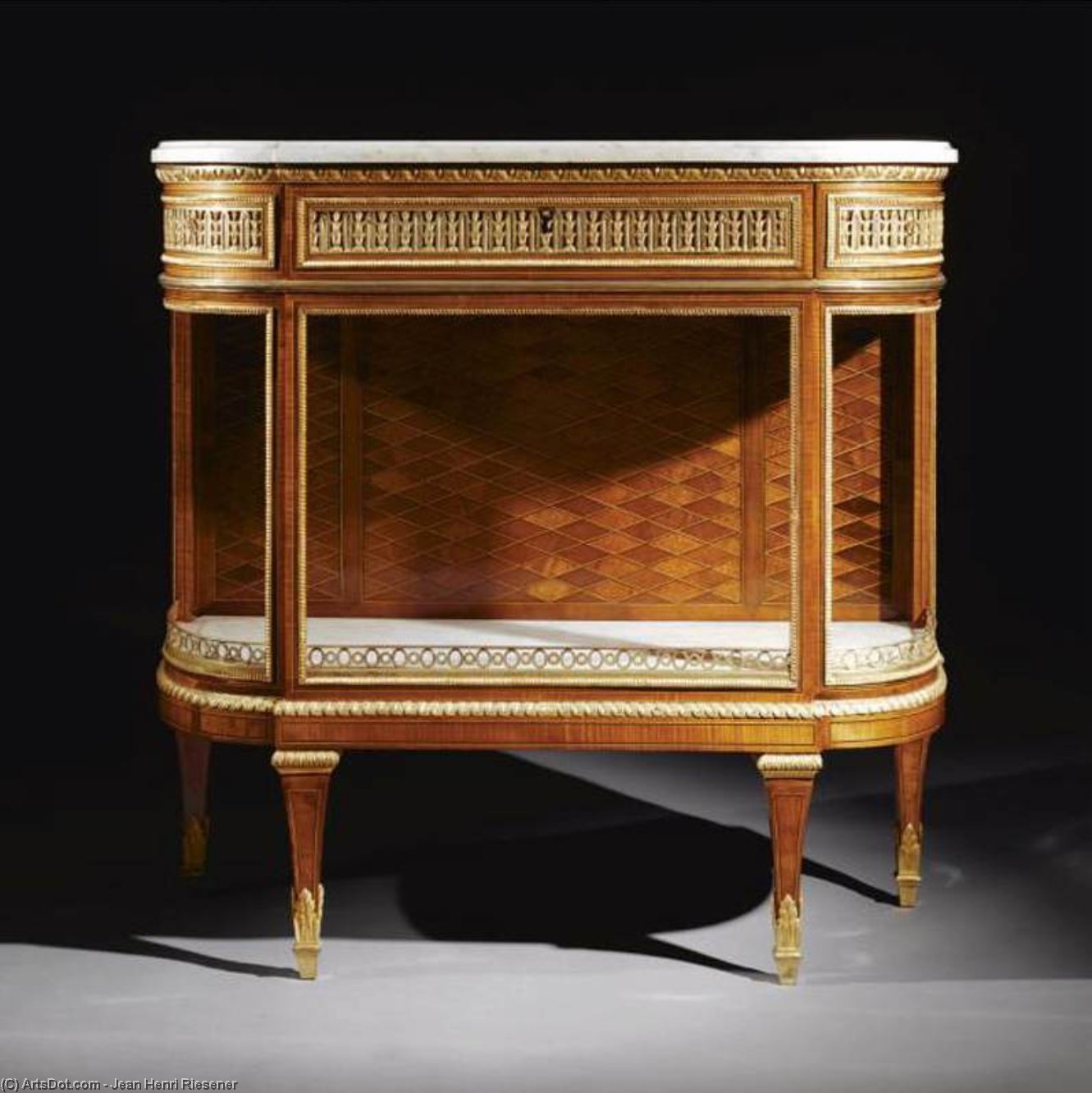
Console-Desserte (1785) af Jean Henri Riesener

Console-Desserte

1785

The Console-Desserte is a stunning example of neoclassical furniture designed by the renowned German ébéniste, Jean Henri Riesener. Created in 1785, this exquisite piece showcases Riesener's exceptional craftsmanship and attention to detail. The console table features intricate carvings, decorative elements, and a rich, dark brown finish, which suggests it could be made of mahogany or another similar hardwood. Design and Features The Console-Desserte has a flat top surface, providing ample…

Motiverne, der fangede Jean Henri Rieseners blik

De fire motiver, der optræder hyppigst i disse originaler, hver med sit fineste eksempel.

De museer, der udstiller Jean Henri Rieseners originalværker

De 5 museer, der rummer flest af malerierne på denne side.

Museum By Værker af Jean Henri Riesener Malerier fra denne liste
Wallace Collection, LondonWallace Collection London 3 Roll-top desk, Drop-front secretaire, Roll-top desk (detail)
The Frick Collection, New York CityThe Frick Collection New York City 2 Secretaire, Writing Table
Musée Nissim de Camondo, ParisMusée Nissim de Camondo Paris 2 Chest of drawers with sliding doors, Trough-shaped sewing table
Royal Collection, LondonRoyal Collection London 1 Jewel cabinet
The Baltimore Museum of Art, BaltimoreThe Baltimore Museum of Art Baltimore 1 Writing Table (Bureau Plat)

Jean Henri Riesener gennem årene: de unikke originaler fra hver enkelt

Jean Henri Rieseners daterede originaler vist her strækker sig over cirka ti år, fra 1780 til 1790: øjet følger dem år for år.

Værker per år

Vælg et årstal for at se de originale værker.

Jean Henri Rieseners malerier: spørgsmål til galleriet

Hvad er det mest berømte værk af Jean Henri Riesener?Vis svaret

Secretaire (1790), The Frick Collection, New York City. Derefter følger Roll-top desk (1769) og Drop-front secretaire (1783).

Hvilken alder havde Jean Henri Riesener, da Secretaire blev skabt?Vis svaret

23 år gammel: Secretaire er fra 1790, og Jean Henri Riesener blev født i 1767.

Hvilke ti malerier af Jean Henri Riesener er de mest berømte?Vis svaret

Secretaire, Roll-top desk, Drop-front secretaire, Chest of drawers with sliding doors, Roll-top desk (detail), Writing Table, Jewel cabinet, Trough-shaped sewing table, Console-Desserte og Writing Table (Bureau Plat). Ranglisten ovenfor viser det enkelte værks årstal og museum.

Hvor mange værker af Jean Henri Riesener er kendt?Vis svaret

Vores katalog indeholder 12 værker af Jean Henri Riesener, dateret fra 1780 til 1790.

Hvor kan de mest berømte originaler af Jean Henri Riesener ses?Vis svaret

Primært i Wallace Collection (London), The Frick Collection (New York City) og Musée Nissim de Camondo (Paris). Museumslisten ovenfor viser dem alle.

I hvilken periode skabte Jean Henri Riesener sine mest kendte malerier?Vis svaret

I 1785: 2 af de 10 værker på denne side blev skabt dengang, herunder Writing Table.

Hvilket berømt maleri af Jean Henri Riesener er det tidligste, og hvilket er det seneste?Vis svaret

På denne side er det tidligste Chest of drawers with sliding doors (1780) og det seneste Secretaire (1790).

Hvilke motiver foretrak Jean Henri Riesener?Vis svaret

Marquetry (4), French furniture (3) og 18th century (3), fordelt på de 10 værker på denne side.

Hvilke materialer brugte Jean Henri Riesener mest til sine malerier?Vis svaret

Wood, for 2 af de 10 værker på denne side.

Hvilken stilart tilhører værkerne fra Jean Henri Riesener?Vis svaret

Neoclassicism, baseret på originalerne på denne side.

Hvilke originalværker af Jean Henri Riesener kan jeg se på Wallace Collection?Vis svaret

Roll-top desk, Drop-front secretaire og Roll-top desk (detail): Wallace Collection, London har 3 af værkerne på denne side.

Jean Henri Riesener: et portræt af kunstneren

The Master of the Louis XVI Style

In the gilded era of late eighteenth-century France, few names commanded as much prestige within the royal workshops as Jean Henri Riesener. An eminent German ébéniste, or cabinetmaker, Riesener brought a level of meticulous artistry to Paris that would eventually define the early Neoclassical aesthetic known as the Louis XVI style. His journey from the Electorate of Cologne to the heart of the French court is a narrative of unparalleled skill and social ascent. After moving to Paris and apprenticing under the celebrated Jean-François Oeben, Riesener did more than just learn a trade; he inherited a legacy of excellence. His connection to his master was so profound that he eventually married Oeben's widow, further cementing his place within the lineage of France's most elite craftsmen.

Riesener’s career reached its zenith when he was formally named ébéniste ordinaire du roi. This title was not merely ceremonial; it signaled his role as a primary provider of luxury furniture for the French Crown. During the decade between 1774 and 1784, the scale of his commissions was staggering, reflecting a period where the French court engaged in furnishing projects of unprecedented opulence. He became a favorite of Queen Marie Antoinette, working alongside other masters like David Roentgen to create pieces that served as both functional furniture and profound statements of status and refined taste.

A Symphony of Marquetry and Form

The work of Riesener is characterized by a breathtaking intersection of utility and decorative splendor. He was a master of marquetry, the delicate art of inlaying different colored woods to create intricate patterns and pictorial scenes. His ability to manipulate materials allowed him to transform hard woods like walnut into fluid, organic compositions. Whether crafting a writing table or a complex chest of drawers, Riesener utilized a sophisticated palette of geometric designs and floral motifs that embodied the transition from the flowing curves of the Rococo to the more structured, disciplined lines of Neoclassicism.

Beyond the surface decoration, his technical mastery extended to the structural integrity and multi-functional design of his pieces. His creations often featured:

  • Intricate Inlays: The use of contrasting shades of wood to create depth and visual movement.
  • Gilt Bronze Accents: The integration of fine metalwork to complement the warmth of the wood.
  • Hidden Complexity: The inclusion of concealed drawers and specialized compartments, such as those found in his sewing tables, designed for the private needs of the aristocracy.

To encounter a Riesener piece is to witness a sculptural masterpiece. His work, such as the exquisite trough-shaped sewing table or his magnificent roll-top desks, transcends mere furniture making. Each piece serves as a portal into a vanished era of aristocratic refinement, where every edge and inlay was designed to evoke the intellectualism and elegance of the Enlightenment.

Legacy of an Ébéniste

The historical significance of Jean Henri Riesener lies in his ability to capture the very spirit of an age. His furniture did not merely occupy space; it defined the atmosphere of the most important salons and private sanctuaries in France, from Saint-Cloud to Versailles. Through his dedication to the highest standards of craftsmanship, he helped establish a standard of excellence that would influence decorative arts for generations. Even as the political landscape of France underwent violent transformations, the enduring beauty of Riesener's work remained a testament to the heights of French decorative achievement, ensuring his place in history as one of the greatest cabinetmakers to ever grace the Parisian workshops.