Portræt af Domenico Beccafumi

De 100 mest berømte Domenico Beccafumi-malerier, hver og en unik

Opdateret oktober 2026 · rangeret efter vores popularitetsscore (søgninger, besøg og ordrer for hvert værk) · 126 værker af Domenico Beccafumi i vores katalog

Kort sagt

St. Michael Scaccia and The Rebel Angels er det maleri af Domenico Beccafumi, der fanger flest blikke. Derefter falder blikket på Saint Catherine Receiving the Stigmata (1545) og St Lucy (1521). Blandt de 126 værker af Domenico Beccafumi i vores katalog er disse 100 de mest berømte, hver især et unikt originalværk præsenteret med sit årstal, sit museum og årsagen til dets tidløse betydning.

1484 – 1551, Montaperto Renaissance mannerism Flest værker: Pinacoteca Nazionale

Top 10 malerier af Domenico Beccafumi, set gennem galleriets øjne

1
St. Michael Scaccia and The Rebel Angels af Domenico Beccafumi

St. Michael Scaccia and The Rebel Angels

Oil On Panel

The air in the painting feels heavy, thick with the weight of a sudden, violent descent. St. Michael Scaccia occupies the center, his arms raised in a gesture that anchors the chaos. Around him, the sky is not a void but a crowded arena of motion. Fourteen figures collide in a swirling vortex, caught in the precise moment where the order of heaven meets the rebellion of the fallen. There…

3
St Lucy (1521) af Domenico Beccafumi

St Lucy

1521 · Oil On Canvas · Pinacoteca Nazionale, Siena

Domenico di Pace Beccafumi's 1521 painting, *St Lucy*, is not merely a portrait; it’s an enigmatic encounter. This captivating work, depicting a woman with flowing hair and a serene gaze, immediately draws the viewer into a world of quiet contemplation. The subject, identified as Saint Lucy – a figure renowned for her martyrdom and association with light and vision – presents a compelling study in restrained elegance and burgeoning Mannerist…

4
Saint Ignatius of Antioch Disemboweled by Trajan's Torturers (1525) af Domenico Beccafumi

Saint Ignatius of Antioch Disemboweled by Trajan's Torturers

1525 · Oil On Panel · Art Institute of Chicago, Chicago

A circular wooden panel holds a scene of visceral tension. Within this tondo, the pale, muscular body of Saint Ignatius of Antioch is caught in a moment of extreme physical undoing. Two executioners flank him, their forms pressed into a tight, triangular arrangement that fills the frame. The central horror is precise: the saint's entrails are being wound upon two spindles. This gruesome detail refers to an apocryphal account from…

6
Stigmatization of St Catherine of Siena (1515) af Domenico Beccafumi

Stigmatization of St Catherine of Siena

1515 · Oil On Canvas · Pinacoteca Nazionale, Siena

In the heart of the Italian Renaissance, where the boundaries between the earthly and the divine often blurred, Domenico Di Pace Beccafumi captured a moment of profound spiritual transformation. His masterpiece, Stigmatization of St Catherine of Siena, is not merely a painting but a window into a celestial event. Completed in 1515, this monumental work serves as a breathtaking example of Sienese Mannerism, a style that moved away from the…

7
The Miraculous Communion of Saint Catherine of Siena (1513) af Domenico Beccafumi

The Miraculous Communion of Saint Catherine of Siena

1513 · Oil On Panel · J. Paul Getty Museum, Los Angeles

The Miraculous Communion of Saint Catherine of Siena emerges from the brush of Domenico Beccafumi as a profound window into a moment of divine intervention. Painted about 1513, this work captures a sacred episode from the life of the Dominican tertiary and mystic, Saint Catherine of Siena. The scene unfolds with a quiet intensity, focusing on the spiritual connection between the earthly and the celestial. It is a work that…

8
Trinity Tryptych (detail) (1513) af Domenico Beccafumi

Trinity Tryptych (detail)

1513 · Oil

This close-up fragment from the 1513 Trinity Tryptych reveals the intimate, fleshy presence of angelic figures or putti. The composition focuses on the physical weight of these celestial beings, emphasizing their musculature and the soft, organic curves of the human form. Light descends from an unseen source above and to the left, casting the upper surfaces of the faces into relief while allowing the lower portions to recede into deep…

9
The Appearance of St. Michael on the Castel Sant'Angelo to Pope Gregory the Great (1526) af Domenico Beccafumi

The Appearance of St. Michael on the Castel Sant'Angelo to Pope Gregory the Great

1526 · Oil · Carnegie Museum of Art, Pittsburgh

A dramatic religious encounter unfolds within this Renaissance-style oil painting, capturing the moment St. Michael appears atop the Castel Sant'Angelo to Pope Gregory the Great. The composition utilizes an asymmetrical arrangement, placing a group of figures in the left foreground who gaze toward a distant, hazy landscape. On the right, a smaller figure provides a sense of scale against the architectural structure. The scene is defined by a deep perspective,…

10
The Miracle of St. Michael on Mt. Gargano (1526) af Domenico Beccafumi

The Miracle of St. Michael on Mt. Gargano

1526 · Tempera On Panel · Carnegie Museum of Art, Pittsburgh

A rugged, mountainous landscape under a dark, atmospheric sky provides the stage for this dramatic religious encounter. The composition is asymmetrical, concentrating heavy figures on the right while a solitary figure and livestock occupy the left. Luminous white robes of the central figures contrast against a palette of deep browns, mossy greens, and ochre. A pale, misty light illuminates the foreground, casting a soft glow on the white-clad figures while…

Domenico Beccafumis berømte malerier, nummer 11 til 100

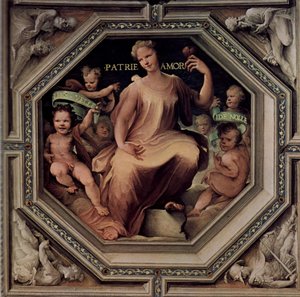
11The Martyrdom of Saint Sigismond and his Family (1520) af Domenico BeccafumiThe Martyrdom of Saint Sigismond and his Family1520 · Museum of Fine Arts 12Saint Dominic and the Burning of the Heretical Books (1520) af Domenico BeccafumiSaint Dominic and the Burning of the Heretical Books1520 · Museum of Fine Arts 13The Annunciation (1545) af Domenico BeccafumiThe Annunciation1545 14Descent of Christ to Limbo (detail, Eva) (1535) af Domenico BeccafumiDescent of Christ to Limbo (detail, Eva)1535 15Saint Markus (1538) af Domenico BeccafumiSaint Markus1538 16Justizia (Detail) (1535) af Domenico BeccafumiJustizia (Detail)1535 17Justizia (1535) af Domenico BeccafumiJustizia1535 18Concordia (1535) af Domenico BeccafumiConcordia1535 19Venus and Cupid with Vulcan (1530) af Domenico BeccafumiVenus and Cupid with Vulcan1530 · New Orleans Museum of Art 20The Flight into Egypt. (1550) af Domenico BeccafumiThe Flight into Egypt.1550 · Musée des beaux-arts de Chambéry 21The Holy Family with Young Saint John (1523) af Domenico BeccafumiThe Holy Family with Young Saint John1523 · Thyssen-Bornemisza Museum 22Birth of the Virgin (1543) af Domenico BeccafumiBirth of the Virgin1543 · Accademia 23Frescoes in the Oratory of St. Benedict in Siena (Italy), Scene: Marriage of Mary with Joseph af Domenico BeccafumiFrescoes in the Oratory of St. Benedict in Siena (Italy), Scene: Marriage of Mary with Joseph 24Coronation of Mary (detail) (1540) af Domenico BeccafumiCoronation of Mary (detail)1540 25Madonna and Child with Infant John the Baptist (1542) af Domenico BeccafumiMadonna and Child with Infant John the Baptist1542 · Art Gallery of New South Wales 26Frescoes in the Oratory of St. Benedict in Siena (Italy), Scene: Marriage of Mary with Joseph (1518) af Domenico BeccafumiFrescoes in the Oratory of St. Benedict in Siena (Italy), Scene: Marriage of Mary with Joseph1518 · Oratory of San Bernardino 27Caritas (1535) af Domenico BeccafumiCaritas1535 28The Continence of Scipio Africanus (1525) af Domenico BeccafumiThe Continence of Scipio Africanus1525 · Museo Nazionale di Palazzo Mansi 29Saint Catherine of Siena receiving the stigmata between Saints Benedict and Jerome (detail) (1517) af Domenico BeccafumiSaint Catherine of Siena receiving the stigmata between Saints Benedict and Jerome (detail)1517 30Saint Catherine of Siena receiving the stigmata between Saints Benedict and Jerome (detail) (1517) af Domenico BeccafumiSaint Catherine of Siena receiving the stigmata between Saints Benedict and Jerome (detail)1517 31Saint Catherine of Siena receiving the stigmata between Saints Benedict and Jerome (detail) (1517) af Domenico BeccafumiSaint Catherine of Siena receiving the stigmata between Saints Benedict and Jerome (detail)1517 32Saint Catherine of Siena receiving the stigmata between Saints Benedict and Jerome (detail) (1517) af Domenico BeccafumiSaint Catherine of Siena receiving the stigmata between Saints Benedict and Jerome (detail)1517 33Saint Catherine of Siena receiving the stigmata between Saints Benedict and Jerome (detail) (1517) af Domenico BeccafumiSaint Catherine of Siena receiving the stigmata between Saints Benedict and Jerome (detail)1517 34Gaius Servilius Ahala presents the body of Spurius Maelius to Cincinnatus (1535) af Domenico BeccafumiGaius Servilius Ahala presents the body of Spurius Maelius to Cincinnatus1535 35Das Opfer Des Seleukus Von Lokris (Detail) (1535) af Domenico BeccafumiDas Opfer Des Seleukus Von Lokris (Detail)1535 36Birth of the Virgin (detail) (1540) af Domenico BeccafumiBirth of the Virgin (detail)1540 37Birth of the Virgin (detail) (1540) af Domenico BeccafumiBirth of the Virgin (detail)1540 38Descent of Christ to Limbo (detail) (1535) af Domenico BeccafumiDescent of Christ to Limbo (detail)1535 39Carundas Von Tiro Und Celius Praetor (1535) af Domenico BeccafumiCarundas Von Tiro Und Celius Praetor1535 40Postumius Tiburzius Tötet Seinen Sohn (Detail) (1535) af Domenico BeccafumiPostumius Tiburzius Tötet Seinen Sohn (Detail)1535 41The Annunciation (1545) af Domenico BeccafumiThe Annunciation1545 42The Holy Family with Angels (1550) af Domenico BeccafumiThe Holy Family with Angels1550 · National Gallery of Art 43The Reconciliation of Marcus Emilius Lepidus and Fulvius Flaccus (1529) af Domenico BeccafumiThe Reconciliation of Marcus Emilius Lepidus and Fulvius Flaccus1529 · Palazzo Pubblico 44Mystical Marriage of St Catherine (1521) af Domenico BeccafumiMystical Marriage of St Catherine1521 · Hermitage Museum 45Patriotism af Domenico BeccafumiPatriotism 46Saint Catherine of Siena Receiving the Stigmata (1513) af Domenico BeccafumiSaint Catherine of Siena Receiving the Stigmata1513 · J. Paul Getty Museum 47Trinity (detail) (1513) af Domenico BeccafumiTrinity (detail)1513 · Pinacoteca Nazionale 48Penelope (1514) af Domenico BeccafumiPenelope1514 · Seminario Patriarcale 49The Holy Family with Young Saint John (1530) af Domenico BeccafumiThe Holy Family with Young Saint John1530 · Galleria degli Uffizi 50Allegory of Justice af Domenico BeccafumiAllegory of JusticePalais des Beaux-Arts de Lille 51Panel painting "The Commission in the Temple" on wood by a follower of Domenico Beccafumi, second half 16th century af Domenico BeccafumiPanel painting "The Commission in the Temple" on wood by a follower of Domenico Beccafumi, second half 16th century 52Holy Family af Domenico BeccafumiHoly Family 53Three Male Nudes af Domenico BeccafumiThree Male Nudes 54TWO MALE NUDES IN A LANDSCAPE af Domenico BeccafumiTWO MALE NUDES IN A LANDSCAPE 55Saint Peter af Domenico BeccafumiSaint Peter 56Tranaquil af Domenico BeccafumiTranaquil 57HEAD OF A BEARDED MAN IN PROFILE af Domenico BeccafumiHEAD OF A BEARDED MAN IN PROFILE 58Fall of the Rebellious Angels af Domenico BeccafumiFall of the Rebellious Angels 59San Antonio and the miracle of the mule af Domenico BeccafumiSan Antonio and the miracle of the mule 60St. Francis receiving the stigmata af Domenico BeccafumiSt. Francis receiving the stigmata 61St Bernard of Siena praying af Domenico BeccafumiSt Bernard of Siena praying 62An Unidentified Scene af Domenico BeccafumiAn Unidentified Scene 63St. Cristophor af Domenico BeccafumiSt. Cristophor 64The killing of Spurius Melius af Domenico BeccafumiThe killing of Spurius Melius 65Reconciliation of Lepidus and Flacco af Domenico BeccafumiReconciliation of Lepidus and FlaccoPalazzo Pubblico 66The Punishment of Heavenly Fire af Domenico BeccafumiThe Punishment of Heavenly Fire 67San Marco af Domenico BeccafumiSan Marco 68Altarpiece of the Stigmata of St. Catherine 2 af Domenico BeccafumiAltarpiece of the Stigmata of St. Catherine 2 69Altarpiece of the Stigmata St. Catherine af Domenico BeccafumiAltarpiece of the Stigmata St. Catherine 70Pennacchio with the Flood af Domenico BeccafumiPennacchio with the Flood 71The sacrifice of Seleucus of Locri 1 af Domenico BeccafumiThe sacrifice of Seleucus of Locri 1 72Altarpiece of the Stigmata of St. Catherine 1 af Domenico BeccafumiAltarpiece of the Stigmata of St. Catherine 1 73Moses breaking the table of the ammendments af Domenico BeccafumiMoses breaking the table of the ammendments 74The suicide of Cato Utica af Domenico BeccafumiThe suicide of Cato Utica 75Precipitated by Marcus Manilius Campoglio af Domenico BeccafumiPrecipitated by Marcus Manilius Campoglio 76The beheading of Spurius Cassius af Domenico BeccafumiThe beheading of Spurius Cassius 77Postumius Tiburcio killing his son af Domenico BeccafumiPostumius Tiburcio killing his son 78Pennacchio with the contest between Minerva Neptune af Domenico BeccafumiPennacchio with the contest between Minerva Neptune 79The tribune Publius Muzio sent to the fire his colleagues af Domenico BeccafumiThe tribune Publius Muzio sent to the fire his colleagues 80The sacrifice of Codrus, King of Athens af Domenico BeccafumiThe sacrifice of Codrus, King of Athens 81Adoration of the golden calf af Domenico BeccafumiAdoration of the golden calfPinacoteca Nazionale 82St. Paul on the Throne af Domenico BeccafumiSt. Paul on the Throne 83The puncturing of the Jews by the Levites af Domenico BeccafumiThe puncturing of the Jews by the Levites 84The sacrifice of Seleucus of Locri af Domenico BeccafumiThe sacrifice of Seleucus of Locri 85Courage of the macedon who witnessed the sacrifice of Alexander af Domenico BeccafumiCourage of the macedon who witnessed the sacrifice of Alexander 86Madonna and Child with St. John af Domenico BeccafumiMadonna and Child with St. John 87Continence of Scipio af Domenico BeccafumiContinence of Scipio 88Scipio appointed tribune of the soldiers af Domenico BeccafumiScipio appointed tribune of the soldiers 89Speusippus Tegeate af Domenico BeccafumiSpeusippus Tegeate 90Caronda shooting af Domenico BeccafumiCaronda shooting 91Annunciation af Domenico BeccafumiAnnunciation 92Transit of the Virgin af Domenico BeccafumiTransit of the Virgin 93Madonna and Child with St John the Baptist af Domenico BeccafumiMadonna and Child with St John the Baptist 94The courage of children who witnessed the sacrifice of Macedonian Alexander af Domenico BeccafumiThe courage of children who witnessed the sacrifice of Macedonian Alexander 95Zeuxis painted the portrait of Helen for the temple of Hera at Croton af Domenico BeccafumiZeuxis painted the portrait of Helen for the temple of Hera at Croton 96Madonna and Child Enthroned with Six Saints and Angels af Domenico BeccafumiMadonna and Child Enthroned with Six Saints and Angels 97The Mutual Benevolence af Domenico BeccafumiThe Mutual Benevolence 98Head of a Youth Seen in Profile af Domenico BeccafumiHead of a Youth Seen in Profile 99St Paul (1515) af Domenico BeccafumiSt Paul1515 · Museo dell'Opera della Metropolitana 100Judith with the Head of Holofernes (1510) af Domenico BeccafumiJudith with the Head of Holofernes1510 · Wallace Collection

Domenico Beccafumis berømte malerier, periode for periode

Motiverne, der fangede Domenico Beccafumis blik

De fire motiver, der optræder hyppigst i disse originaler, hver med sit fineste eksempel.

De museer, der udstiller Domenico Beccafumis originalværker

De 8 museer, der rummer flest af malerierne på denne side.

Museum By Værker af Domenico Beccafumi Malerier fra denne liste
Pinacoteca Nazionale, SienaPinacoteca Nazionale Siena 11 St Lucy, Stigmatization of St Catherine of Siena, Trinity (detail)
J. Paul Getty Museum, Los AngelesJ. Paul Getty Museum Los Angeles 2 The Miraculous Communion of Saint Catherine of Siena, Saint Catherine of Siena Receiving the Stigmata
Carnegie Museum of Art, PittsburghCarnegie Museum of Art Pittsburgh 2 The Appearance of St. Michael on the Castel Sant'Angelo to Pope Gregory the Great, The Miracle of St. Michael on Mt. Gargano
Museum of Fine Arts, BostonMuseum of Fine Arts Boston 2 The Martyrdom of Saint Sigismond and his Family, Saint Dominic and the Burning of the Heretical Books
Palazzo Pubblico, SienaPalazzo Pubblico Siena 2 The Reconciliation of Marcus Emilius Lepidus and Fulvius Flaccus, Reconciliation of Lepidus and Flacco
Museum Boijmans Van Beuningen, RotterdamMuseum Boijmans Van Beuningen Rotterdam 1 Saint Catherine Receiving the Stigmata
Art Institute of Chicago, ChicagoArt Institute of Chicago Chicago 1 Saint Ignatius of Antioch Disemboweled by Trajan's Torturers
Victoria and Albert Museum, LondonVictoria and Albert Museum London 1 Charity Surrounded by Children Playing with Dogs and Hobby Horses

Domenico Beccafumi gennem årtierne: ét unikt originalværk til hver

Værker per årti

Vælg et årti for at se det originale værk, der definerer det.

Domenico Beccafumis malerier: spørgsmål til galleriet

Hvad er det mest berømte værk af Domenico Beccafumi?Vis svaret

St. Michael Scaccia and The Rebel Angels. Derefter følger Saint Catherine Receiving the Stigmata (1545) og St Lucy (1521).

Hvilke ti malerier af Domenico Beccafumi er de mest berømte?Vis svaret

St. Michael Scaccia and The Rebel Angels, Saint Catherine Receiving the Stigmata, St Lucy, Saint Ignatius of Antioch Disemboweled by Trajan's Torturers, Charity Surrounded by Children Playing with Dogs and Hobby Horses, Stigmatization of St Catherine of Siena, The Miraculous Communion of Saint Catherine of Siena, Trinity Tryptych (detail), The Appearance of St. Michael on the Castel Sant'Angelo to Pope Gregory the Great og The Miracle of St. Michael on Mt. Gargano. Ranglisten ovenfor viser det enkelte værks årstal og museum.

Hvor mange værker af Domenico Beccafumi er kendt?Vis svaret

Vores katalog indeholder 126 værker af Domenico Beccafumi, dateret fra 1510 til 1550.

Hvor kan de mest berømte originaler af Domenico Beccafumi ses?Vis svaret

Primært i Pinacoteca Nazionale (Siena), J. Paul Getty Museum (Los Angeles) og Carnegie Museum of Art (Pittsburgh). Museumslisten ovenfor viser dem alle.

I hvilken periode skabte Domenico Beccafumi sine mest kendte malerier?Vis svaret

I 1510s: 14 af de 100 værker på denne side blev skabt dengang, herunder Stigmatization of St Catherine of Siena.

Hvilket berømt maleri af Domenico Beccafumi er det tidligste, og hvilket er det seneste?Vis svaret

På denne side er det tidligste Judith with the Head of Holofernes (1510) og det seneste The Flight into Egypt. (1550).

Hvilke motiver foretrak Domenico Beccafumi?Vis svaret

Woman (12), Saints (9) og Figures (7), fordelt på de 100 værker på denne side.

Hvilke materialer brugte Domenico Beccafumi mest til sine malerier?Vis svaret

Oil On Panel, for 13 af de 100 værker på denne side.

Hvilken stilart tilhører værkerne fra Domenico Beccafumi?Vis svaret

Renaissance mannerism, baseret på originalerne på denne side.

Hvilke originalværker af Domenico Beccafumi kan jeg se på Pinacoteca Nazionale?Vis svaret

St Lucy, Stigmatization of St Catherine of Siena og Trinity (detail): Pinacoteca Nazionale, Siena har 4 af værkerne på denne side.

Domenico Beccafumi: et portræt af kunstneren

Domenico Beccafumi (1486-1551): En Sienese Visionær

Domenico di Pace Beccafumi er et navn, der måske ikke runger lige så højt som navnene på hans florentinske samtidnere, men han indtager en central rolle i fortællingen om italiensk renæssansemusik – en kunstner, hvis rejse var præget af bemærkelsesværdig udvikling og kulminerede i en stil, der brogede mellem højrenæssancen og den spirende kompleksitet af manierismen. Hans historie handler ikke kun om teknisk dygtighed; det er om en dybtgående individuel vision – en følsomhed præget af hans sienesiske arv og samtidig modtagelig for nye udtryksmuligheder. Han blev født omkring 1486 i den lille tuscansiske by Montaperto, nær Siena, søn af Giacomo di Pace, en bonde, hvis talent blev erkendt af Lorenzo Beccafumi, der tog ham til sig og sørgede for hans første kunstneriske uddannelse med Mechero, en lokal sienesiske kunstner. Dette tidlige grundlag i den sienesiske skole ville være fundamentalt, selvom han ventured ud over dens etablerede konventioner. Den sienesiske tradition var allerede forskellig fra klassiske idealer omfavnet andre steder i Italien og fremmede et miljø, hvor følelsesmæssig intensitet og dekorativ detalje blev værdsat – kvaliteter, der ville blive kendetegnende for Beccafumis unikke stil.

Fra Montaperto til Rom: En Kunstnerisk Transformation

Beccafumi begyndte sin kunstneriske rejse i Siena, hvor han modtog en grundlæggende uddannelse fra Mechero og senere blev adopteret af Lorenzo Beccafumi, hvilket gav ham mulighed for at udvikle sine færdigheder. Omkring 1509 tog han til Rom – et transformativt øjeblik, der udsatte ham for kunstens ferment i den pavelige by og introducerede ham direkte til arbejdet hos nogle af de mest betydningsfulde kunstnere på tiden, Raphael og Michelangelo. Disse møder havde en dybtgående effekt på hans kunstneriske udvikling og førte til en forståelse af klassisk anatomi og komposition, der ville forme hans senere stil. Han absorberede deres innovationer ikke blot ved at kopiere deres teknikker; han filtrerede deres indflydelse gennem sin egen unikke linse – han efterlignede ikke direkte den romerske stil; han filtrerede den gennem en allerede eksisterende sienesiske æstetik – én karakteriseret af en vis provinsialisme, fokus på dekorativ detalje og et vedvarende middelalderligt følsomhed. Denne kontrast til klassiske idealer omfavnet andre italienske kunstnere var særlig vigtig for hans udvikling som kunstner.

Mannerismen: Et Udtryk For Individuel Følelse

Beccafumi var ikke blandt kunstnerne, der søgte direkte at efterligne de romerske mestere; han filtrerede deres indflydelse gennem sin egen kunstneriske linse og udviklede en stil, der var både innovativ og distinkt. Han var en pioner inden for manierismen – en kunststil, der blomstrede i Italien fra omkring 1520 til midten af ​​det 16. århundrede og karakteriseres ved ekstrem følelsesmæssig ekspression, deformerede figurer og overdådig dekorativ detalje. Han var blandt de få kunstnere på tiden, der ikke blot efterlignede klassiske idealer om symmetri og harmoni; han udforskede nye udtryksmuligheder og søgte at skabe kunstværker, der var både dynamiske og psykologisk komplekse. Denne stil var præget af en følelse af uro og dissonans – et direkte resultat af hans møde med den klassiske tradition og en afstandtagen fra højrenæssancens fokus på balance og proportion. Han var ikke blandt kunstnerne, der søgte direkte at efterligne klassiske idealer om symmetri og harmoni; han udforskede nye udtryksmuligheder og søgte at skabe kunstværker, der var både dynamiske og psykologisk komplekse. Dette gjorde hans kunst unik og satte ham i kontrast til mange andre kunstnere på tiden.

Monumentale Frescoes og Siena Cathedral

Beccafumi blev mest kendt for sine monumentale frescher i Siena Domkirke – et projekt, han ledede fra 1517 til 1544 og som varte over flere århundreder. Disse fresker prægede sig ved deres dramatiske kompositioner og følelsesmæssige intensitet og repræsenterede nogle af de mest betydningsfulde kunstværker fra hans tid. Han udførte et imponerende arbejde med at skabe komplekse scenarier og udtrykke menneskelige følelser på en måde, der var både ærefuld og bevækkende – hvilket gjorde ham til en af ​​Sienas største kunstnere og sikrede hans navn i kunsthistorien. Hans mest bemærkelsesværdige projekt var pavillonen for Siena Domkirke, hvor han udførte et omfattende arbejde med dekorative mosaikker og prægede sig ved sin tekniske dygtighed og kreativitet. Han var blandt de få kunstnere på tiden, der ikke blot efterlignede klassiske idealer om symmetri og harmoni; han udforskede nye udtryksmuligheder og søgte at skabe kunstværker, der var både dynamiske og psykologisk komplekse. Dette gjorde hans kunst unik og satte ham i kontrast til mange andre kunstnere på tiden.

Et Efterladenskab Af Innovation Og Udtryk

Domenico Beccafumi døde i Siena i 1551 og markerede en symbolsk afslutning på Sienas lange og ædle tradition inden for kunst – han blev betragtet som den sidste betydningsfulde repræsentant for sienesiske kunstnere og sikrede hans navn i kunsthistorien. Hans arbejde står adskilt fra højrenæssancens harmoniske kompositioner og omfavnede snarere følelsesmæssig spænding, ustabilitet og udtryksdistortion – hvilket gjorde ham til en pioner inden for manierismen og satte ham i kontrast til mange andre kunstnere på tiden. Hans kunst var præget af følelser og dissonans – et direkte resultat af hans møde med klassiske idealer om symmetri og harmoni. Han var blandt de få kunstnere på tiden, der ikke blot efterlignede klassiske idealer om symmetri og harmoni; han udforskede nye udtryksmuligheder og søgte at skabe kunstværker, der var både dynamiske og psykologisk komplekse. Dette gjorde hans kunst unik og satte ham i kontrast til mange andre kunstnere på tiden. Hans efterladenskab er ikke blot som en kunstner, men som en visionær, der modtog klassiske idealer om symmetri og harmoni; han udforskede nye udtryksmuligheder og søgte at skabe kunstværker, der var både dynamiske og psykologisk komplekse. Hans kunst var præget af følelser og dissonans – et direkte resultat af hans møde med klassiske idealer om symmetri og harmoni. Han var blandt de få kunstnere på tiden, der ikke blot efterlignede klassiske idealer om symmetri og harmoni; han udforskede nye udtryksmuligheder og søgte at skabe kunstværker, der var både dynamiske og psykologisk komplekse. Dette gjorde hans kunst unik og satte ham i kontrast til mange andre kunstnere på tiden. Hans efterladenskab er ikke blot som en kunstner, men som en visionær, der modtog klassiske idealer om symmetri og harmoni. Han var blandt de få kunstnere på tiden, der ikke blot efterlignede klassiske idealer om symmetri og harmoni; han udforskede nye udtryksmuligheder og søgte at skabe kunstværker, der var både dynamiske og psykologisk komplekse. Dette gjorde hans kunst unik og satte ham i kontrast til mange andre kunstnere på tiden. Hans efterladenskab er ikke blot som en kunstner, men som en visionær, der modtog klassiske idealer om symmetri og harmoni. Han var blandt de få kunstnere på tiden, der ikke blot efterlignede klassiske idealer om symmetri og harmoni; han udforskede nye udtryksmuligheder og søgte at skabe kunstværker, der var både dynamiske og psykologisk komplekse. Dette gjorde hans kunst unik og satte ham i kontrast til mange andre kunstnere på tiden. Hans efterladenskab er ikke blot som en kunstner, men som en visionær, der modtog klassiske idealer om symmetri og harmoni. Han var blandt de få kunstnere på tiden, der ikke blot efterlignede klassiske idealer om symmetri og harmoni; han udforskede nye udtryksmuligheder og søgte at sk