


1


Aktualizováno říjen 2026 · seřazeno podle našeho skóre popularity (vyhledávání, návštěvy a objednávky u každého díla) · 59 děl umělce William Roberts v našem katalogu
Stručně řečeno
Z pohledu galerie je nejslavnějším dílem William Roberts obraz The Boxing Match (1890). The First German Gas Attack at Ypres (1918) a The Cinema (1920) doplňují trio, které každé oko okamžitě pozná. Z 59 děl umělce William Roberts v našem katalogu představuje galerie níže 59 nejznámějších děl, z nichž každé je originálem s uvedením roku vzniku, muzea a toho, co jej činí jedinečným.


 The Diners1919
12
 A Shell Dump, France1918
13
 'Feeds Round ' Stable Time in the Wagon Lines, France1922
14
 Professor Janko Lavrin (1885–1986)1919 · Nottingham Castle Museum And Art Gallery
15
 The Crucifixion1920 · Oxford Brookes University
16
 The Stockbroker's Clerk1920 · Britský radový fond
17
 The Dancers1919
18
 The Farm (Country Scene)1922 · The Hepworth Wakefield
19
 At the Hippodrome1921 · New Walk Museum - Art Gallery
20
 Esther Lahr1925
21
 The Char1924
22
 Miss Jane Tupper Carey1924
23
 A Woman (Sarah)1927
24
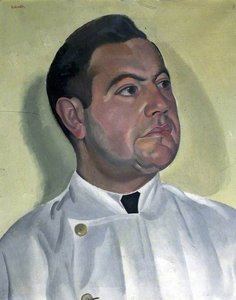 The Dentist1925 · County Hall
25
 Esther Lahr1925
26
 T. E. Lawrence as Aircraftsman Shaw1923 · The Ashmolean Museum of Art and Archaeology
27
 The Paddock (Jockeys)1928
28
 The Happy Family1924
29
 Deposition from the Cross1926
30
 A Gipsy Girl1926 · Arts Council Collection
31
 Self Portrait Wearing a Cap1931
32
 Sawing Wood1930
33
 The Dressmakers1931 · Victoria Art Gallery
34
 The Ballet1932
35
 John Roberts1930
36
 Tea Shop1938
37
 Skipping (The Gutter)1934
38
 Playground (The Gutter)1934
39
 The Artist's Son Playing the Recorder1936 · The Ingram Collection of Modern British And Contemporary Art
40
 The Palms Foretell1937 · Bristol Museum - Art Gallery
41
 Bath Time (The Miner's Toilet and Wash Night)1935 · Bolton Museum And Art Gallery
42
 Bicycle Boys1939
43
 The Control Room1941 · Salford Museum - Art Gallery
44
 Punting on the Cherwell1939 · Jerwood Gallery
45
 The Demolition Squad1941 · Guildhall Art Gallery
46
 Portrait of a Man Lighting a Pipe1948
47
 The Rhododendron1948 · The Ingram Collection of Modern British And Contemporary Art
48
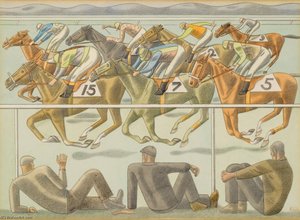 In the Straight1949
49
 Cantering to the Post1949
50
 Selecting Calves1950
51
 The Barber's Shop
52
 Checkmate
53
 Portrait of a Negress
54
 The Chess Players
55
 Sidney James Barton (1909–1986), Chairman of London County Council (1959–1960)Guildhall Art Gallery
56
 Munitions Factory1940 · Salford Museum - Art Gallery
57
 Sarah1925
58
 Les Routiers1931
59
 Study for Kites1966 · Royal Albert Memorial Museum - Art Gallery
Čtyři témata, která se v těchto originálech nejčastěji objevují, z nichž každé má svůj nejlepší příklad.
8 muzea, v nichž je umístěno nejvíce obrazů z této stránky.
| Muzea | Město | Díla autora William Roberts | Obrazy z tohoto seznamu |
|---|---|---|---|
 The Ingram Collection of Modern British And Contemporary Art |
London | 3 | The Garden of Eden, The Artist's Son Playing the Recorder, The Rhododendron |
 Nottingham Castle Museum And Art Gallery |
Nottingham | 2 | The Return of Ulysses, Professor Janko Lavrin (1885–1986) |
 Salford Museum - Art Gallery |
Greater Manchester | 2 | The Control Room, Munitions Factory |
 Guildhall Art Gallery |
Londýn | 2 | The Demolition Squad, Sidney James Barton (1909–1986), Chairman of London County Council (1959–1960) |
 Národní galerie Kanady |
Ottawa | 1 | The First German Gas Attack at Ypres |
 Wolverhampton Art Gallery |
Wolverhampton | 1 | Kit (Katie Bissett Smith née Knewstub, 1907–2008) |
 Oxford Brookes University |
Oxford | 1 | The Crucifixion |
 Britský radový fond |
Londýn | 1 | The Stockbroker's Clerk |
Vyberte si dekádu a prohlédněte si originál, který ji definuje.


William Roberts is a British painter of figure compositions and portraits. He was a pioneer of abstract art before the First World War. Roberts worked outside the mainstream. Later in his career he would describe himself as an English Cubist. In 1914 Roberts joined the short-lived art movement the Vorticists, founded by the artist and writer Wyndam Lewis. The Vorticists believed that British art at this time was in a…
The Boxing Match (1890). Následují The First German Gas Attack at Ypres (1918) a The Cinema (1920).
The Boxing Match, The First German Gas Attack at Ypres, The Cinema, The Garden of Eden, John Maynard Keynes, Baron Keynes Lydia Lopokova, Kit (Katie Bissett Smith née Knewstub, 1907–2008), The Port of London, The Return of Ulysses, The Red Turban a Portrait of a Young Woman. Hodnocení výše uvádí rok a muzeum pro každé z nich.
Náš katalog obsahuje 59 děl umělce William Roberts z let 1913 až 1966.
Většinou v The Ingram Collection of Modern British And Contemporary Art (London), Nottingham Castle Museum And Art Gallery (Nottingham) a Salford Museum - Art Gallery (Greater Manchester). V tabulce muzeí výše jsou vypsány všechny.
V období 1920s: 21 z celkem 59 děl na této stránce vzniklo právě tehdy, z toho The Cinema z nich.
Na této stránce je nejstarší dílo z The Return of Ulysses (1913) a nejnovější z Study for Kites (1966).
British art (3), Victorian (2) a Crowd (2) napříč 59 díly na této stránce.
Cubism, podle originálů na této stránce.
The Garden of Eden, The Artist's Son Playing the Recorder a The Rhododendron: muzeum The Ingram Collection of Modern British And Contemporary Art, London má v obsluze 3 děl z této stránky.
In the turbulent landscape of early twentieth-century British art, few figures navigated the tension between tradition and the avant-garde as uniquely as William Patrick Roberts. Born in London in 1895, Roberts emerged during a period of profound aesthetic upheaval, where the stability of Victorian realism was being dismantled by the rapid pulse of modernity. As an artist often categorized as an English Cubist, he did not merely adopt a style; he forged a visual language that captured the fractured, energetic essence of a world in transition. His journey was one of constant movement, reflecting the very dynamism he sought to portray on canvas.
Roberts’ formative years were deeply shaped by his time at the Slade School of Fine Art, an institution that provided him with a rigorous foundation even as he began to push against academic constraints. It was here that he encountered the burgeoning influences of Vorticism and Futurism—movements characterized by their obsession with machine-age energy, geometric precision, and the violent beauty of motion. Through his association with the Vorticist circle, particularly under the influence of figures like Wyndham Lewis, Roberts learned to utilize sharp angles and interlocking planes to deconstruct his subjects, transforming ordinary scenes into rhythmic, structural compositions.
The evolution of Roberts’ work is inextricably linked to the historical tremors of his era. The experience of war left an indelible mark on his psyche and his palette, leading him to document the industrial grit and human endurance of the period. His paintings often serve as windows into the mechanical heart of the twentieth century, where the boundaries between man and machine begin to blur. In works such as Munitions Factory, one can witness his mastery of the Cubist technique applied to the heavy, rhythmic atmosphere of wartime production, using geometric forms to convey the relentless momentum of industry.
Beyond the industrial, Roberts possessed a profound ability to find poetic resonance in the everyday. His explorations of human connection and social landscapes are marked by an unflinching honesty. Whether depicting the quiet intimacy of a portrait, such as Sarah, or the bustling, structured chaos of street scenes like Les Routiers, he maintained a commitment to emotional depth. He utilized color not just for descriptive accuracy, but as a symbolic tool to evoke the psychological weight of his subjects, often bathing his compositions in a light that felt both modern and strangely primordial.
The significance of William Patrick Roberts lies in his ability to synthesize the radical abstractions of Continental Europe with a distinctly British sensibility. While he embraced the fractured perspectives of Cubism, he never abandoned the figurative essence that allowed him to communicate the human condition. His work stands as a bridge between the classical traditions of the past and the experimental fervor of the modern age.
Throughout his long career, which spanned until 1980, Roberts earned prestigious recognition, including frequent exhibitions at the Royal Academy. His ability to capture the "vortex" of modern life ensured that his work remained relevant even as art movements shifted toward total abstraction. Today, he is remembered not just as a follower of a movement, but as a pioneer who helped define the visual identity of a generation caught between the old world and the new.
