Portrét William Fettes Douglas

35 nejslavnějších obrazů autora William Fettes Douglas, každý naprosto unikátní

Aktualizováno listopad 2026 · seřazeno podle našeho skóre popularity (vyhledávání, návštěvy a objednávky u každého díla) · 36 děl umělce William Fettes Douglas v našem katalogu

Stručně řečeno

The Bibliophilist's Haunt (Creech's Bookshop) (1864) je obraz autora William Fettes Douglas, který přitahuje nejvíce pohledů. Poté se zrak přesouvá k Stonehaven Harbour (1874) a Sir William Fettes Douglas (1822–1891), Artist, Self Portrait (1845). Z 36 děl umělce William Fettes Douglas v našem katalogu je těchto 35 těch nejznámějších; každé z nich je unikátním originálem s uvedením roku vzniku, muzea a důvodu jeho nesmrtelnosti.

1822 – 1891, Edinburgh Pre-raphaelite Nejvíce děl: Scottish National Gallery

Top 10 obrazů autora William Fettes Douglas podle výběru galerie

1
The Bibliophilist's Haunt (Creech's Bookshop) (1864) od William Fettes Douglas

The Bibliophilist's Haunt (Creech's Bookshop)

1864 · Oil

In this 1864 composition, we find ourselves drawn into a quiet, intellectual enclosure. The scene depicts a man amidst a gathering of people, all contained within a room defined by the presence of books. It is a space that feels lived-in and deeply personal, where the weight of accumulated knowledge is felt through the sheer volume of volumes scattered across shelves and surfaces. A single chair sits toward the right,…

2
Stonehaven Harbour (1874) od William Fettes Douglas

Stonehaven Harbour

1874 · Oil On Canvas · Scottish National Gallery, Edinburgh

The salt air seems to linger around Stonehaven Harbour, a work by the Scottish artist William Fettes Douglas. Painted about 1874, this oil on canvas captures a moment of maritime life along the waterfront. The scene unfolds across a wide, horizontal plane, measuring 119 x 59 cm, inviting the eye to wander through the activity of the village. It is a window into a specific time and place, where the…

3
Sir William Fettes Douglas (1822–1891), Artist, Self Portrait (1845) od William Fettes Douglas

Sir William Fettes Douglas (1822–1891), Artist, Self Portrait

1845 · Oil On Canvas · Scottish National Portrait Gallery, Edinburgh

Sir William Fettes Douglas (1822–1891), Artist, Self Portrait is an oil painting by the Scottish artist William Fettes Douglas. Executed in 1845, the work represents an early entry in the artist's career, coinciding with his first exhibition at the Royal Scottish Academy. The portrait captures the subject in a moment of quiet contemplation or study, presenting a psychological depth that would characterize much of his later output.

4
Bibliomania (1852) od William Fettes Douglas

Bibliomania

1852 · Oil On Canvas

In 1852, William Fettes Douglas produced Bibliomania, a highly detailed genre painting. The work captures a cluttered, scholarly interior, perhaps a private library or a bookshop. Here, the air feels heavy with the scent of old paper and the weight of accumulated thought. The scene centers on a moment of intense exchange between two men, framed by the towering presence of overflowing bookshelves.

5
The Alchemist (1855) od William Fettes Douglas

The Alchemist

1855 · Oil · Victoria and Albert Museum, Londýn

The Alchemist was painted by William Fettes Douglas in 1855. Born in Edinburgh, United Kingdom, on March 12th, 1822, the artist developed a practice centered on meticulous observation and the exploration of scholarly and mystical themes. His career spanned much of the nineteenth century until his death in 1891.

6
Study for the Figure of Luther (verso) (1862) od William Fettes Douglas

Study for the Figure of Luther (verso)

1862 · Oil

The gaze meets Study for the Figure of Luther (verso), a work that emerges from the creative mind of William Fettes Douglas. This piece captures a moment of intense preparation, a glimpse into the artist's process as he seeks to define a significant figure. The work dates to 1862, a period when the artist's hand was finding its unique voice amidst the shifting artistic currents of the nineteenth century.

7
Wishart Preaching against Mariolatry (1871) od William Fettes Douglas

Wishart Preaching against Mariolatry

1871 · Oil · Scottish National Gallery, Edinburgh

In Wishart Preaching against Mariolatry, William Fettes Douglas presents a large-scale historical scene centered on an act of legal or governmental authority. The composition is densely packed, featuring a multitude of observers—men and women—gathered to witness a public announcement or legal proceeding. This crowded arrangement creates a sense of chaos, emphasizing the significant scale of the event and the sheer number of people present.

8
The Spell (1864) od William Fettes Douglas

The Spell

1864 · Oil On Canvas · Scottish National Gallery, Edinburgh

The painting titled The Spell is an oil on canvas created by the artist William Fettes Douglas. This work was executed in 1864. The physical dimensions of the piece are 78 x 157 cm.

9
Dr John Brown, Physician and Author of 'Rab and his Friends' (1850) od William Fettes Douglas

Dr John Brown, Physician and Author of 'Rab and his Friends'

1850

This portrait captures a man of intellect and dual vocation, presented within a circular frame that lends a classical, archival quality to the composition. The subject, Dr John Brown, is depicted with a bald head and spectacles, his gaze directed toward the viewer with a steady, composed expression. He wears a formal suit and tie, the textures of which suggest the professional dignity of a nineteenth-century physician. In his hands,…

10
Thomas Faed (1826–1900), Artist (1850) od William Fettes Douglas

Thomas Faed (1826–1900), Artist

1850 · Oil On Canvas · Scottish National Portrait Gallery, Edinburgh

The portrait presents a man with a beard and a mustache, positioned in a three-quarter view. He wears a dark suit and a tie, looking directly toward the viewer with a steady, serious expression. The man's attire is rendered with attention to the structure of the fabric and the formal nature of nineteenth-century dress. The background remains indistinct and blurred, which directs the focus toward the facial features and the…

Slavná díla umělce William Fettes Douglas, čísla 11 až 35

Slavná díla William Fettes Douglas podle jednotlivých období

Motivy, které zaujaly William Fettes Douglas

Čtyři témata, která se v těchto originálech nejčastěji objevují, z nichž každé má svůj nejlepší příklad.

Muzea, v nichž jsou vystavena originálna umělce William Fettes Douglas

7 muzea, v nichž je umístěno nejvíce obrazů z této stránky.

Muzeum Město Díla autora William Fettes Douglas Obrazy z tohoto seznamu
Scottish National Gallery, EdinburghScottish National Gallery Edinburgh 9 Stonehaven Harbour, Wishart Preaching against Mariolatry, The Spell
Scottish National Portrait Gallery, EdinburghScottish National Portrait Gallery Edinburgh 4 Sir William Fettes Douglas (1822–1891), Artist, Self Portrait, Thomas Faed (1826–1900), Artist, David Laing (1793–1878), Antiquarian (recto)
Royal Scottish Academy of Art - Architecture, ÉdinRoyal Scottish Academy of Art - Architecture Édin 3 The Messenger of Evil Tidings, Erskine Nicol (1825–1904), RSA, Alexander Fraser (1828–1899), RSA, as a Young Man
Victoria and Albert Museum, LondýnVictoria and Albert Museum Londýn 1 The Alchemist
Hospitalfield Arts, ArbroathHospitalfield Arts Arbroath 1 Benvenuto Cellini Selling Plate
Art Gallery of South Australia, AdelaideArt Gallery of South Australia Adelaide 1 Stonehaven
National Portrait Gallery, LondýnNational Portrait Gallery Londýn 1 Thomas Faed

William Fettes Douglas napříč desetiletími: jeden unikátní originál pro každou dekádu

Díla podle dekád

Vyberte si dekádu a prohlédněte si originál, který ji definuje.

Obrazy umělce William Fettes Douglas: dotazy pro galerii

Kterým nejznámějším dílem je William Fettes Douglas?Odhalit odpověď

The Bibliophilist's Haunt (Creech's Bookshop) (1864). Následují Stonehaven Harbour (1874) a Sir William Fettes Douglas (1822–1891), Artist, Self Portrait (1845).

V jakém věku vytvořil(a) William Fettes Douglas dílo The Bibliophilist's Haunt (Creech's Bookshop)?Odhalit odpověď

42 let: dílo The Bibliophilist's Haunt (Creech's Bookshop) pochází z roku 1864 a William Fettes Douglas se narodil/a v roce 1822.

Kterých deset obrazů autora William Fettes Douglas je nejznámějších?Odhalit odpověď

The Bibliophilist's Haunt (Creech's Bookshop), Stonehaven Harbour, Sir William Fettes Douglas (1822–1891), Artist, Self Portrait, Bibliomania, The Alchemist, Study for the Figure of Luther (verso), Wishart Preaching against Mariolatry, The Spell, Dr John Brown, Physician and Author of 'Rab and his Friends' a Thomas Faed (1826–1900), Artist. Hodnocení výše uvádí rok a muzeum pro každé z nich.

Kolik známých děl má autor William Fettes Douglas?Odhalit odpověď

Náš katalog obsahuje 36 děl umělce William Fettes Douglas z let 1845 až 1878.

Kde lze vidět nejznámější originály umělce William Fettes Douglas?Odhalit odpověď

Většinou v Scottish National Gallery (Edinburgh), Scottish National Portrait Gallery (Edinburgh) a Royal Scottish Academy of Art - Architecture (Édin). V tabulce muzeí výše jsou vypsány všechny.

V jakém období vytvořil(a) William Fettes Douglas svá nejznámější obrazy?Odhalit odpověď

V období 1850s: 11 z celkem 35 děl na této stránce vzniklo právě tehdy, z toho Bibliomania z nich.

Který slavný obraz od William Fettes Douglas je nejstarší a který nejnovější?Odhalit odpověď

Na této stránce je nejstarší dílo z Sir William Fettes Douglas (1822–1891), Artist, Self Portrait (1845) a nejnovější z The Village of the Water of Leith from a Window in Rothesay Terrace (1878).

Jakým tématům se William Fettes Douglas věnoval/a nejčastěji?Odhalit odpověď

Man (12), Books (7) a Book (6) napříč 35 díly na této stránce.

Jaké materiály používal(a) William Fettes Douglas nejčastěji?Odhalit odpověď

Oil On Canvas, u 14 z 35 děl na této stránce.

K kterému směru patří dílo umělce William Fettes Douglas?Odhalit odpověď

Pre-raphaelite, podle originálů na této stránce.

Jaká originální díla William Fettes Douglas mohu vidět v Scottish National Gallery?Odhalit odpověď

Stonehaven Harbour, Wishart Preaching against Mariolatry a The Spell: muzeum Scottish National Gallery, Edinburgh má v obsluze 9 děl z této stránky.

William Fettes Douglas: portrét umělce

The Visionary of Edinburgh: The Life and Legacy of Sir William Fettes Douglas

In the heart of nineteenth-century Edinburgh, a period defined by both industrial progress and a deep reverence for the arcane, Sir William Fettes Douglas emerged as a painter of profound spiritual and intellectual depth. Born on March 12th, 1822, Douglas was a man whose very lineage whispered of tradition and prestige. As the son of James Douglas, an esteemed accountant for the Commercial Bank of Scotland, and the grand-nephew of the illustrious Sir William Fettes, his upbringing was steeped in the cultural fabric of Scotland’s elite. Yet, beneath this veneer of aristocratic stability lay a restless, searching spirit that would eventually lead him away from the ledger books of banking and toward the ethereal realms of the Pre-Raphaelite aesthetic.

Douglas’s path to mastery was notably unconventional. Eschewing the rigid confines of formal academic training in his early years, he embraced a more intimate, self-directed method of discovery. His education at the High School of Edinburgh provided the foundation, but it was through diligent sketching and the mentorship of fellow artists like Alexander Fraser and even the legendary James Abbott MacKenzie Whistler that his draughtsmanship began to flourish. This period of independent study instilled in him a lifelong commitment to meticulous observation—a trait that would become his hallmark. He did not merely seek to paint what he saw, but to capture the atmospheric subtleties and the hidden, often mystical, truths residing within the physical world.

A Tapestry of Myth, Mystery, and Meticulous Detail

The true ascent of Douglas’s career began in 1845 with his debut at the Royal Scottish Academy. It was here that the art world first encountered his unique ability to imbue canvas with a palpable spiritual resonance. Heavily influenced by the aesthetic philosophies of John Ruskin and the evocative imagery of Dante Gabriel Rossetti, Douglas turned his gaze toward themes of mythology, folklore, and biblical narrative. His work became a bridge between the tangible and the transcendent, where every brushstroke served to explore complex notions of mortality, symbolism, and psychological depth.

His masterpieces from the mid-nineteenth century serve as windows into a world of enchantment and scholarly intrigue. Consider his evocative works such as:

  • The Ruby Ring (1853): A piece that exemplifies his ability to weave narrative tension with jewel-like precision.
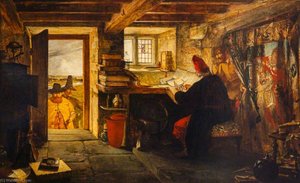
  • The Alchemist (1855): A profound exploration of transformation and the esoteric pursuit of knowledge.
  • The Spell (1864): Currently housed in the National Galleries of Scotland, this work showcases his mastery of light and shadow, depicting a scene of quiet, ritualistic intensity that leaves the viewer suspended in a moment of magic.
  • The Summons to the Secret Tribunal (1860): A captivating composition where books, clocks, and papers create an atmosphere of heavy mystery and intellectual weight.

In these paintings, Douglas utilized a technique characterized by an unwavering commitment to accuracy. His ability to render textures—the cold gleam of metal, the weathered grain of ancient wood, or the soft glow of candlelight—created a sense of hyper-reality that heightened the supernatural elements of his subjects.

Ascension and Historical Significance

As his reputation grew, so too did his influence within the Scottish art establishment. Douglas was not merely a practitioner of his craft but a true connoisseur and leader of his era. His rise to the position of President of the Royal Scottish Academy marked the pinnacle of his professional achievements, signaling the respect he commanded among his peers. He became a central figure in the Victorian intellectual landscape, representing a movement that sought to find meaning and beauty in the shadows of history and the depths of the human psyche.

The historical significance of Sir William Fettes Douglas lies in his role as a bridge between the classical traditions of Scotland and the burgeoning romanticism of the Pre-Raphaelite Brotherhood. He brought a uniquely Scottish sensibility—one of scholarly rigor and atmospheric gloom—to the broader European movement. Even today, his works remain vital touchstones for those studying the intersection of art, mysticism, and the Victorian obsession with the archaeological and the ancient. Through his meticulous hand, Douglas ensured that the ephemeral whispers of myth and folklore were etched permanently into the annals of art history.