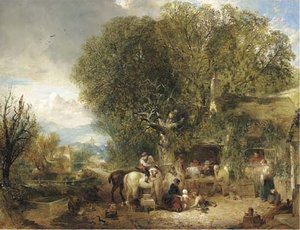
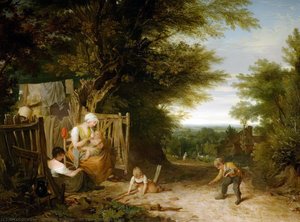
Portrét William Collins

100 nejslavnějších obrazů autora William Collins, každý naprosto unikátní

Aktualizováno listopad 2026 · seřazeno podle našeho skóre popularity (vyhledávání, návštěvy a objednávky u každého díla) · 126 děl umělce William Collins v našem katalogu

Stručně řečeno

Ztoulé kotě je obraz autora William Collins, který přitahuje nejvíce pohledů. Poté se zrak přesouvá k Happy as a King (1836) a The Day's Bag. Z 126 děl umělce William Collins v našem katalogu je těchto 100 těch nejznámějších; každé z nich je unikátním originálem s uvedením roku vzniku, muzea a důvodu jeho nesmrtelnosti.

1824 – 1889, Londýn Romanticism Nejvíce děl: Yale Center for British Art

Top 10 obrazů autora William Collins podle výběru galerie

1
Ztoulé kotě od William Collins

Ztoulé kotě

Olej na panelu

Scéna se odehrává na venkovském nádvoří, kde se skupina dětí a žena shromáždily kolem velké mísy s mlékem. Středem celkové kompozice je interakce mezi lidskými postavami a malým kotětem. Děti se naklánějí dovnitř, jejich těla jsou natočena směrem k zvířeti, zatímco žena pozoruje skupinu z mírného odstupu. Prostředí definují textury stěny budovy a organické tvary okolní vegetace a stromů. V pozadí se krajina ztrácí směrem k vzdálené vesnici, což vytváří…

2
Happy as a King (1836) od William Collins

Happy as a King

1836 · Oil On Canvas

The scene unfolds in a work titled Happy as a King, a painting that captures a fleeting moment of pure, unburdened joy. Created in 1836, this piece brings us into the heart of a lively, rural setting where the simple pleasures of life take center stage. We find ourselves looking upon a world where the boundaries between the landscape and the spirit of those within it seem to dissolve into…

3
The Day's Bag od William Collins

The Day's Bag

Oil On Canvas

In The Day's Bag, William Collins captures a quiet moment of leisure within a rural landscape. A young boy sits amidst the grass, his presence anchored by the company of hunting dogs. The scene is a genre study of the pursuit of game, where the stillness of childhood meets the instinct of the animal. They exist together in a natural setting, framed by the heavy textures of the earth and…

4
Seaford, Sussex od William Collins

Seaford, Sussex

Oil On Canvas

The oil on canvas depicts the coastline at Seaford Head in East Sussex, overlooking the English Channel. In the foreground, three children occupy the sandy beach; one child is engaged in carving a toy boat using a Sussex trug basket. Nearby, the shoreline is populated by men engaged in manual labor, specifically collecting chalk and managing fishing nets. The middle ground features the expanse of the sea, where a few…

5
Sunday Morning od William Collins

Sunday Morning

Oil On Canvas

In this pastoral scene, we find ourselves in a rural village during the late afternoon, a moment where the light begins to stretch and soften. The composition draws the eye through a carefully layered landscape, moving from the immediate intimacy of the foreground into a deep, wooded background. At the heart of this encounter is a small boy, his gesture of offering a piece of bread to a white horse…

6
The Cottage Door od William Collins

The Cottage Door

Oil

The sun hangs softly over a peaceful countryside scene where time seems to slow to a crawl. Outside a modest cottage, a small group of people gathers, their figures caught in the middle of a quiet conversation. One person stands to the left, while another occupies the center, and a third lingers toward the right, creating a natural, unforced rhythm among the subjects. A horse rests nearby, adding to the…

7
Cottage Hospitality od William Collins

Cottage Hospitality

The air feels still and warm around the small cottage, where a gathering of souls finds comfort in each other's presence. A man rests on the ground, his proximity to a loyal dog suggesting a deep, unspoken bond of companionship. Nearby, a woman holds a child close, her posture radiating a gentle sense of protection and maternal grace. The scene unfolds with a natural, unforced rhythm, as if the viewer…

8
The Cherry Seller od William Collins

The Cherry Seller

Oil

In this scene, we find ourselves standing on a dirt-covered street, observing a moment of stillness within a rural community. The composition is populated by several figures scattered throughout the space, some positioned in the foreground to draw us into their immediate surroundings, while others recede into the distance. A man sits quietly on a bench near the center, a figure of repose amidst the subtle movement of the village.…

9
At The Cottage Gate od William Collins

At The Cottage Gate

Oil On Canvas

At The Cottage Gate is a work by William Collins. Born in London, United Kingdom, the artist developed a style centered on the depiction of rural life and the quietude of the countryside. His approach focused on the dignity of everyday existence, often capturing scenes of domestic leisure and the innocence of childhood.

10
Rustic Civility od William Collins

Rustic Civility

Oil On Canvas

Rustic Civility is an oil on canvas genre painting by the British artist William Collins. Created in 1832, the work was first presented to the public at the Royal Academy Exhibition of 1832 at Somerset House, London.

Slavná díla umělce William Collins, čísla 11 až 100

11The venturesome robin, (1831) od William CollinsThe venturesome robin,1831 12Nutting Party, (1831) od William CollinsNutting Party,1831 13May Day (1812) od William CollinsMay Day1812 · Yale Center for British Art 14Fisherwomen On The Coast Near Boulogne od William CollinsFisherwomen On The Coast Near Boulogne 15Fishing Boats Beached At Sunset od William CollinsFishing Boats Beached At Sunset 16Street In Naples od William CollinsStreet In Naples 17Mussel Gatherers od William CollinsMussel Gatherers 18Beach Scene od William CollinsBeach Scene 19Barmouth Sands od William CollinsBarmouth Sands 20Hastings, East Sussex od William CollinsHastings, East Sussex 21May Day od William CollinsMay Day 22Children Resting On A Beach od William CollinsChildren Resting On A Beach 23After The Storm od William CollinsAfter The Storm 24Coast Scene With Figures od William CollinsCoast Scene With Figures 25Nude Female Figure Leaning Against A Statue In A Garden od William CollinsNude Female Figure Leaning Against A Statue In A Garden 26Three Children Under A Tree od William CollinsThree Children Under A Tree 27Coast Scene od William CollinsCoast Scene 28Children Playing By The Shore od William CollinsChildren Playing By The Shore 29Shrimp Boys At Cromer, Norfolk od William CollinsShrimp Boys At Cromer, Norfolk 30Spinning Girl Of Sorrento od William CollinsSpinning Girl Of Sorrento 31The Mariner's Widow od William CollinsThe Mariner's Widow 32The End Of A Days Fishing od William CollinsThe End Of A Days Fishing 33Figures By A Cottage In An Extensive Wooded Landscape od William CollinsFigures By A Cottage In An Extensive Wooded Landscape 34The Reluctant Departure od William CollinsThe Reluctant Departure 35Returning From The Haunts Of The Seafowl od William CollinsReturning From The Haunts Of The SeafowlWalker Art Gallery 36The Reform Club Banquet, Edinburgh od William CollinsThe Reform Club Banquet, Edinburgh 37Early Morning - Cromer od William CollinsEarly Morning - Cromer 38Borrowdale, Cumbria od William CollinsBorrowdale, Cumbria 39Landscape With Three Figures od William CollinsLandscape With Three Figures 40Taking Out The Thorn od William CollinsTaking Out The Thorn 41The end of the day; and boys crabbing od William CollinsThe end of the day; and boys crabbing 42Children Playing With Puppies od William CollinsChildren Playing With Puppies 43Borrowdale, Cumberland, With Children Playing By The Banks Of A Brook od William CollinsBorrowdale, Cumberland, With Children Playing By The Banks Of A Brook 44View Of Sir David Wilkie's House In Vicarage Place, Kensington od William CollinsView Of Sir David Wilkie's House In Vicarage Place, Kensington 45The Minnow Catchers od William CollinsThe Minnow Catchers 46Salcombe, Devonshire od William CollinsSalcombe, Devonshire 47Littlehampton od William CollinsLittlehampton 48On The Coast at Yarmouth od William CollinsOn The Coast at Yarmouth 49Studies of English Scenery, 19th century od William CollinsStudies of English Scenery, 19th century 50On the Coast of Yarmouth od William CollinsOn the Coast of Yarmouth 51Children At A Rock Pool od William CollinsChildren At A Rock Pool 52The Young Shrimp-catchers od William CollinsThe Young Shrimp-catchers 53Kentish Peasant Girls od William CollinsKentish Peasant Girls 54Dedham Ferry od William CollinsDedham Ferry 55The riverside od William CollinsThe riverside 56Figures on a Beach od William CollinsFigures on a Beach 57Sketch For 'happy As A King', 19th Century od William CollinsSketch For 'happy As A King', 19th Century 58Fisherfolk Returning With The Catch od William CollinsFisherfolk Returning With The Catch 59Beach, Boys Sailing A Toy Boat od William CollinsBeach, Boys Sailing A Toy Boat 60Eel Pots od William CollinsEel Pots 61Coastal Scene With Yachts, And Fisherfolk On A Beach od William CollinsCoastal Scene With Yachts, And Fisherfolk On A Beach 62Sketch Of A Man Embracing A Woman At A Cottage Gate od William CollinsSketch Of A Man Embracing A Woman At A Cottage Gate 63The Caves Of Ulysses At Sorrento, Naples od William CollinsThe Caves Of Ulysses At Sorrento, Naples 64Down By The Stream od William CollinsDown By The Stream 65Fisherfolk On A Beach od William CollinsFisherfolk On A Beach 66The Return Of The Fishing Boats od William CollinsThe Return Of The Fishing Boats 67View Of The South And West Fronts Of Clumber House, Nottinghamshire od William CollinsView Of The South And West Fronts Of Clumber House, Nottinghamshire 68The Young Fisherman od William CollinsThe Young Fisherman 69Happy As A King - od William CollinsHappy As A King - 70A Country Lane (illustrated); And Study Of Trees od William CollinsA Country Lane (illustrated); And Study Of Trees 71Ave Maria Scene Near Tivoli od William CollinsAve Maria Scene Near Tivoli 72Coast View Near Sorrento, Bay Of Naples od William CollinsCoast View Near Sorrento, Bay Of Naples 73Hall Sands, Devonshire od William CollinsHall Sands, Devonshire 74The Childhood Of Wilkie Collins od William CollinsThe Childhood Of Wilkie Collins 75Coastal Scene With Fishermen And Their Baskets On The Shore od William CollinsCoastal Scene With Fishermen And Their Baskets On The Shore 76A shrimper sitting on the rocks at dusk od William CollinsA shrimper sitting on the rocks at dusk 77The Little Water-maid od William CollinsThe Little Water-maid 78A Girl of Sorrento od William CollinsA Girl of Sorrento 79The Withered Tree od William CollinsThe Withered Tree 80The Shrimpers od William CollinsThe Shrimpers 81The West Front Of Clumber House, Nottinghamshire od William CollinsThe West Front Of Clumber House, Nottinghamshire 82The Broom Seller od William CollinsThe Broom Seller 83Bayham Abbey, Near Tunbridge Wells od William CollinsBayham Abbey, Near Tunbridge Wells 84The Shell Seeker; And Eyeing The Catch od William CollinsThe Shell Seeker; And Eyeing The Catch 85The Decoy Pond At Hendon od William CollinsThe Decoy Pond At Hendon 86Harvest Time od William CollinsHarvest Time 87Boys Gleaning od William CollinsBoys Gleaning 88The Villa D'este, Tivoli od William CollinsThe Villa D'este, Tivoli 89Sorrento - Bay Of Naples od William CollinsSorrento - Bay Of Naples 90The Market Place And Frauenkirche, Nuremberg, Germany od William CollinsThe Market Place And Frauenkirche, Nuremberg, Germany 91Fisherfolk On A Beach, A Ruined Castle On A Cliff Top Beyond od William CollinsFisherfolk On A Beach, A Ruined Castle On A Cliff Top Beyond 92Welsh Peasants Returning From Market; Scene Near Barmouth od William CollinsWelsh Peasants Returning From Market; Scene Near Barmouth 93The Nutting Party od William CollinsThe Nutting Party 94The Carrier's Resting Place od William CollinsThe Carrier's Resting Place 95The South And East Front Of Clumber House, Nottinghamshire od William CollinsThe South And East Front Of Clumber House, Nottinghamshire 96The Sale Of The Pet Lamb od William CollinsThe Sale Of The Pet Lamb 97Young Anglers od William CollinsYoung Anglers 98The World od William CollinsThe World 99River Scene With Trees And Mountains od William CollinsRiver Scene With Trees And Mountains 100My Favourite Cottage od William CollinsMy Favourite Cottage

Motivy, které zaujaly William Collins

Čtyři témata, která se v těchto originálech nejčastěji objevují, z nichž každé má svůj nejlepší příklad.

Muzea, v nichž jsou vystavena originálna umělce William Collins

2 muzea, v nichž je umístěno nejvíce obrazů z této stránky.

Muzeum Město Díla autora William Collins Obrazy z tohoto seznamu
Yale Center for British Art, New HavenYale Center for British Art New Haven 2 May Day
Walker Art Gallery, LiverpoolWalker Art Gallery Liverpool 1 Returning From The Haunts Of The Seafowl

William Collins v průběhu let: unikátní originály každého díla

Všechny originály umělce William Collins s datem 1836 zobrazené zde patří k jednomu roku, 1836: jsou uspořádány podle míry slavnosti.

Díla podle roku

Vyberte rok a prohlédněte si originály.

Obrazy umělce William Collins: dotazy pro galerii

Kterým nejznámějším dílem je William Collins?Odhalit odpověď

Ztoulé kotě. Následují Happy as a King (1836) a The Day's Bag.

Kterých deset obrazů autora William Collins je nejznámějších?Odhalit odpověď

Ztoulé kotě, Happy as a King, The Day's Bag, Seaford, Sussex, Sunday Morning, The Cottage Door, Cottage Hospitality, The Cherry Seller, At The Cottage Gate a Rustic Civility. Hodnocení výše uvádí rok a muzeum pro každé z nich.

Kolik známých děl má autor William Collins?Odhalit odpověď

Náš katalog obsahuje 126 děl od William Collins.

Kde lze vidět nejznámější originály umělce William Collins?Odhalit odpověď

Většinou v Yale Center for British Art (New Haven) a Walker Art Gallery (Liverpool). V tabulce muzeí výše jsou vypsány všechny.

Jakým tématům se William Collins věnoval/a nejčastěji?Odhalit odpověď

Rural life (18), Beach (12) a Coastal scene (11) napříč 100 díly na této stránce.

Jaké materiály používal(a) William Collins nejčastěji?Odhalit odpověď

Oil On Canvas, u 34 z 100 děl na této stránce.

K kterému směru patří dílo umělce William Collins?Odhalit odpověď

Romanticism, podle originálů na této stránce.

William Collins: portrét umělce

A Life Immersed in Sentiment: The World of William Collins

Born in London in 1788, William Collins emerged as a significant voice within the British Romantic tradition, though his path to artistic recognition was subtly interwoven with familial and societal currents. His father, also named William Collins, was a respected painter and writer, providing young William with an early immersion into the world of art. This foundational exposure shaped his aesthetic sensibilities, yet his journey wasn’t simply one of direct imitation. While initially intended for a career mirroring his father's, Collins ultimately carved out a distinctive niche for himself, focusing on scenes that resonated deeply with Victorian audiences – idyllic portrayals of rural life and tender depictions of childhood innocence. His early education included time spent in Italy and France, experiences which instilled within him not only linguistic skills but also an appreciation for the light and atmosphere that would later characterize his landscapes. A period as a clerk at Antrobus & Co., tea merchants, proved deeply unsatisfying, yet it perhaps sharpened his observational skills, providing glimpses into the lives of ordinary people that would inform his artistic vision.

The Blossoming of a Romantic Vision

Collins’s formal training began at the Royal Academy Schools in 1807, where he honed his technical abilities and developed his unique style. He quickly gained recognition, winning awards and exhibiting regularly. However, it was his departure from grand historical narratives or portraiture towards genre painting – scenes of everyday life – that truly defined him. Influenced by the Romantic movement, Collins didn’t merely depict landscapes; he imbued them with emotion. His paintings weren't simply representations of places but rather evocations of feeling, capturing fleeting moments of beauty and tranquility. He possessed a remarkable ability to portray children and those on the margins of society with dignity and compassion. Muted tones and a careful attention to natural light became hallmarks of his work, creating an atmosphere of gentle nostalgia. His paintings like “Barmouth Sands” or "Figures By A Cottage In An Extensive Wooded Landscape" exemplify this approach, inviting viewers into a world of quiet contemplation. He rivaled the popularity of John Constable, demonstrating his significant impact on British art during his time.

Notable Works and Artistic Style

Collins’s oeuvre comprises approximately 150 paintings, predominantly landscapes imbued with Romantic sensibilities. His distinctive style is characterized by a meticulous observation of nature combined with an expressive use of color and brushwork—techniques honed through extensive study at the Royal Academy. He skillfully captured the subtleties of light and shadow, conveying not just visual accuracy but also profound emotional resonance. Recurring themes include pastoral scenes depicting shepherds tending flocks, tranquil lakes reflecting serene skies, and depictions of rural cottages bathed in golden afternoon sunlight. These images reflect a deep fascination with the beauty of the English countryside and an idealized vision of rural life—a sentiment that resonated powerfully with Victorian audiences eager for escapism from urban pressures. Among his most celebrated works are “Barmouth Sands,” showcasing a dramatic seascape rendered with masterful brushstrokes, and "The Stray Kitten," portraying a tender moment between a mother cat and her newborn offspring – pieces that exemplify Collins’s commitment to capturing genuine emotion within carefully crafted compositions.

Family Legacy and Artistic Influence

William Collins's personal life was inextricably linked to his artistic pursuits. He married Eliza Mary Lloyd in 1813, establishing a family rooted in the arts—his son, Wilkie Collins, would become one of Britain’s most prolific novelists, crafting tales steeped in Gothic horror and psychological intrigue. This familial connection fostered an environment conducive to creativity and intellectual curiosity, shaping Wilkie's literary sensibilities as profoundly as it influenced his father's artistic vision. Furthermore, Collins’s meticulous attention to detail and his masterful handling of light—traits evident throughout his paintings—served as inspiration for subsequent generations of artists striving to emulate the Romantic ideal. He stands alongside Constable and Turner as a cornerstone of British landscape painting, demonstrating that art could simultaneously convey visual splendor and profound emotional depth.

A Lasting Impression: Recognition and Remembrance

Despite facing challenges during his lifetime – including financial difficulties—William Collins achieved posthumous recognition as a significant contributor to the Romantic movement. His paintings gained popularity in the 1870s, fueled by an appreciation for sentimental art and a yearning for idealized depictions of rural life. Today, William Collins is remembered not only as a talented painter but also as a father who nurtured his son’s literary genius—a testament to the enduring legacy of artistic excellence and familial devotion. His works continue to inspire admiration for their beauty, precision, and ability to evoke feelings of tranquility and nostalgia—solidifying his place within the annals of British art history.