William Glackens: A Capturer of American Life in the Gilded Age
The year 1870 marked a pivotal moment in art history, a period of burgeoning experimentation and shifting artistic sensibilities. Within this dynamic landscape emerged William Glackens (1870-1938), an American painter whose career unfolded against the backdrop of rapid industrialization, social change, and the rise of modernism. Born in Philadelphia, Glackens’s early life was marked by financial hardship, a circumstance that profoundly shaped his artistic vision and ultimately fueled his commitment to portraying the realities of everyday American life.
Glackens's formative years were spent working various jobs – as a clerk, an illustrator for Harper’s Weekly, and even a brief stint as a stagehand. These experiences instilled in him a keen observational eye and a deep understanding of the urban environment. Initially, his work leaned towards a darker palette and a focus on the gritty details of city life—the crowded streets, the bustling markets, and the faces of ordinary people. This early style, reminiscent of the Ashcan School movement, was characterized by its unflinching honesty and its rejection of idealized representations. His illustrations for Harper’s Weekly, depicting scenes of urban poverty and social unrest, demonstrated a remarkable ability to capture the spirit of the era.
A significant turning point in Glackens's career came with his association with The Eight – a group of progressive artists who challenged the established conventions of the art world. This collective, which included Robert Henri, John Sloan, and Everett Shinn, advocated for an artistic approach rooted in direct observation and social realism. The influence of The Eight is readily apparent in Glackens’s later work, particularly his vibrant depictions of New York City during the 1920s. He embraced brighter colors, looser brushstrokes, and a more expressive style, capturing the energy and dynamism of the metropolis.
Glackens's artistic development can be traced through several key themes. His early works often featured scenes of urban poverty and social injustice, reflecting his empathy for the marginalized members of society. As he matured, his subject matter broadened to encompass a wider range of experiences – from intimate portraits of friends and family to lively depictions of nightlife and entertainment venues. He was particularly drawn to capturing the atmosphere of New York City’s speakeasies and dance halls, immortalizing the spirit of the Jazz Age in his paintings. His work is notable for its humor, its warmth, and its ability to evoke a sense of nostalgia for a bygone era.
The Influence of Impressionism and Modernity
While firmly rooted in American realism, Glackens’s artistic style was also influenced by the burgeoning Impressionist movement. He admired the Impressionists' emphasis on capturing fleeting moments of light and color, and he incorporated these techniques into his own work. His use of broken brushstrokes, vibrant hues, and a focus on atmospheric effects demonstrates a clear debt to Monet, Renoir, and other leading figures of the Impressionist school.
However, Glackens never fully embraced the purely subjective approach of the Impressionists. He retained a strong sense of narrative and composition, using his paintings to tell stories about the people and places he observed. His work can be seen as a synthesis of realism and impressionism—a uniquely American style that captured both the gritty realities of urban life and the beauty of everyday moments.
Furthermore, Glackens’s artistic trajectory reflects the broader shifts occurring in American society during the late 19th and early 20th centuries. The rise of industrialization, urbanization, and immigration transformed the nation's landscape and its culture, creating a new set of challenges and opportunities for artists. Glackens’s paintings provide a valuable record of this period of rapid change, offering insights into the lives and experiences of ordinary Americans.
Key Works and Notable Achievements
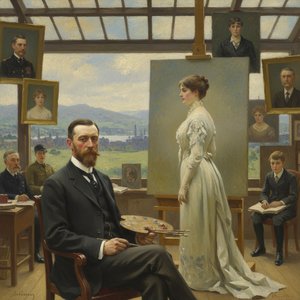
Several works stand out as particularly significant examples of Glackens's artistic achievement. “The Eight” (1913), a group portrait of his fellow members of The Eight, is a testament to the collective’s shared vision and their commitment to challenging artistic conventions. “Speakeasy” (c. 1925) captures the vibrant atmosphere of New York City's underground nightlife with remarkable energy and detail. “The Dance Hall” (1928) showcases his ability to convey a sense of movement and excitement through his use of color, brushstroke, and composition.
Glackens’s contributions extended beyond painting. He was also an accomplished illustrator and graphic artist, producing posters, advertisements, and book illustrations for a variety of clients. His work as an illustrator helped to establish him as a prominent figure in the American art world and contributed significantly to his financial stability.
Despite facing periods of hardship and struggling to find consistent recognition during his career, Glackens ultimately achieved considerable success. He exhibited his paintings in galleries across the United States and abroad, and his work is now held in major museums including the Smithsonian American Art Museum and the Metropolitan Museum of Art.
A Legacy of Realism and Observation
William Glackens’s legacy as an artist lies not only in the beauty of his paintings but also in his unwavering commitment to portraying the realities of American life. His work offers a valuable window into the social, cultural, and economic conditions of the late 19th and early 20th centuries. He demonstrated that art could be a powerful tool for social commentary and that artists had a responsibility to document and interpret the world around them.
Glackens’s influence can still be felt in contemporary American painting, where artists continue to explore themes of urban life, social justice, and personal experience. His legacy serves as an inspiration to those who believe in the power of art to illuminate the human condition and to challenge conventional perspectives. His paintings remain a testament to his remarkable talent, his unwavering integrity, and his enduring contribution to American art history.