Portrét Winslow Homer

Obrazy autora Winslow Homer: 100 nejznámějších díel podle pohledu galerie

Aktualizováno listopad 2026 · seřazeno podle našeho skóre popularity (vyhledávání, návštěvy a objednávky u každého díla) · 716 děl umělce Winslow Homer v našem katalogu

Stručně řečeno

Z pohledu galerie je nejslavnějším dílem Winslow Homer obrazem Mlžný poplach (1885), jehož originál je vystaven v Muzeum umění v Bostonu v obci Boston. Roztrhni provaz (1872) a Loďky rybářské, Key West (1903) doplňují trio, které každé oko okamžitě pozná. Z 716 děl umělce Winslow Homer v našem katalogu představuje galerie níže 100 nejznámějších děl, z nichž každé je originálem s uvedením roku vzniku, muzea a toho, co jej činí jedinečným.

1836 – 1910, Boston American realism Nejvíce děl: National Gallery of Art

Top 10 obrazů umělce Winslow Homer v naší galerii

1
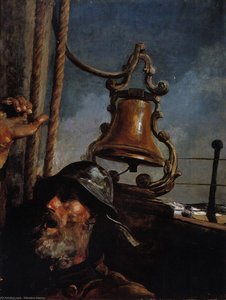
Mlžný poplach (1885) od Winslow Homer

Mlžný poplach

1885 · Olej na plátně · Muzeum umění v Bostonu, Boston

Winslow Homer, mistr realistické malby 19. století, nám v obraze “Varování před mlhou” (The Fog Warning) z roku 1885 nabízí pohled na osamělého rybáře bojujícího s nepředvídatelnou mocí oceánu. Toto není pouhé zachycení každodenní práce; je to hluboká meditace nad vztahem člověka k přírodě, odolností tváří v tvář útrapám a křehkostí lidského života. Homer se nesnaží idealizovat, ale s nekompromisní upřímností zobrazuje drsnou realitu života těch, kteří si vydělávají obživu…

2
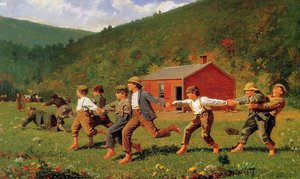
Roztrhni provaz (1872) od Winslow Homer

Roztrhni provaz

1872 · Olej na plátně · Butler Institute of American Art, Mahoning County

Poutavá scéna venkovského mládí Dílo Winslowe Homera „Snap the Whip“ je živobylným a dynamickým zobrazením dětí hrajících si venku v krajinném prostředí. Obraz zachycuje okamžik čisté radosti a energie, kdy se skupina chlapců zapojuje do živé hry na tahání lana. Tato scéna je zasazena do pozadí červené školky nebo stodoly, obklopené bujnou zelení a vlnitými vrchy, což vyvolává pocit nostalgie a nadčasovosti. Mistrovská kompozice a technika Homerova kompozice je zároveň…

3
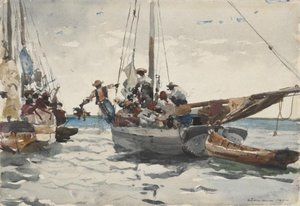
Loďky rybářské, Key West (1903) od Winslow Homer

Loďky rybářské, Key West

1903 · Akvarel · Metropolitan Museum of Art, New York

Winslow Homer, jeden z nejvýznamnějších amerických impresionistů, v díle „Fishing Boats, Key West“ (1903) zachytil podmanivou atmosféru a klidné prostředí ostrova Key West. Nejde o historickou fresku nebo dramatický portrét; spíše o intimní moment, který Homer s typickým pro něj citlivým zrakem a technickými dovednostmi dokázal vtisknout na papír. Jeho přístup se odlišoval od tehdejších akademických trendů – Homer se soustředil na zachycení *pocitu*, spíše než na detailní reprodukci reality.…

4
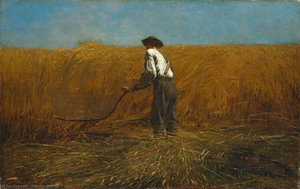
Veterán v novém poli (1865) od Winslow Homer

Veterán v novém poli

1865 · Olej na plátně · Metropolitan Museum of Art, New York

Winslow Homerova obrazová studie, „The Veteran in a New Field“ (1865), není jenom ilustrací venkovské práce; je to hluboká meditace nad americkou realitou po skončení občanské války. V době, kdy národ se snažil uzdravit rány z krvavého konfliktu, Homer zachytil moment introspekce a obnovy v jednoduché, ale nesmírně sugestivní scéně. Obraz zobrazuje samotného muže, veterána z Unie, který s klidnou vytrvalostí skládá úrodu žita na rozsáhlém poli. Jeho postava, odhozená…

5
Životová linka (1884) od Winslow Homer

Životová linka

1884 · Olej na plátně · Philadelphia Museum of Art, Philadelphia

Winslow Homerova "The Life Line" není jen obraz; je to ztělesnění amerického ducha, zachycujícího sílu, odvahu a neúprosnou krásu přírody. Představuje dramatickou scénu záchrany na moři, kde muž riskujícím způsobem zachraňuje ženu uvězněnou v bouřlivých vodách. Homerova práce, datovaná rokem 1884, je fascinující ukázkou jeho schopnosti vyprávět příběh prostřednictvím obrazu – příběh o lidské odolnosti a neochvějné naději uprostřed největšího chaosu.

6
proud_stream (1906) od Winslow Homer

proud_stream

1906 · Olej na plátně · Metropolitan Museum of Art, New York

Winslow Homer, jeden z nejvýznamnějších amerických malířů 19. století, se s dílem "The Gulf Stream" (1899) vrací k tématům, která ho fascinovala po celá desetiletí: střet člověka s divokou silou přírody a hluboké zkoumání lidské existence ve světě neúprosné nástrahy. Tato obrazová studie, zachycující dramatickou scénu v moři, je mnohem více než jen ilustrace; je to výzva k zamyšlení nad křehkostí života a sílou nevyhnutelného osudu. Homer, známý svým realistickým…

7
A Wall, Nassau (1898) od Winslow Homer

A Wall, Nassau

1898 · Akvarel · Metropolitan Museum of Art, New York

„A Wall, Nassau“ od Winslowa Homera je obraz, který vás okamžitě vtáhne do klidného a melancholického světa. Nejde o dynamickou scénu nebo dramatický moment, ale spíše o tichý pohled na život v Bahamech – konkrétně na malou městskou zídku v Nassau, kterou Homer zachytil s mimořádnou citlivostí a jemností. Je to obraz, který vyzařuje klid, ale zároveň skrývá pod povrchem i náznak nostalgie a odosobnění. Homera se jednalo o umělce,…

8
Dlouhá Ramena, New Jersey (1869) od Winslow Homer

Dlouhá Ramena, New Jersey

1869 · Olej na plátně · Muzeum umění v Bostonu, Boston

Dlouhá Ramena, New Jersey – Osvětlení Zlatého věku Winslow Homerova “Dlouhá Ramena, New Jersey” z roku 1869 vás pozve do klidné plážové scény, zachycující podstatu volného času a společenských interakcí během Zlatého věku. Tato okouzlující práce zobrazuje živé shlukání lidí u moře, kde se hosté těší přírodě a vzájemnému společenství na pozadí jemných modrých odstínů, teplých písečných dun a tlumeně zelených tónů. Je to důkaz Homerovy schopnosti spojit realismus s…

9
Lov zajíců (1893) od Winslow Homer

Lov zajíců

1893 · Olej na plátně

Poutavý motiv a kompozice Toto evokativní umělecké dílo mistrovsky zachycuje klidnou zimní krajinu, jejímž středobodem je osamělý lišák, který v tichém kráse sněhem pokryté země představuje odolnost a bdělost. Scéna je promyšleně vyvážená, přičemž liška je umístěna výrazně v popředí, čímž diváka zve do okamžiku klidu a zamyšlení. Nad ní se tyčí tmavá křídlatá postava – možná pták nebo symbolický strážce – která dodává dílu nádech tajemna a emocionální hloubky…

10
The gulf stream, Metropolitan Mus (1899) od Winslow Homer

The gulf stream, Metropolitan Mus

1899 · Oil On Canvas

A Tempestuous Encounter: Winslow Homer’s *The Gulf Stream* Winslow Homer's *The Gulf Stream* (1899) is a powerfully evocative painting that transcends mere depiction of a maritime disaster, becoming a profound meditation on humanity’s vulnerability in the face of nature’s immense power. This iconic work, measuring 72 x 125 cm and housed at The Metropolitan Museum of Art, continues to captivate viewers with its dramatic composition and symbolic weight. Subject &…

Obrazy autora Winslow Homer, seřazeny od 11 do 100

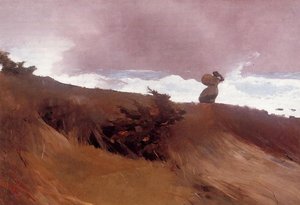
11Východní bod, Proutův krk (1900) od Winslow HomerVýchodní bod, Proutův krk1900 · Sterling and Francine Clark Art Institute 12Sponge Boats, Key West (1903) od Winslow HomerSponge Boats, Key West1903 13Fishing (1879) od Winslow HomerFishing1879 · Rhode Island School of Design Museum of Art 14Milking Time (1875) od Winslow HomerMilking Time1875 · Crystal Bridges Museum of American Art 15Kissing the Moon (1904) od Winslow HomerKissing the Moon1904 · Addison Gallery of American Art 16Martha (1835) od Winslow HomerMartha1835 17Saco Bay (1896) od Winslow HomerSaco Bay1896 18Shark Fishing (1885) od Winslow HomerShark Fishing1885 19Cape Trinity, Saguenay River (1904) od Winslow HomerCape Trinity, Saguenay River1904 20Crab Fishing (1883) od Winslow HomerCrab Fishing1883 · Worcester Art Museum 21Girl with Red Stockings (1882) od Winslow HomerGirl with Red Stockings1882 22Waiting for a Bite (1874) od Winslow HomerWaiting for a Bite1874 23Kanoe v Prádelně (1897) od Winslow HomerKanoe v Prádelně1897 24Gloucester Harbor and Dory (1880) od Winslow HomerGloucester Harbor and Dory1880 · Fogg Art Museum 25Watching the Breakers (1891) od Winslow HomerWatching the Breakers1891 · Gilcrease Museum 26A Tropical Breeze, Nassau (1879) od Winslow HomerA Tropical Breeze, Nassau1879 27Ryby a motýli (1900) od Winslow HomerRyby a motýli1900 · Sterling and Francine Clark Art Institute 28Dívka s hrablořem (1878) od Winslow HomerDívka s hrablořem1878 · National Gallery of Art 29Country School (1871) od Winslow HomerCountry School1871 · Addison Gallery of American Art 30Západ Slunce Sžehnáně (1880) od Winslow HomerZápad Slunce Sžehnáně1880 31Soumrak v Leeds, New York (1876) od Winslow HomerSoumrak v Leeds, New York1876 · Muzeum umění v Bostonu 32Ranní Lotyše (1873) od Winslow HomerRanní Lotyše1873 33West Point, Prout's Neck (1900) od Winslow HomerWest Point, Prout's Neck1900 · Sterling and Francine Clark Art Institute 34Střelec na hlídce (1863) od Winslow HomerStřelec na hlídce1863 · Portland Museum of Art 35The Lookout - All's Well, oil on canvas, Museum o (1896) od Winslow HomerThe Lookout - All's Well, oil on canvas, Museum o1896 36Still Life of Fruit (1880) od Winslow HomerStill Life of Fruit1880 37Čekání na odpověď (1872) od Winslow HomerČekání na odpověď1872 · Baltimore Museum of Art 38Vystřežitel - 'Vše je v pořádku' (1896) od Winslow HomerVystřežitel - 'Vše je v pořádku'1896 · Muzeum umění v Bostonu 39Beach Scene od Winslow HomerBeach SceneThyssen-Bornemisza Museum 40Pobřeží Maine (1893) od Winslow HomerPobřeží Maine1893 · Art Institute of Chicago 41Zimní pobřeží (1890) od Winslow HomerZimní pobřeží1890 · Philadelphia Museum of Art 42Haymaking (1864) od Winslow HomerHaymaking1864 43On the Beach (also known as On the Beach, Long Branch, New Jersey) (1869) od Winslow HomerOn the Beach (also known as On the Beach, Long Branch, New Jersey)1869 44Fisherwomen, Cullercoats (1881) od Winslow HomerFisherwomen, Cullercoats1881 45Scene in the Adirondacks (1892) od Winslow HomerScene in the Adirondacks1892 46Gloucester Harbor (1873) od Winslow HomerGloucester Harbor1873 · Nelson-Atkins Museum of Art 47Rvačka v divočině (1864) od Winslow HomerRvačka v divočině1864 · New Britain Museum of American Art 48Sailboat and Fourth of July Fireworks (1880) od Winslow HomerSailboat and Fourth of July Fireworks1880 · Fogg Art Museum 49Two Boys in a Meadow (1874) od Winslow HomerTwo Boys in a Meadow1874 50Sloop, Nassau (1899) od Winslow HomerSloop, Nassau1899 · Metropolitan Museum of Art 51The Pumpkin Patch (1878) od Winslow HomerThe Pumpkin Patch1878 52Starousedlíci (1892) od Winslow HomerStarousedlíci1892 · Muzeum umění v Bostonu 53Salt Kettle, Bermuda (1899) od Winslow HomerSalt Kettle, Bermuda1899 · National Gallery of Art 54The West Wind (1891) od Winslow HomerThe West Wind1891 · Addison Gallery of American Art 55Farm House at Basildon, England (1881) od Winslow HomerFarm House at Basildon, England1881 56Hromádka mušlí (1904) od Winslow HomerHromádka mušlí1904 · Brooklyn Museum 57Waiting for Dad (also known as Longing) (1873) od Winslow HomerWaiting for Dad (also known as Longing)1873 58Woman and Elephant (1877) od Winslow HomerWoman and Elephant1877 59Mount Washington (1869) od Winslow HomerMount Washington1869 · Art Institute of Chicago 60Summer Squall (1904) od Winslow HomerSummer Squall1904 61The New Novel, detail, watercolor, Museum of Fin (1877) od Winslow HomerThe New Novel, detail, watercolor, Museum of Fin1877 62Výška útesu při pobřeží Maine (1894) od Winslow HomerVýška útesu při pobřeží Maine1894 · National Gallery of Art 63Návrat sklizavčího (1867) od Winslow HomerNávrat sklizavčího1867 · Crystal Bridges Museum of American Art 64Roh corner, Santiago de Cuba (1885) od Winslow HomerRoh corner, Santiago de Cuba1885 · Muzeum umění v Bostonu 65Breezing Up (aka A Fair Wind) od Winslow HomerBreezing Up (aka A Fair Wind) 66Homework (1874) od Winslow HomerHomework1874 67Dívka zalévající rostliny (1875) od Winslow HomerDívka zalévající rostliny1875 68Sunset (1875) od Winslow HomerSunset1875 · National Gallery of Art 69Returning Fishing Boats (1883) od Winslow HomerReturning Fishing Boats1883 · Fogg Art Museum 70Market Scene, Nassau od Winslow HomerMarket Scene, Nassau 71Pod palmy (1886) od Winslow HomerPod palmy1886 · National Gallery of Art 72Fisherman and Girl in a Rowboat Streaked Red, White and Blue (1881) od Winslow HomerFisherman and Girl in a Rowboat Streaked Red, White and Blue1881 · Charles Allis Art Museum 73Watching the Harbor (1873) od Winslow HomerWatching the Harbor1873 74Feeding Time (1878) od Winslow HomerFeeding Time1878 · Sterling and Francine Clark Art Institute 75Two Schooners (also known as Two Sailboats) (1880) od Winslow HomerTwo Schooners (also known as Two Sailboats)1880 76The woodcutter, Watercolor over graphite, - (34.9x5) (1891) od Winslow HomerThe woodcutter, Watercolor over graphite, - (34.9x5)1891 77Returning from the Spring (1874) od Winslow HomerReturning from the Spring1874 · Portland Museum of Art 78Two Scouts (1887) od Winslow HomerTwo Scouts1887 79Paris Courtyard (1867) od Winslow HomerParis Courtyard1867 80Reverie (1872) od Winslow HomerReverie1872 81The Croquet Game, oil on canvas, The Art Institu (1866) od Winslow HomerThe Croquet Game, oil on canvas, The Art Institu1866 · Art Institute of Chicago 82Čerstvá vejce (1874) od Winslow HomerČerstvá vejce1874 · National Gallery of Art 83Na pláži, Marshfield (1872) od Winslow HomerNa pláži, Marshfield1872 84Boy on a Swing (1879) od Winslow HomerBoy on a Swing1879 85Little Girl in White (1895) od Winslow HomerLittle Girl in White1895 86Teplý odpoledne (Pastorka) (1878) od Winslow HomerTeplý odpoledne (Pastorka)1878 87Moonlight (1874) od Winslow HomerMoonlight1874 88Negro Cabins and Palms (1898) od Winslow HomerNegro Cabins and Palms1898 · Brooklyn Museum 89Sandy Beach with Breakers (1869) od Winslow HomerSandy Beach with Breakers1869 · Cooper Hewitt, Smithsonian Design Museum 90Little Shepherdess (1878) od Winslow HomerLittle Shepherdess1878 91Ptáci (1840) od Winslow HomerPtáci1840 92Breezing Up, oil on canvas, National Gallery of (1876) od Winslow HomerBreezing Up, oil on canvas, National Gallery of1876 93Gloucester Boys (1880) od Winslow HomerGloucester Boys1880 94Sisters (1840) od Winslow HomerSisters1840 95The coral divers (1885) od Winslow HomerThe coral divers1885 96Hound and Hunter (sketch) (1892) od Winslow HomerHound and Hunter (sketch)1892 · National Gallery of Art 97Farmer with a Pitchfork od Winslow HomerFarmer with a Pitchfork 98Večerní roh (1873) od Winslow HomerVečerní roh1873 · Detroit Institute of Arts 99Květ pro učitelku (1875) od Winslow HomerKvět pro učitelku1875 100The end of the hunt, Watercolor and graphite, - (38) (1892) od Winslow HomerThe end of the hunt, Watercolor and graphite, - (38)1892

Slavná díla Winslow Homer podle jednotlivých období

Motivy, které zaujaly Winslow Homer

Čtyři témata, která se v těchto originálech nejčastěji objevují, z nichž každé má svůj nejlepší příklad.

Muzea, v nichž jsou vystavena originálna umělce Winslow Homer

8 muzea, v nichž je umístěno nejvíce obrazů z této stránky.

Muzeum Město Díla autora Winslow Homer Obrazy z tohoto seznamu
National Gallery of Art, WashingtonNational Gallery of Art Washington 32 Dívka s hrablořem, Salt Kettle, Bermuda, Výška útesu při pobřeží Maine
Muzeum umění v Bostonu, BostonMuzeum umění v Bostonu Boston 22 Mlžný poplach, Dlouhá Ramena, New Jersey, Soumrak v Leeds, New York
Metropolitan Museum of Art, New YorkMetropolitan Museum of Art New York 34 Loďky rybářské, Key West, Veterán v novém poli, proud_stream
Sterling and Francine Clark Art Institute, WilliamsburgSterling and Francine Clark Art Institute Williamsburg 12 Východní bod, Proutův krk, Ryby a motýli, West Point, Prout's Neck
Fogg Art Museum, CambridgeFogg Art Museum Cambridge 9 Gloucester Harbor and Dory, Sailboat and Fourth of July Fireworks, Returning Fishing Boats
Art Institute of Chicago, ChicagoArt Institute of Chicago Chicago 8 Pobřeží Maine, Mount Washington, The Croquet Game, oil on canvas, The Art Institu
Addison Gallery of American Art, MassachusettsAddison Gallery of American Art Massachusetts 5 Kissing the Moon, Country School, The West Wind
Brooklyn Museum, New York CityBrooklyn Museum New York City 17 Hromádka mušlí, Negro Cabins and Palms

Winslow Homer, jeden ikonický obraz na každé desetiletí

Díla podle dekád

Vyberte si dekádu a prohlédněte si originál, který ji definuje.

Obrazy umělce Winslow Homer: odpovědi galerie

Který obraz autora Winslow Homer je nejslavnější ze všech?Odhalit odpověď

Mlžný poplach (1885), Muzeum umění v Bostonu, Boston. Následují Roztrhni provaz (1872) a Loďky rybářské, Key West (1903).

Kolik let bylo Winslow Homer, když dokončil/a Mlžný poplach?Odhalit odpověď

49 let: dílo Mlžný poplach pochází z roku 1885 a Winslow Homer se narodil/a v roce 1836.

Kterých 10 nejlepších obrazů má Winslow Homer?Odhalit odpověď

Mlžný poplach, Roztrhni provaz, Loďky rybářské, Key West, Veterán v novém poli, Životová linka, proud_stream, A Wall, Nassau, Dlouhá Ramena, New Jersey, Lov zajíců a The gulf stream, Metropolitan Mus. Hodnocení výše uvádí rok a muzeum pro každé z nich.

Kolik děl vytvořil/a Winslow Homer?Odhalit odpověď

Náš katalog obsahuje 716 děl umělce Winslow Homer z let 1863 až 1906.

Kde jsou vystavena nejznámější originály umělce Winslow Homer?Odhalit odpověď

Většinou v National Gallery of Art (Washington), Muzeum umění v Bostonu (Boston) a Metropolitan Museum of Art (New York). V tabulce muzeí výše jsou vypsány všechny.

Kdy Winslow Homer vytvořil své nejslavnější obrazy?Odhalit odpověď

V období 1870s: 32 z celkem 100 děl na této stránce vzniklo právě tehdy, z toho Roztrhni provaz z nich.

Která jsou nejstarší a nejnovější slavná díla umělce Winslow Homer?Odhalit odpověď

Na této stránce je nejstarší dílo z Střelec na hlídce (1863) a nejnovější z proud_stream (1906).

Kterým tématům se Winslow Homer věnoval(a) nejčastěji?Odhalit odpověď

Coastal landscape (12), Landscape (9) a Rural landscape (7) napříč 100 díly na této stránce.

V jaké technice tvořil(a) Winslow Homer nejčastěji?Odhalit odpověď

Oil On Canvas, u 23 z 100 děl na této stránce.

S jakým směrem je spojen(a) Winslow Homer?Odhalit odpověď

American realism, podle originálů na této stránce.

Jaká originální díla Winslow Homer má v obsluze National Gallery of Art?Odhalit odpověď

Dívka s hrablořem, Salt Kettle, Bermuda a Výška útesu při pobřeží Maine: muzeum National Gallery of Art, Washington má v obsluze 7 děl z této stránky.

Winslow Homer: umělec

The Life and Origins of Winslow Homer

Winslow Homer arrived in Boston, Massachusetts, on February 24, 1836. He was the second of three sons born to Charles Savage Homer and Henrietta Maria Benson. His father, a merchant, eventually left the family to seek a fortune in the California gold rush. This departure left the household to be shaped by the presence of his mother, Henrietta Maria Benson Homer. She was a gifted amateur watercolorist who became his first teacher, passing on a way of seeing the world through the delicate application of color.

The boy grew up in a household where the quiet work of art was a known presence. While his father pursued distant opportunities, the influence of his mother’s watercolors remained. This early exposure to the medium helped form the foundation of his later work. His childhood in rural Cambridge, Massachusetts, provided a backdrop of steady, observant life before he moved toward the more frantic pace of commercial work.

Early Life, Family and Training

Growing up in the rural stretches of Cambridge, Massachusetts, provided a quiet backdrop to his early years. He began sketching at the age of eleven, finding his way through the simple act of drawing. His mother, a watercolorist who painted studies of plants and flowers, was his first teacher. She shared a close relationship with him, passing down both her artistic talent and a certain temperament. His father, a merchant, was a restless man who eventually left the family to seek fortune in the California gold rush and later in Europe.

At nineteen, he entered a two-year apprenticeship with J. H. Bufford, a commercial lithographer in Boston. It was a repetitive, treadmill experience. He spent his days working on sheet music covers, a task that required a specific kind of discipline and a steady hand. This period of commercial work helped develop the clarity and detail that would later define his vision. He eventually moved toward formal study, attending classes at the National Academy of Design until 1863. During this time, he also spent a brief period studying with Frederic Rondel.

The Freelance Illustrator and War Correspondent

By 1857, the independence of a freelance career was already underway, following a decision to decline a position at Harper's Weekly. He opened his own studio in Boston, spending nearly twenty years working as an illustrator. His drawings appeared in various publications, including Ballou's Pictorial. In 1859, he moved to New York City, a shift that placed him at the center of the country's publishing activity.

The outbreak of the American Civil War changed the nature of his observations. Harper's sent him to the front lines between 1861 and 1865. As a "special artist," he was assigned to chronicle the lives of Union troops in Virginia. He spent his time sketching the realities of camp life and the scenes of battle. These sketches were not merely drawings; they were records of the movement and the quiet, often heavy moments of the soldiers.

Artistic Development in New York and Europe

In 1859, Homer moved to New York City and opened a studio in the Tenth Street Studio Building. This move marked a shift from his earlier freelance work toward a more focused pursuit of painting. He spent time studying at the National Academy of Design until 1863, taking lessons from Frédéric Rondel. During these years, he began to move away from the simple outlines of his commercial engravings and toward the weight of oil painting. His work from this period often dealt with the realities of the era, including the effects of war on the home front.

The years that followed saw him traveling through New York State, Virginia, and Massachusetts. In 1867, he spent a year in France and visited Europe, an experience that coincided with his growing interest in the landscape. By the 1870s, his focus had shifted toward scenes of childhood and young women, reflecting a certain nostalgia for simpler times. He was developing a style that was objective and true to what he observed, avoiding the polished refinements often found in the academies of the time.

In 1881, he began a two-year stay in England, living in Cullercoats, near Newcastle. This period of living near the coast would influence the way he approached the sea in his later years. He was no longer just an illustrator of social scenes; he was becoming a painter of the elements.

The Maine Years and Tropical Travels

In 1884, Homer moved to Prout's Neck, Maine. He stayed there for the next three decades, living and painting in a studio that had been expanded and altered to suit his needs. The building sat on a stretch of coast where the Atlantic was a constant presence. He spent much of his time there, often painting from a balcony that overlooked the water, even during the winter months.

The heavy Maine winters prompted a change in scenery. Between 1884 and 1905, he made several trips from the coast of Maine to the tropics. He traveled to the Bahamas, Florida, Cuba, and Bermuda. These excursions took him to the Caribbean and the Adirondacks, as well as through Canada. In these warmer places, he used watercolors to capture the light and the different textures of the landscape.

Technique, Style and Artistic Mastery

His early work in commercial engravings relied on clean outlines and simplified forms. He used a dramatic contrast of light and dark to define his subjects. This graphic clarity carried over into his later paintings. In his major studio works in oil, the paint carries a sense of weight and density. He often employed chiaroscuro, using the interplay of light and shadow to sculpt form and build atmosphere on the canvas.

He was equally prolific in watercolor. His approach to the medium was fluid and direct. When painting the Caribbean, he used the inherent transparency of the watercolor to replicate the crystalline clarity of the Bahamian sea. This ability to handle both the heavy application of oil and the delicate washes of watercolor allowed him to capture different aspects of the natural world.

Key Works and Masterpieces

His early work shows a focus on the small details of domestic life. In Lady Wearing Spectacles, painted about 1840, the subject sits in a chair, her glasses catching the light. This period of his work reflects a quiet observation of the people around him. As the years passed and he moved toward the front lines of the Civil War, the subject matter shifted. He produced Sharpshooter on Picket Duty in 1862 and Home, Sweet Home in 1863, works that captured the reality of the conflict through his sketches and paintings.

The sea became a constant presence in his later years. Breezing Up, painted about 1876, captures the movement of a boat catching a fair wind. By 1885, his focus had turned to the struggle of the fisherman in The Fog Warning, Halibut Fishing. He often returned to the rugged coast of Maine, where the weight of the paint and the texture of the canvas mirrored the heavy, salt-soaked atmosphere of the Atlantic. In 1896, The Lookout - "All's Well" presented a view from the edge of the land, looking out toward the horizon.

His final years were spent watching the tide and the elements. The Gulf Stream, created in 1906, shows a man facing the vastness of the ocean. His last completed work, Driftwood, was painted in 1909. These late paintings carry a sense of the physical world—the spray of the water, the grit of the sand, and the relentless pull of the currents.

Later Years and Death

The studio at Prout's Neck became the center of his world. From 1884 until the end, he lived and painted within those walls, a space that had been expanded and altered to suit his needs. He spent his final decades there, working through the seasons and finding a rhythm in the coastal light. The building, a two-story structure of 2,200 square feet, held his life and his work in a quiet, steady presence.

He died in Maine in 1910. The end came in his studio on September 30, 1910. He was a man who had spent his life observing the movement of the sea and the weight of the air, and he remained in that space until the very end. His remains were laid to rest at Mount Auburn, in Lot 563 on Lily Path.

Legacy and Historical Significance

Homer remains a central figure in the development of American Realism. His work provides a window into the 19th-century American experience, capturing a nation in the midst of rapid change. He did not look for the polished, academic styles of Europe, but instead focused on the honest, often difficult realities of his own country. This commitment to seeing things as they were—from the aftermath of the Civil War to the shifting landscapes of the coast—ensures his place among the most important artists in the American tradition.

His ability to document the tension between human life and the natural world continues to influence the way contemporary artists approach their subjects. He moved away from the idyllic scenes of his youth to confront the elemental forces of the sea and the quiet resilience of people facing hardship. This shift from pastoral views to a more direct, observational style helped define a uniquely American way of seeing. His paintings do not offer a romanticized version of history; they offer a record of it.

Where to See the Works Today

Tracing the physical presence of his work requires visiting several major institutions across the United States. The Metropolitan Museum of Art in New York holds 26 of his pieces. Nearby, the Brooklyn Museum in New York City maintains a collection of 17 works. For those looking toward the capital, the National Gallery of Art in Washington holds 23 paintings and drawings.

In the Northeast, the Museum of Fine Arts in Boston keeps 16 works in its collection. Further south, the Sterling and Francine Clark Art Institute in Williamsburg holds 12 pieces. These collections offer a way to see the evolution of his hand, from the early sketches of the Civil War to the heavy textures of his later years.