Portrét Vilém Mráz

26 nejslavnějších obrazů autora Vilém Mráz, výběr z galerie

Aktualizováno říjen 2026 · seřazeno podle našeho skóre popularity (vyhledávání, návštěvy a objednávky u každého díla) · 37 děl umělce Vilém Mráz v našem katalogu

Stručně řečeno

Z všech originálů, které Vilém Mráz zanechal, je nejslavnější Strawberry Thief (1936), který se nachází ve sbírce Clevelandské muzeum umění, Cleveland. Hned za ním následují The Little Tree (Hammersmith Rug) (1895) a Snakeshead (1900). Náš katalog obsahuje 37 děl umělce Vilém Mráz; galerie si zachovala 26 děl, která obdivuje celý svět, přičemž každé je znázorněno s datem vzniku, názevem muzea a jeho příběhem.

1834 – 1896, Walthamstow Arts and crafts Nejvíce děl: William Morris Gallery

10 nejlepších obrazů umělce Vilém Mráz: výběr galerie

1
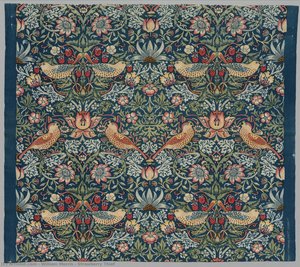
Strawberry Thief (1936) od Vilém Mráz

Strawberry Thief

1936 · Textile · Clevelandské muzeum umění, Cleveland

William Morris's "Strawberry Thief," completed in 1936, isn’t merely a decorative textile; it’s a vibrant distillation of the Arts and Crafts movement’s core tenets – a celebration of nature, a rejection of industrialization, and a subtle yet potent expression of social critique. This iconic design, now instantly recognizable, draws its inspiration from Morris's own garden at Kelmscott Manor in Oxfordshire, specifically the mischievous thrushes that frequented his fruit beds. The…

2
The Little Tree (Hammersmith Rug) (1895) od Vilém Mráz

The Little Tree (Hammersmith Rug)

1895 · Textile · Iparművészeti Múzeum, Budapešť

William Morris’s “The Little Tree” (Hammersmith Rug), completed in 1895, isn't merely a decorative textile; it’s a meticulously crafted portal to a world steeped in medieval romance, folklore, and the enduring beauty of nature. Born from the fertile imagination of one of England’s most influential artists and designers, this rug embodies the core tenets of the Arts and Crafts movement – a rejection of mass-produced industrialism in favour of handcrafted…

3
Snakeshead (1900) od Vilém Mráz

Snakeshead

1900 · Textile · Clevelandské muzeum umění, Cleveland

The fabric breathes with a heavy, rhythmic energy, pulling the eye into a dense thicket of color. Deep reds and stark blacks collide in a pattern that feels both grounded and strikingly bold. Small, delicate motifs move across the surface, creating a sense of movement that mimics the swaying of wildflowers in a summer breeze. There is a certain tension here, found in the way the dark tones press against…

4
Design for (1881) od Vilém Mráz

Design for

1881 · Textile · William Morris Gallery, Walthamstow

Before he was a revolutionary socialist, a poet of immense talent, or simply one of the most celebrated textile designers in history, William Morris was a young man captivated by the remnants of a lost world. Born in Walthamstow, Essex, in 1834, his childhood was steeped in the romanticism of medieval chivalry and the beauty of the English countryside—a landscape he would relentlessly strive to capture within his designs. This…

5
Design for (1876) od Vilém Mráz

Design for

1876 · William Morris Gallery, Walthamstow

In the delicate interplay of flora and geometry, Design for stands as a profound testament to the visionary genius of William Morris. Created in 1876, this exquisite piece is far more than a mere decorative pattern; it is a bridge between the artisanal traditions of the past and the burgeoning aesthetic movements of the nineteenth century. The work captures a moment where nature and craftsmanship converge, offering a rhythmic dance…

8
Design for (1862) od Vilém Mráz

Design for

1862 · Acrylic · William Morris Gallery, Walthamstow

A Celebration of Pastoral Harmony: Exploring William Morris’s Watercolor Design The watercolor painting titled “Design for” by William Morris stands as a testament to the Arts and Crafts movement's unwavering belief in the restorative power of nature and its rejection of mass production. Executed in 1862, this artwork isn’t merely a depiction of flora; it’s an embodiment of Morris’s artistic ethos—a deliberate attempt to recapture the idealized beauty of the…

9
Design for woven fabric with birds and palms (1870) od Vilém Mráz

Design for woven fabric with birds and palms

1870 · William Morris Gallery, Walthamstow

This sketch by William Morris was likely intended for a woven textile repeat pattern, but was never realised. It bears a resemblance to a number of bird designs Morris & Co. produced in the late 1870s, including ‘Bird’ and ‘Bird and Dragon’, both designed by Morris in 1878. The fabrics were manufactured at the Morris & Co. premises at Queen Square, London, before subsequently being woven on hand-activated jacquard looms…

10
Qui Bien Aime Tard Oublie (1860) od Vilém Mráz

Qui Bien Aime Tard Oublie

1860 · Embroidery · William Morris Gallery, Walthamstow

In the delicate interplay of thread and color, "Qui Bien Aime Tard Oublie" emerges as a breathtaking testament to the Pre-Raphaelite spirit and the profound connection between art and the natural world. Created in 1860 by the legendary William Morris, this extraordinary embroidery is far more than a mere decorative hanging; it is a window into a romanticized era where craftsmanship served as a vessel for deep emotion. The work…

Výběr umělce Vilém Mráz pokračuje, od 11 do 26

Motivy, které zaujaly Vilém Mráz

Čtyři témata, která se v těchto originálech nejčastěji objevují, z nichž každé má svůj nejlepší příklad.

Muzea, v nichž jsou vystavena originálna umělce Vilém Mráz

6 muzea, v nichž je umístěno nejvíce obrazů z této stránky.

Muzea Město Díla autora Vilém Mráz Obrazy z tohoto seznamu
William Morris Gallery, WalthamstowWilliam Morris Gallery Walthamstow 13 Design for, Design for, Design for
Clevelandské muzeum umění, ClevelandClevelandské muzeum umění Cleveland 2 Strawberry Thief, Snakeshead
Iparművészeti Múzeum, BudapešťIparművészeti Múzeum Budapešť 1 The Little Tree (Hammersmith Rug)
Boca Raton Museum of Art, Boca RatonBoca Raton Museum of Art Boca Raton 1 Petroglyfská loď
The Baltimore Museum of Art, BaltimoreThe Baltimore Museum of Art Baltimore 1 Rosa
Tate Britain, LondýnTate Britain Londýn 1 La Belle Iseult

Vilém Mráz dekáda po dekádě: originální díla, která definují každou z nich

Díla podle dekád

Vyberte si dekádu a prohlédněte si originál, který ji definuje.

Otázky sběratelů o obrazech umělce Vilém Mráz

Kterým dílem je Vilém Mráz nejznámější?Odhalit odpověď

Strawberry Thief (1936), Clevelandské muzeum umění, Cleveland. Následují The Little Tree (Hammersmith Rug) (1895) a Snakeshead (1900).

Kterých deset nejslavnějších obrazů má Vilém Mráz?Odhalit odpověď

Strawberry Thief, The Little Tree (Hammersmith Rug), Snakeshead, Design for, Design for, Fruit, Honeycomb, Design for, Design for woven fabric with birds and palms a Qui Bien Aime Tard Oublie. Hodnocení výše uvádí rok a muzeum pro každé z nich.

Kolik obrazů zanechal(a) Vilém Mráz?Odhalit odpověď

Náš katalog obsahuje 37 děl umělce Vilém Mráz z let 1857 až 1895.

Ve kterých muzeích jsou vystavena díla mistrovská umělce Vilém Mráz?Odhalit odpověď

Většinou v William Morris Gallery (Walthamstow), Clevelandské muzeum umění (Cleveland) a Iparművészeti Múzeum (Budapešť). V tabulce muzeí výše jsou vypsány všechny.

V jakých letech namaloval Vilém Mráz svá nejznámější díla?Odhalit odpověď

V období 1870s: 5 z celkem 26 děl na této stránce vzniklo právě tehdy, z toho Design for z nich.

Jaká jsou první a poslední slavná originální díla umělce Vilém Mráz?Odhalit odpověď

Na této stránce je nejstarší dílo z Sword (1857) a nejnovější z The Little Tree (Hammersmith Rug) (1895).

Jaká témata si Vilém Mráz vybíral nejčastěji?Odhalit odpověď

Pattern (4), Floral pattern (4) a Floral design (4) napříč 26 díly na této stránce.

Kterou techniku používal(a) Vilém Mráz nejčastěji?Odhalit odpověď

Textile, u 4 z 26 děl na této stránce.

K kterému uměleckému směru patří Vilém Mráz?Odhalit odpověď

Arts and crafts, podle originálů na této stránce.

Která díla umělce Vilém Mráz jsou vystavena v William Morris Gallery?Odhalit odpověď

Design for, Design for a Design for: muzeum William Morris Gallery, Walthamstow má v obsluze 10 děl z této stránky.

Mohu si nechat vyrobit reprodukci obrazu od Vilém Mráz?Odhalit odpověď

Ano, jako reprodukce: originál zůstává ve svém muzeu, ale jakýkoli obraz na této stránce může být pro vás ručně namalován na zakázku z jeho vlastní stránky.

Vilém Mráz: život a dílo

William Morris (1834–1896): A Life Rooted in Nature and Romance

William Morris, born on March 24, 1834, in Walthamstow, Essex, emerged from a comfortably affluent middle-class background—a circumstance that afforded him the freedom to pursue passions rather than professions. His father’s success as a financier provided not only security but also an environment where aesthetic sensibilities could flourish. Morris's childhood was deeply shaped by the English countryside surrounding his home and a fascination with tales of medieval chivalry, laying the groundwork for a lifelong devotion to both natural beauty and romantic narratives. These early influences weren’t merely sentimental; they formed the core of his artistic philosophy. He wasn’t simply *inspired* by nature or the past—he believed in their inherent moral and aesthetic superiority to the rapidly industrializing present. His formal education at Oxford University initially steered him toward a clerical path, but it was within the vibrant intellectual circles of the university that his true calling began to take shape. He joined “The Set,” a group of students who shared an intense interest in art, literature, and medieval history, forging friendships—most notably with Edward Burne-Jones—that would profoundly impact his artistic trajectory. It was during this period that he encountered the writings of John Ruskin, whose critique of industrial society and advocacy for craftsmanship resonated deeply with Morris’s burgeoning beliefs.

The Arts & Crafts Revolution

Following Oxford, a brief foray into architecture quickly gave way to painting, as Morris collaborated with Dante Gabriel Rossetti on mural projects. However, it was the founding of Morris, Marshall, Faulkner & Co. in 1861—later known simply as Morris & Co.—that marked a pivotal moment, not just in his career but in the history of design. This wasn’t merely a business venture; it was an attempt to create a new way of life, one where art permeated every aspect of daily existence and craftsmanship was valued above all else. Alongside Burne-Jones, Rossetti, Philip Webb, and others, Morris sought to revive traditional techniques and produce beautiful, well-made objects for the home. The firm’s early work was profoundly influenced by Red House, a home Morris commissioned from Webb—a structure that embodied the Arts & Crafts ideal of creating a unified aesthetic environment through handcrafted furnishings and decoration. Morris became a leading voice in the burgeoning Arts & Crafts movement, championing handmade craftsmanship as an antidote to the perceived dehumanizing effects of mass production. He believed passionately that art should be accessible to all, not just the wealthy elite, and that it should be integrated into everyday life—a radical notion at a time when design was often seen as separate from function. This conviction extended beyond mere aesthetics; it was rooted in a deep social conscience and a desire to improve the lives of working people.

A Legacy Woven in Textiles, Poetry, and Print

While Morris & Co. encompassed a wide range of decorative arts—furniture, stained glass, carpets—he is perhaps most celebrated for his textile designs. These weren’t simply patterns; they were intricate narratives woven with flowing floral motifs, lush foliage, and rich, evocative colors. His wallpapers, in particular, revolutionized interior design, moving away from the sterile imitations prevalent during the Victorian era toward nature-inspired creations that were both beautiful and functional. He didn't just *design* these patterns; he immersed himself in the process of their creation, understanding the nuances of dyeing techniques and weaving methods. Beyond textiles, Morris revived the art of tapestry making, producing large-scale narrative tapestries based on medieval romances and Arthurian legends—works that showcased his skill as a storyteller and his deep connection to the past. His creative energy wasn’t confined to the visual arts; he was also a prolific writer, composing poetry, novels, and translations. *The Earthly Paradise* (1868–1870) and *News from Nowhere* (1890) are testaments to his literary talent and his utopian vision of a society rooted in craftsmanship and social justice.

Socialism, Conservation, and Enduring Influence

Morris’s commitment extended beyond aesthetics into the realm of social activism. He became increasingly involved in socialist politics, advocating for workers' rights and social reform. He believed that a truly beautiful society couldn’t exist without economic equality and justice—a conviction that informed both his art and his political writings. This wasn’t abstract theorizing; he actively supported various socialist causes and used his platform to raise awareness about the plight of working people. Furthermore, Morris was a pioneer in conservation, recognizing the importance of preserving historic buildings and landscapes for future generations. He understood that these structures weren't merely relics of the past but vital links to cultural identity and artistic inspiration. The William Morris Gallery in Walthamstow stands as a testament to his enduring legacy, showcasing his work and providing insights into his life and ideas. His vision of a world where beauty and utility are intertwined—and where art is accessible to all—remains as relevant today as it was in the 19th century. He wasn’t just an artist; he was a visionary who sought to transform society through the power of design, craftsmanship, and social justice.

Všechna díla od Vilém Mráz: 37 →