Wilfredo Lam: portrét umělce
Wifredo Lam - A Crossroads of Cultures: The Life and Art of Wifredo Lam
Wifredo Óscar de la Concepción Lam y Castilla, known simply as Wifredo Lam, was a painter who embodied the complexities of cultural identity in the 20th century. Born in Sagua La Grande, Cuba, in 1902, his very lineage spoke to the island’s layered history – a father descended from Chinese immigrants and a mother tracing her roots back to Spanish conquistadors and enslaved Africans. This multicultural heritage wasn't merely biographical detail; it became the wellspring of his artistic vision, fueling a unique style that fused European modernism with Afro-Cuban spirituality and symbolism. Lam’s early life was marked by an initial pursuit of law in Havana, but even amidst legal studies, he found himself drawn to the natural world, spending time at the botanical gardens – a foreshadowing of the organic forms that would later dominate his canvases. Formal artistic training followed at the Escuela de Bellas Artes in Havana and then in Madrid under Fernando Álvarez de Sotomayor y Zaragoza, where he absorbed traditional techniques while simultaneously beginning to question their limitations.
Early Life and Influences
Wifredo Lam’s birth in 1902 into a family steeped in multicultural heritage profoundly shaped his artistic trajectory. His father, Enrique Lam-Yam, was a Chinese immigrant from Canton (Guangdong province) who arrived in Cuba as part of the late-19th-century wave of Chinese laborers and merchants. This familial connection instilled an appreciation for Eastern aesthetics and traditions that would permeate his work throughout his life. Simultaneously, Ana Serafina Catilla, Lam’s mother, descended from Spanish conquistadors and enslaved Africans—a lineage that underscored the pervasive influence of colonialism on Cuban society. Growing up in Sagua La Grande, surrounded by a vibrant Afro-Cuban culture deeply rooted in Santería rituals and beliefs, Lam experienced firsthand the spiritual traditions that would become integral to his artistic vision. His godmother, Matonica Wilson, a Santería priestess locally celebrated as a healer and sorceress, instilled in him an understanding of Yoruba cosmology and symbolism—influences that would manifest in recurring motifs within his paintings. Early exposure to Goya’s unflinching depictions of social injustice and Bosch’s unsettling visions of fantastical creatures fostered a fascination with allegory and psychological depth, shaping Lam’s artistic sensibilities from the outset.
European Encounters and Artistic Transformation
Lam’s formative years in Spain were marked by immersion in the masterpieces of the Prado Museum—particularly Velázquez’s portraits and Goya’s dramatic landscapes—which instilled in him a profound appreciation for realism and tonal modulation. However, he was equally captivated by the Surrealist movement spearheaded by André Breton and Henri Matisse, artists who championed automatism and explored the subconscious mind. This encounter ignited his imagination and propelled him toward experimentation with innovative techniques—most notably Cubism, influenced by Picasso’s groundbreaking work on collage and fragmentation. Lam’s artistic training at the Academy of Fine Arts in Madrid provided him with a grounding in classical tradition while simultaneously encouraging him to challenge established conventions. He diligently studied the works of Goya and Velázquez, absorbing their stylistic nuances and mastering their compositional strategies—skills that would serve as invaluable tools for his subsequent artistic endeavors.
The Surrealist Period and Artistic Exploration
Lam’s arrival in Paris in 1938 coincided with a pivotal moment in European art history—the outbreak of World War II—and marked the beginning of his most prolific creative period. He quickly established connections with leading Surrealists, including Pablo Picasso, Joan Miró, René Char, and Benjamin Péret, engaging in collaborative projects and experimenting with diverse artistic mediums. His involvement with Breton’s Surrealist group fostered a spirit of intellectual inquiry and encouraged him to push the boundaries of conventional representation. Lam embraced automatism—a technique championed by Breton that aimed to bypass conscious thought—producing drawings and paintings characterized by spontaneous gesture and unexpected juxtapositions. This stylistic approach reflected his belief in accessing deeper levels of consciousness and translating psychological experiences into visual form. The influence of Matisse’s bold color palettes and simplified forms further enriched Lam’s artistic vocabulary, shaping his distinctive aesthetic sensibility.
Major Works and Legacy
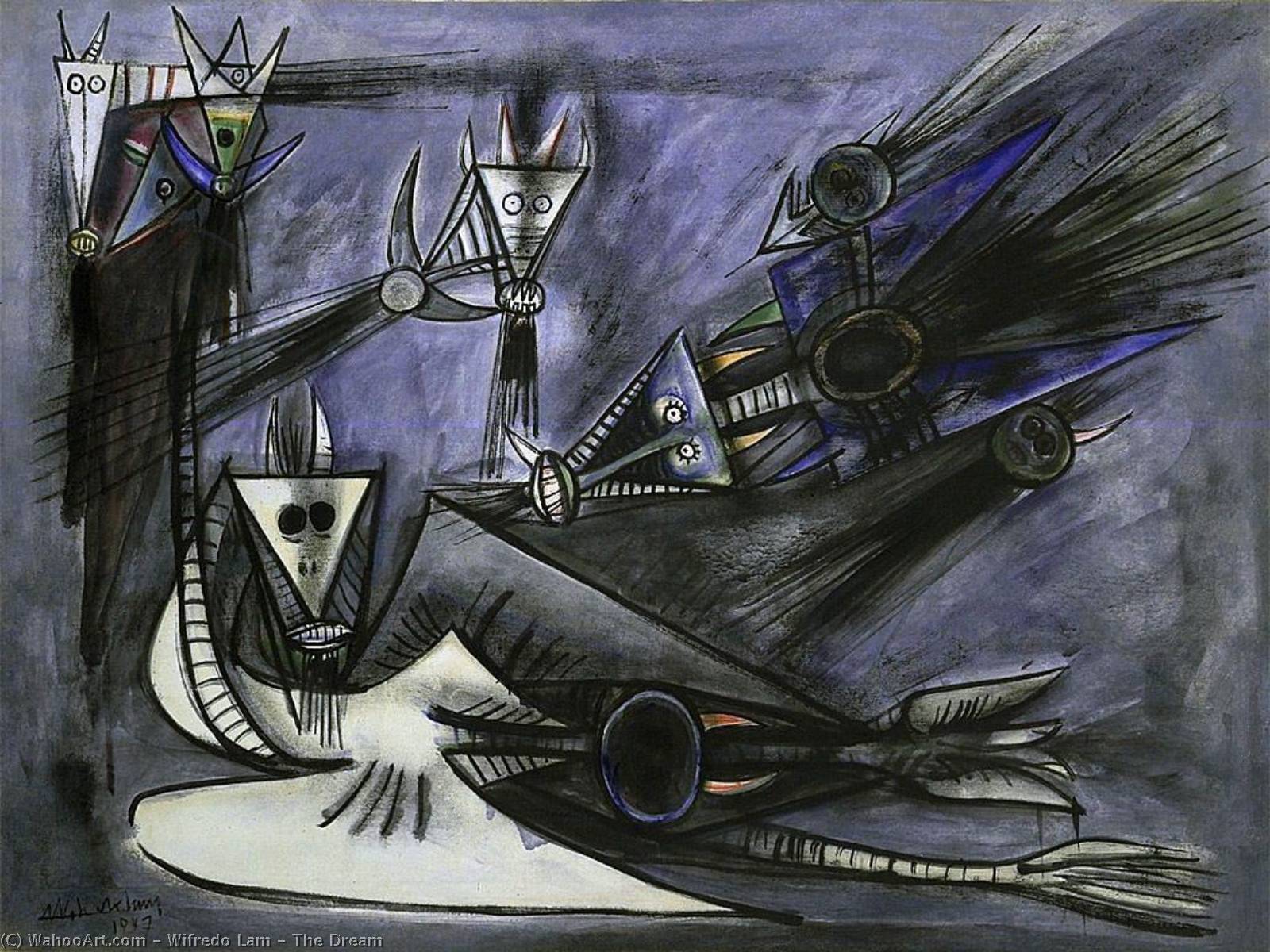
Lam’s most celebrated masterpiece, *La Jungla* (1943), exemplifies the culmination of his artistic explorations—a monumental oil painting on kraft paper that blends Surrealist imagery with Caribbean symbolism and references to Afro-Cuban rituals. The canvas depicts a dense jungle landscape populated by stylized figures—human, animal, and vegetal forms intertwined in a dynamic composition that conveys both beauty and unease. Lam’s masterful use of color, texture, and perspective creates an immersive experience for the viewer, inviting contemplation on themes of colonialism, cultural identity, and spiritual transformation. Beyond *La Jungla*, Lam produced numerous other paintings—including *Two Heads* (c. 1948), *The Dream* (1950), and *San Sebastián* (1962)—that demonstrate his unwavering commitment to artistic innovation and his ability to convey complex emotions through visual language. His work continues to inspire artists worldwide, serving as a testament to the enduring power of art to engage with profound questions about human experience and cultural heritage. Wifredo Lam’s legacy extends beyond his individual artworks; he fundamentally reshaped the trajectory of modern art by forging a unique artistic style that bridged European abstractionism with Afro-Caribbean spirituality—a contribution that secures his place as one of the most influential artists of the 20th century.
Všechna díla od Wilfredo Lam: 26 →