Portrét Paul Sandby

79 nejslavnějších obrazů autora Paul Sandby, výběr z galerie

Aktualizováno říjen 2026 · seřazeno podle našeho skóre popularity (vyhledávání, návštěvy a objednávky u každého díla) · 79 děl umělce Paul Sandby v našem katalogu

Stručně řečeno

Z všech originálů, které Paul Sandby zanechal, je nejslavnější Man standing in a landscape. Hned za ním následují Horse Fair on Bruntsfield Links, Edinburgh (1750) a London Cries: A Muffin Man (1759). Náš katalog obsahuje 79 děl umělce Paul Sandby; galerie si zachovala 79 děl, která obdivuje celý svět, přičemž každé je znázorněno s datem vzniku, názevem muzea a jeho příběhem.

1798 – 1863, Nottingham Romanticism Nejvíce děl: Yale Center for British Art

10 nejlepších obrazů umělce Paul Sandby: výběr galerie

1
Man standing in a landscape od Paul Sandby

Man standing in a landscape

Charcoal

Paul Sandby presents a quiet study in Man standing in a landscape. The work captures a gentleman in period clothing, frozen in a three-quarter pose. He looks toward the left, his figure occupying much of the vertical space against a simplified rural scene. The man remains the central focus, a solitary presence amidst the soft suggestions of buildings and structures on the horizon.

2
Horse Fair on Bruntsfield Links, Edinburgh (1750) od Paul Sandby

Horse Fair on Bruntsfield Links, Edinburgh

1750 · Watercolor · Scottish National Gallery, Edinburgh

Paul Sandby: The Father of Modern Landscape Painting Paul Sandby RA stands as a pivotal figure in the history of British landscape painting, recognized not merely for his artistic skill but for establishing a new aesthetic tradition that profoundly impacted subsequent generations. Born in Nottingham to Thomas Sandby, a textile worker, Paul’s early life was marked by self-education and an innate fascination with observation—qualities that would prove instrumental in shaping…

3
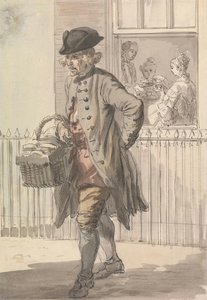
London Cries: A Muffin Man (1759) od Paul Sandby

London Cries: A Muffin Man

1759 · Drawing · Yale Center for British Art, New Haven

This evocative drawing, titled "London Cries: A Muffin Man," transports the modern viewer directly into the bustling, atmospheric heart of 18th-century London. The scene is rendered with a captivating immediacy that speaks volumes about daily commerce and human interaction. At the center moves the muffin man, his basket laden with tempting goods, embodying a moment of everyday ritual. His figure, complete with a distinctive hat and mustache, anchors the composition,…

6
The Laterna Magica (1760) od Paul Sandby

The Laterna Magica

1760 · Watercolor · British Museum, Londýn

Paul Sandby’s “The Laterna Magica,” painted in 1760, isn't merely a depiction of a room; it’s a meticulously crafted illusion, a vibrant snapshot of a world fascinated by the burgeoning technology of optical projection. More than just a charming scene of gentlemen observing a theatrical display, this watercolor offers a profound glimpse into the intellectual and social currents of 18th-century England – a period grappling with scientific advancement, artistic convention,…

7
London Cries: A Man with a Bottle (1759) od Paul Sandby

London Cries: A Man with a Bottle

1759 · Acrylic On Canvas · Yale Center for British Art, New Haven

Paul Sandby's "London Cries: A Man with a Bottle," painted in 1759, isn’t merely a depiction of a street scene; it’s a vibrant, almost theatrical window into the bustling heart of eighteenth-century London. This watercolor, now meticulously reproduced as a hand-painted artwork by WahooArt, captures a moment of everyday commerce and perhaps, a touch of wry observation, offering a glimpse into the lives of ordinary people within the grand tapestry…

8
The Meteor of August 18, 1783, as seen from the East Angle of the North Terrace, Windsor Castle (1783) od Paul Sandby

The Meteor of August 18, 1783, as seen from the East Angle of the North Terrace, Windsor Castle

1783 · Watercolor · Yale Center for British Art, New Haven

Paul Sandby's watercolor, “The Meteor of August 18, 1783,” isn’t merely a depiction of a fleeting astronomical event; it’s a window into the collective wonder and scientific curiosity of late 18th-century England. Painted from the East Angle of the North Terrace at Windsor Castle, the scene captures a pivotal moment – the transit of a meteor across the night sky – as observed by a small group of onlookers. The…

Výběr umělce Paul Sandby pokračuje, od 11 do 79

11Study of a coachman od Paul SandbyStudy of a coachmanNational Portrait Gallery of Sweden 12Thomas Sandby and His Family od Paul SandbyThomas Sandby and His Family 13A Group of Four Children, with Dogs od Paul SandbyA Group of Four Children, with Dogs 14The Bayswater Road, Paddington od Paul SandbyThe Bayswater Road, Paddington 15Sketch of an elegant lady od Paul SandbySketch of an elegant lady 16Two Coaches with Passengers od Paul SandbyTwo Coaches with Passengers 17View of the Powder Magazine in Hyde Park od Paul SandbyView of the Powder Magazine in Hyde Park 18A riverside landscape od Paul SandbyA riverside landscape 19Back of the Public House near Bayswater od Paul SandbyBack of the Public House near Bayswater 20Windsor Park od Paul SandbyWindsor Park 21A Sleeping Woman; Study of a Head od Paul SandbyA Sleeping Woman; Study of a Head 22Travelers Entering a Town od Paul SandbyTravelers Entering a Town 23Ross Castle, Killarney, with villagers on a ferryboat od Paul SandbyRoss Castle, Killarney, with villagers on a ferryboat 24Windsor Great Park od Paul SandbyWindsor Great Park 25St. George's Gate, Canterbury od Paul SandbySt. George's Gate, Canterbury 26Rochester, Kent od Paul SandbyRochester, Kent 27Views of Windsor Castle od Paul SandbyViews of Windsor Castle 28The Iron Forge between Dolgelli and Barmouth 1 od Paul SandbyThe Iron Forge between Dolgelli and Barmouth 1 29The Light Steps, Hastings od Paul SandbyThe Light Steps, Hastings 30An Italianate landscape with women washing clothes od Paul SandbyAn Italianate landscape with women washing clothes 31The Cemetery Gate of St Augustine's Monastery Canterbury od Paul SandbyThe Cemetery Gate of St Augustine's Monastery Canterbury 32The Encampment in St James's Park od Paul SandbyThe Encampment in St James's Park 33A Boy Crawling on the Floor od Paul SandbyA Boy Crawling on the Floor 34A mother and child seated in a garden od Paul SandbyA mother and child seated in a garden 35A wooded river landscape with figures and cattle, a castle beyond od Paul SandbyA wooded river landscape with figures and cattle, a castle beyond 36The North Terrace of Windsor Castle looking west od Paul SandbyThe North Terrace of Windsor Castle looking west 37Naval post with three soldiers od Paul SandbyNaval post with three soldiers 38Part of the Banqueting Hall of the Royal Palace at Eltham od Paul SandbyPart of the Banqueting Hall of the Royal Palace at Eltham 39Man driving a donkey, and man leading a cart od Paul SandbyMan driving a donkey, and man leading a cart 40Woolwich from the Conduit Hill, the Thames estuary beyond od Paul SandbyWoolwich from the Conduit Hill, the Thames estuary beyond 41Young lady writing at a table od Paul SandbyYoung lady writing at a table 42A rural landscape od Paul SandbyA rural landscape 43A cottage by a river with figures in the foreground od Paul SandbyA cottage by a river with figures in the foreground 44The garden front of Old Somerset House, London od Paul SandbyThe garden front of Old Somerset House, London 45Henry VIII Gateway, Windsor Castle od Paul SandbyHenry VIII Gateway, Windsor Castle 46Young boy on a see-saw od Paul SandbyYoung boy on a see-saw 47Children on a see-saw od Paul SandbyChildren on a see-saw 48Young man, seated, holding a riding crop od Paul SandbyYoung man, seated, holding a riding crop 49Two of the artist's children with their nurse, seated in a garden od Paul SandbyTwo of the artist's children with their nurse, seated in a garden 50The Iron Forge between Dolgelli and Barmouth od Paul SandbyThe Iron Forge between Dolgelli and Barmouth 51View from a London terrace od Paul SandbyView from a London terrace 52Windsor Castle: The Round Tower, Royal Court and Devil (1767) od Paul SandbyWindsor Castle: The Round Tower, Royal Court and Devil1767 · National Gallery of Victoria 53Buildwas od Paul SandbyBuildwas 54View down a valley towards distant buildings, trees in the foreground od Paul SandbyView down a valley towards distant buildings, trees in the foreground 55Derwent Waster od Paul SandbyDerwent Waster 56Edinburgh Castle od Paul SandbyEdinburgh Castle 57View of Tonbridge od Paul SandbyView of Tonbridge 58View of Rackett Lodge, Wandsworth, London od Paul SandbyView of Rackett Lodge, Wandsworth, London 59Study of a donkey od Paul SandbyStudy of a donkey 60Old Windsor Green od Paul SandbyOld Windsor Green 61Middleham Castle, Yorkshire od Paul SandbyMiddleham Castle, Yorkshire 62An extensive river landscape with travellers od Paul SandbyAn extensive river landscape with travellers 63A horse and cart leaving a harbour od Paul SandbyA horse and cart leaving a harbour 64Woolwich from the Conduit Hill, the Thames beyond od Paul SandbyWoolwich from the Conduit Hill, the Thames beyond 65Cows in a Park od Paul SandbyCows in a Park 66Study of a Tree od Paul SandbyStudy of a Tree 67Trees and house seen from a meadow - Bishopgate od Paul SandbyTrees and house seen from a meadow - Bishopgate 68A shepherd driving his flock before a Scottish castle od Paul SandbyA shepherd driving his flock before a Scottish castle 69South East View of Windsor Castle From the Park od Paul SandbySouth East View of Windsor Castle From the Park 70A horse od Paul SandbyA horse 71An old grey horse tethered to a tree, a boy resting nearby od Paul SandbyAn old grey horse tethered to a tree, a boy resting nearby 72Foresters In Windsor Great Park od Paul SandbyForesters In Windsor Great Park 73View Of Windsor Castle And Part Of The Town From The Spital Hill od Paul SandbyView Of Windsor Castle And Part Of The Town From The Spital Hill 74An extensive wooded river landscape with an amorous couple making music under a tree od Paul SandbyAn extensive wooded river landscape with an amorous couple making music under a tree 75Sanby paul the spread eagle tavern millbank od Paul SandbySanby paul the spread eagle tavern millbank 76Llangollen, Denbighshire od Paul SandbyLlangollen, Denbighshire 77Part of the Old Bridge at Shrewsbury with two arches of the new one od Paul SandbyPart of the Old Bridge at Shrewsbury with two arches of the new one 78Cow­Girl in the Windsor Great Park od Paul SandbyCow­Girl in the Windsor Great Park 79A Man and a Saddled Horse od Paul SandbyA Man and a Saddled HorseYale Center for British Art

Motivy, které zaujaly Paul Sandby

Čtyři témata, která se v těchto originálech nejčastěji objevují, z nichž každé má svůj nejlepší příklad.

Muzea, v nichž jsou vystavena originálna umělce Paul Sandby

5 muzea, v nichž je umístěno nejvíce obrazů z této stránky.

Muzeum Město Díla autora Paul Sandby Obrazy z tohoto seznamu
Yale Center for British Art, New HavenYale Center for British Art New Haven 4 London Cries: A Muffin Man, London Cries: A Man with a Bottle, The Meteor of August 18, 1783, as seen from the East Angle of the North Terrace, Windsor Castle
Scottish National Gallery, EdinburghScottish National Gallery Edinburgh 1 Horse Fair on Bruntsfield Links, Edinburgh
British Museum, LondýnBritish Museum Londýn 1 The Laterna Magica
National Portrait Gallery of Sweden, SträngnäsNational Portrait Gallery of Sweden Strängnäs 1 Study of a coachman
National Gallery of Victoria, MelbourneNational Gallery of Victoria Melbourne 1 Windsor Castle: The Round Tower, Royal Court and Devil

Otázky sběratelů o obrazech umělce Paul Sandby

Kterým dílem je Paul Sandby nejznámější?Odhalit odpověď

Man standing in a landscape. Následují Horse Fair on Bruntsfield Links, Edinburgh (1750) a London Cries: A Muffin Man (1759).

Kterých deset nejslavnějších obrazů má Paul Sandby?Odhalit odpověď

Man standing in a landscape, Horse Fair on Bruntsfield Links, Edinburgh, London Cries: A Muffin Man, Windsor Castle from the Great Park, Miss Marsden - back view, The Laterna Magica, London Cries: A Man with a Bottle, The Meteor of August 18, 1783, as seen from the East Angle of the North Terrace, Windsor Castle, Boy with a whip a Study of a woman pointing. Hodnocení výše uvádí rok a muzeum pro každé z nich.

Kolik obrazů zanechal(a) Paul Sandby?Odhalit odpověď

Náš katalog obsahuje 79 děl od Paul Sandby.

Ve kterých muzeích jsou vystavena díla mistrovská umělce Paul Sandby?Odhalit odpověď

Většinou v Yale Center for British Art (New Haven), Scottish National Gallery (Edinburgh) a British Museum (Londýn). V tabulce muzeí výše jsou vypsány všechny.

Jaká témata si Paul Sandby vybíral nejčastěji?Odhalit odpověď

Buildings (17), Gardens and parks (11) a Landscape (9) napříč 79 díly na této stránce.

Kterou techniku používal(a) Paul Sandby nejčastěji?Odhalit odpověď

Watercolor, u 3 z 79 děl na této stránce.

K kterému uměleckému směru patří Paul Sandby?Odhalit odpověď

Romanticism a Neoclassicism, podle originálů na této stránce.

Která díla umělce Paul Sandby jsou vystavena v Yale Center for British Art?Odhalit odpověď

London Cries: A Muffin Man, London Cries: A Man with a Bottle a The Meteor of August 18, 1783, as seen from the East Angle of the North Terrace, Windsor Castle: muzeum Yale Center for British Art, New Haven má v obsluze 4 děl z této stránky.

Paul Sandby: život a dílo

Otec moderního krajinářského malířství

Paul Sandby stojí jako klíčová postava v historii britského krajinářského malířství, uznávaný nejen pro svou uměleckou zručnost, ale především za to, že nastolil novou estetickou tradici, která hluboce ovlivnila následující generace. Paul se narodil v Nottinghamu jako syn Thomasa Sandbyho, textilního pracovníka, a jeho rané životy byly poznamenány samoudidactikou a vrozenou fascinací pro pozorování – vlastnostmi, které se později ukázaly jako zásadní pro utváření jeho mimořádné kariéry jak mapáře, tak malíře. Na rozdíl od mnoha umělců své doby, kteří vyhledávali formální vzdělání, Sandby zdokonaloval svůj řemeslo nezávisle, ponořil se do přírodního světa a pečlivě dokumentoval jeho krásu prostřednictvím vodovázní techniky.

Jeho formativní roky v něm vštíply hluboké uctivění detailu a přesnosti, dovednosti, které se později bezproblémově přenesly i do jeho kartografické činnosti. Jeho bratr Thomas, rovněž kreslíř, tuto uměleckou sklonění podporoval, povzbuzoval k experimentům a kultivoval v nich společného ducha. Společně založili v Nottinghamu akademii, která přitahovala ambiciózní umělce toužící se učit od jejich odborné znalosti. Jejich specifický styl – charakteristický světlistými lavurami barev a mistrovským ztvárněním atmosférické perspektivy – se stal okamžitě rozpoznatelným a hluboce vlivným po celých Britských ostrovech.

Topografie a duch země

Sandbyho profesní cesta byla jedinečně ovlivněna jeho zapojením do vojenské kreslickí složky v Tower of London. Tato role ho vystrčila na pozici, která mu umožnila prozkoumat velkolepost Skotska během jakobitského povstání. Při svém úkolu vytvářet topografické mapy a skici vysocehorských krajin se stal vizuálním kronikářem historie, čímž se proměnil z pouhého ilustrátora v jednoho z předních krajinářských uměcí své éry. Toto období služby mu umožnilo propojit preciznost kartografa s duší umělce a zachytit drsnou majestátnost skotského terénu s bezprecedentní jasností.

Jeho dílo odráží neuvěřitelnou všestrannost, sahající od rozlehlých výhledů až po intimní městské zachycení okamžiků. Ve své slavné sérii London Cries, jako je například dojmově silná zobrazení v díle A Man with a Bottle, Sandby zachytil rytmický puls pouličního života 18. století. Disponoval vzácnou schopností nacházet krásu v každodennosti a dokumentovat postavy i obchod Londýna s okouzlujícím realismem, který fascinuje i dnešní diváky. Ať už maloval klidné řekovní scény v Llangollen nebo živobudnou energii na Horse Fair on Bruntsfield Links, jeho práce vždy si zachovala smysl pro topografickou pravdu spojenou s poetickým světlem.

Odkaz a umělecká inovace

Jako zakládající člen Královské akademie odehrál Sandby zásadní roli v pozvednutí statusu vodovázního malířství. Před jeho vlivem byla akvarel často omezována na přípravné skici nebo pouhé instruktážní nástroje; díky jeho mistrovství však pomohl ugruntovat tento žánr jako respektovanou formu krásného umění schopnou hluboké výraznosti. Jeho využívání akvatintové techniky dále umožnilo, aby jeho detailní pohledy oslovily širší publikum a rozšířily krásu britské krajiny po celé Evropě.

Historický význam Paula Sandbyho spočívá v jeho schopnosti překlenout propast mezi vědeckou dokumentací a romantickou expresí. Jeho odkaz nacházíme v:

  • Rozvoji anglické akvarelové tradice: budování technických základů pro budoucí mistry tohoto média.
  • Topografické vynikavosti: spojení přesnosti mapování s emotivní silou krajinního umění.
  • Kulturní dokumentaci: uchovávání sociální struktury 18. století v Británii prostřednictvím jeho detailních městských a venkovských pozorování.

Díky své neúnavné oddanosti pozorování světa Sandby udělal víc než jen maloval krajiny; naučil celý národ, jak vidět vlastní krásu.