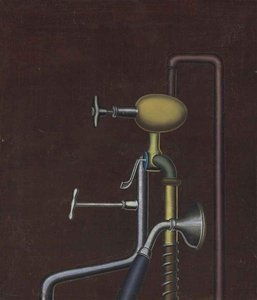
1


Aktualizováno říjen 2026 · seřazeno podle našeho skóre popularity (vyhledávání, návštěvy a objednávky u každého díla) · 18 děl umělce Konrad Klapheck v našem katalogu
Stručně řečeno
Z pohledu galerie je nejslavnějším dílem Konrad Klapheck obrazem The Night Beauties (Die Schönen der Nacht) (1961), jehož originál je vystaven v Izraelské muzeum v obci Jeruzalém. Cruel Night / Bitter Night (Nuit cruelle) (1959) a The Horoscope (1966) doplňují trio, které každé oko okamžitě pozná. Z 18 děl umělce Konrad Klapheck v našem katalogu představuje galerie níže 18 nejznámějších děl, z nichž každé je originálem s uvedením roku vzniku, muzea a toho, co jej činí jedinečným.


4 muzea, v nichž je umístěno nejvíce obrazů z této stránky.
| Muzea | Město | Díla autora Konrad Klapheck | Obrazy z tohoto seznamu |
|---|---|---|---|
 Izraelské muzeum |
Jeruzalém | 3 | The Night Beauties (Die Schönen der Nacht), Cruel Night / Bitter Night (Nuit cruelle), The Female Terrorist (Die Terroristin) |
 Bavarské státní sbírky malby |
Mnichov | 2 | The Horoscope, The Show-off |
 Staatliche Kunsthalle Karlsruhe |
Karlsruhe | 1 | Life in Society |
 Städel Museum |
Frankfurt nad Mohanem | 1 | Der Gesetzgeber |
Vyberte si dekádu a prohlédněte si originál, který ji definuje.
The Night Beauties (Die Schönen der Nacht) (1961), Izraelské muzeum, Jeruzalém. Následují Cruel Night / Bitter Night (Nuit cruelle) (1959) a The Horoscope (1966).
26 let: dílo The Night Beauties (Die Schönen der Nacht) pochází z roku 1961 a Konrad Klapheck se narodil/a v roce 1935.
The Night Beauties (Die Schönen der Nacht), Cruel Night / Bitter Night (Nuit cruelle), The Horoscope, The Female Terrorist (Die Terroristin), The Show-off, Life in Society, Der Gesetzgeber, The mistress, The swagger a The fanatic. Hodnocení výše uvádí rok a muzeum pro každé z nich.
Náš katalog obsahuje 18 děl umělce Konrad Klapheck z let 1959 až 1971.
Většinou v Izraelské muzeum (Jeruzalém), Bavarské státní sbírky malby (Mnichov) a Staatliche Kunsthalle Karlsruhe (Karlsruhe). V tabulce muzeí výše jsou vypsány všechny.
V období 1960s: 5 z celkem 18 děl na této stránce vzniklo právě tehdy, z toho The Night Beauties (Die Schönen der Nacht) z nich.
Na této stránce je nejstarší dílo z Cruel Night / Bitter Night (Nuit cruelle) (1959) a nejnovější z The Female Terrorist (Die Terroristin) (1971).
Pop art, podle originálů na této stránce.
The Night Beauties (Die Schönen der Nacht), Cruel Night / Bitter Night (Nuit cruelle) a The Female Terrorist (Die Terroristin): muzeum Izraelské muzeum, Jeruzalém má v obsluze 3 děl z této stránky.
In the quiet intersection where the precision of industrial machinery meets the irrationality of a dream, lies the singular world of Konrad Klapheck. Born in Düsseldorf on February 10, 1935, to a lineage of esteemed art historians, Klapheck was destined for a life steeped in aesthetic contemplation. His early years at the Kunstakademie Düsseldorf, studying under the guidance of Bruno Goller, provided him with a rigorous foundation in craftsmanship. Yet, beneath this disciplined training, a more subversive spirit was brewing—one that would eventually reject the purely abstract in favor of a hauntingly realistic yet profoundly distorted vision of the everyday.
Klapheck’s artistic evolution is a fascinating journey from magic realism to a highly idiosyncratic blend of Surrealism and Pop Art. While his mid-1950s works adhered to more traditional modes, a transformative shift occurred when he first turned his gaze toward the typewriter. This was not merely a change in subject matter, but a revolution in perception. By isolating these mechanical objects and presenting them with an almost obsessive clarity, he stripped them of their utility and imbued them with a psychological weight. These machines became characters in a silent, surreal drama, bathed in vibrant, often unsettling hues that challenged the viewer's sense of reality.
To look upon a Klapheck painting is to experience a strange sense of alienation within the familiar. He possessed a remarkable ability to take the most utilitarian items—objects we touch and use without thought—and transform them into monumental icons of mystery. His repertoire of subjects expanded from his iconic typewriters to include a parade of mechanical and domestic artifacts:
This technique was never merely about photographic accuracy. Instead, Klapheck utilized a masterful manipulation of color and scale to inject an element of the absurd. His work often carries a subtle, biting wit, layered with political commentary and even sexual innuendo. By enlarging these small, domestic objects to a monumental scale, he forced a confrontation between the viewer and the inanimate, making the mechanical feel alive, and the living feel strangely mechanical.
The historical significance of Konrad Klapheck lies in his ability to bridge the gap between the conceptual provocations of Marcel Duchamp and the vibrant, consumer-driven energy of Pop Art. He drew deep inspiration from the avant-garde masters—Man Ray, Max Ernst, and René Magritte—yet he applied their surrealist logic to a much more modern, industrial landscape. His work mirrors the tension of the mid-20th century: the fascination with technological progress clashing with the underlying anxiety of an increasingly automated world.
Through his precise lines and dreamlike compositions, Klapheck achieved a rare feat in contemporary art: he made the inanimate speak. He left behind a body of work that serves as a profound meditation on alienation, fascination, and the hidden life of objects. Even decades after his passing, his paintings continue to haunt the galleries of the world, reminding us that within the most ordinary machine, there may lie an extraordinary, unsettling truth.